Penelope J Corfield
  • HOME
    • Index to Blogs
    • Monthly Blogs
    • CONTACT
    • Key to Dancing Dates Film
  • CURRENT
    • President International Association C18 Studies
    • Lectures on offer
    • London University’s Long C18 History Seminar
    • Living in Battersea
    • Career at a Glance
    • PJC Publications
  • BRITISH HISTORY
    • Long C18 Overviews
    • Society & Culture
    • Town Life
    • Electoral History
    • Radical Poets
    • The Professions
    • Religion & Irreligion
  • GLOBAL
    • Urban History Through Time
    • C18 European History Overviews
    • Gender History
    • ‘Racial’ Classifications as Pseudo-Science
    • Responding to Climate Change
    • Advance of the International Sphere
  • TIME & HISTORY
    • Time & The Shape of History (2007)
    • Rethinking Historical Periodisation
    • Dimensions of The Long Term
    • Returning to Big History
  • HISTORY-MAKING
    • Why History Matters
    • History of History
    • Fellow Historians
    • Arts of Academic Assessment
    • Pleasures of Intellectual Life
  • REVIEWS
    • History Book Reviews
      • Social History
      • Approaches to History
      • Big History
    • Theatre Reviews
    • Civic/Political Commentaries
    • Personal Portraits
  • Menu Menu

Tag Archive for: blogs

MONTHLY BLOG 165, HOW DID BENJAMIN FRANKLIN DISCOVER THE POWER OF LIGHTNING?

2 September 2024/in Monthly Blog, Personal/by Penelope J. Corfield

If citing, please kindly acknowledge copyright © Penelope J. Corfield (2024)

Lightning Flash © Clipart 2024

During the summer months, I’m getting through big task after big task. I’m feeling increasingly happy. But right now I don’t want to compose a long BLOG. After all, there are no rules that specify how long a BLOG must be. It’s an optional thing, done to salute the world and (hopefully) not to be too boring. So for September 2024, here is one of my favourite jokes:

          Q: How did Benjamin Franklin discover the power of lightning?

          A: It just struck him.

No loud laughter required. But a pleasant smile would be good.
PS: For website showing in real time where lightning is striking world-wide, see https://www.lightningmaps.org/.

For further discussion, see Twitter

To read other discussion-points, please click here

To download Monthly Blog 165 please click here

https://www.penelopejcorfield.com/wp-content/uploads/2024/09/165-1-flash-of-lightning-e1725368036172.jpg 714 400 Penelope J. Corfield https://www.penelopejcorfield.com/wp-content/uploads/2020/12/P.J.C.png Penelope J. Corfield2024-09-02 13:49:162024-09-03 14:15:13MONTHLY BLOG 165, HOW DID BENJAMIN FRANKLIN DISCOVER THE POWER OF LIGHTNING?

MONTHLY BLOG 41, HISTORICAL REPUTATIONS: DISAPPEARING FROM HISTORY

1 May 2014/in History, Monthly Blog/by Penelope J. Corfield

If citing, please kindly acknowledge copyright © Penelope J. Corfield (2014)

What does it take for individuals to disappear from recorded history? Most people manage it. How is it done? The first answer is to die young. That deed has been achieved by far too many historic humans, especially in eras of highly infectious diseases. Any death before the age of (say) 21 erases immense quantities of potential ability.

After all, how many child prodigies or Wunderkinder have there been? Very few whose fame has outlasted the immediate fuss in their own day. A number of chess-masters and mathematicians have shown dramatic early abilities. But the prodigy of all prodigies is Wolfgang Amadeus Mozart, who began composing at the age of five and continued prolifically for the remaining thirty years of his life. His music is now more famous and more widely performed than it ever was in his own day. Mozart is, however, very much the exception – and his specialist field, music, is also distinctive in its ability to appeal across time and cultures.

A second way of avoiding the attentions of history is to live and die before the invention of writing. Multiple generations of humans did that, so that all details of their lifestyles, as inferred by archaeologists and palao-anthropologists, pertain to the generality rather than to individuals. Oblivion is particularly guaranteed when corpses have been cremated or have been buried in conditions that lead to total decay.

As it happens, a number of frozen, embalmed, or bog-mummified bodies from pre-literate times have survived for many thousands of years. Scholars can then study their way of life and death in unparalleled and fascinating detail. One example is Ötzi the Iceman, found in a high glacier on the Italian/Austrian border in 1991, and now on dignified display in the South Tyrol Museum of Archaeology at Bolzano, Italy. His clothing and weaponry reveal much about the technological abilities of Alpine hunters from over five thousand years ago, just as his bodily remains are informative about his diet, health, death, and genetic inheritance.1 Nonetheless, the world-view of individuals like Ötzi are matters of inference only. And the number of time-survivors from pre-literate eras are very few.22014-5-Pic1 OtzitheIceman
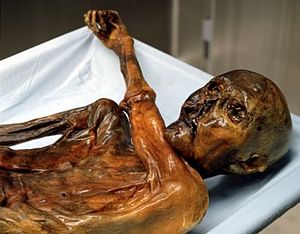
Ötzi the Iceman, over 5000 years old but initially thought to be a recent cadaver when discovered in 1991:
now in the South Tyrol Museum of Archaeology, Bolzano, Italy.

The third way of avoiding historical attention is to live a quiet and secluded life, whether willingly or unwillingly. Most people in every generation constitute the rank-and-file of history. Their deeds might well be important, especially collectively. Yet they remain unknown individually. That oblivion applies especially to those who remain illiterate, even if they live in an era when reading and writing are known.

‘Full many a flower is born to blush unseen/ And waste its sweetness on the desert air’, as Thomas Gray put it eloquently in 1751 (in context, talking about humans, not horticulture).3 One might take his elegiac observation to constitute an oblique call for universal education (though he didn’t). Yet even in eras of widening or general literacy, it remains difficult for every viewpoint to be recorded and to survive. In nineteenth-century Britain, when more people than ever were writing personal letters, diaries and autobiographies, those who did so remained a minority. And most of their intimate communications, especially if unpublished, have been lost or destroyed.

Of course, past people were also known by many other forms of surviving evidence. The current vogue in historical studies (in which I participate) is to encourage the analysis of all possible data about as many as possible individuals, whether ‘high’ or ‘lowly’, by making the information available and searchable on-line.4 Nonetheless, historians, however determined and assiduous, cannot recover everybody. Nor can they make all recovered information meaningful. Sometimes past data is too fragmented or cryptic to have great resonance. It can also be difficult to link imperfect items of information together, with attendant risks: on the one hand, of making false linkages and, on the other hand, of missing real ones.

Moreover, there are still many people, even in well documented eras, whose lives left very little evidence. They were the unknowns who, in George Eliot’s much-quoted passage at the end of Middlemarch (1871/2): ‘lived faithfully a hidden life, and rest in unvisited tombs’.5 She did not intend to slight such blushing violets. On the contrary, Eliot hailed their quiet importance. ‘The growing good of the world is partly dependent on unhistoric acts’, she concluded. A realist might add that the same is true of the ‘bad of the world’ too. But again many lives remain hidden from historic record, even if the long-term impact of their collective actions and inactions has not.

Finally, there is concealment. Plenty of people then and now have reasons for hiding evidence – for example, pertaining to illegitimacy, adultery, addiction, crime, criminal conviction, or being on the losing side in warfare. And many people will have succeeded, despite the best efforts of subsequent scholar-sleuths. Today, however, those seeking to erase their public footprint face an uphill task. The replicating powers of the electronic media mean that evidence removed from one set of files returns, unbidden, in other versions or lurks in distant master files. ‘Delete’ does not mean absolute deletion.

Concluding the saga of The Mayor of Casterbridge (1886), the bipolar anti-hero Michael Henchard seeks to become a non-person after his death, leaving a savage will demanding ‘That I be not buried in consecrated ground & That no sexton be asked to toll the bell … & That no flowers be planted on my grave & That no man remember me’.6

2014-5-Pic2 Non-person

Non-Person © www.idam365.com (2014)

Today: yes, people can still be forgotten; or even fall through the administrative cracks and become a non-person. But to disappear from the record entirely is far from easy. Future historians of on-line societies are going to face the problems not of evidential dearth but of massive electronic glut. Still, don’t stop writing BLOGs, tweets, texts, emails, letters, books, graffiti. If we can’t disappear from the record, then everyone – whether famous, infamous, or unknown – can take action and ‘bear witness’.

1 For Ötzi, see: http://en.wikipedia.org/wiki/%C3%96tzi.

2 See P.V. Glob, The Bog People: Iron-Age Man Preserved, transl. R. Bruce-Mitford (London, 1969); D.R. Brothwell, The Bog Man and the Archaeology of People (London, 1986).

3 T. Gray, ‘Elegy Written in a Country Churchyard’ (1751), lines 55-6.

4 See e.g. Proceedings of the Old Bailey Online, 1674-1913: www.oldbaileyonline.org; London Lives, 1690-1800: www.londonlives.org; Clergy of the Church of England Database, 1540-1835: www.theclergydatabase.org; London Electoral History, 1700-1850: www.londonelectoralhistory.com.

5 G. Eliot [Mary Ann Evans], Middlemarch: A Study of Provincial Life (1871/2), ed. W.J. Harvey (Harmondsworth, 1969), p. 896.

6 T. Hardy, The Mayor of Casterbridge: The Life and Death of a Man of Character (1886), ed. K. Wilson (London, 2003), p. 321.

For further discussion, see Twitter

To read other discussion-points, please click here

To download Monthly Blog 41 please click here

https://www.penelopejcorfield.com/wp-content/uploads/2020/12/P.J.C.png 0 0 Penelope J. Corfield https://www.penelopejcorfield.com/wp-content/uploads/2020/12/P.J.C.png Penelope J. Corfield2014-05-01 12:00:222021-01-12 18:53:16MONTHLY BLOG 41, HISTORICAL REPUTATIONS: DISAPPEARING FROM HISTORY
Search Search

Monthly Blogs

  • MONTHLY BLOG 184, THE MOON – FAMILIAR FRIEND OR LONELY STRANGER? 2 April 2026
  • MONTHLY BLOG 183, HICKORY DICKORY DOCK! IN MEMORY OF MY LATE BROTHER JULIAN, OUR HAPPY CHILDHOOD TOGETHER, AND HIS LIFELONG SENSE OF DROLL HUMOUR 1 March 2026
  • MONTHLY BLOG 182, TO LAUGH OR CRY? RESPONDING TO ACADEMIC CRITICISMS 2 February 2026
  • MONTHLY BLOG 181, A YEAR OF POEMS 3 January 2026
  • MONTHLY BLOG 180, TIME & INSPIRATION 1 December 2025
  • MONTHLY BLOG 179, IDENTIFYING DIFFERENT ERAS OF TIME: POTENTIAL & PITFALLS … 1 November 2025
  • MONTHLY BLOG 178, THINKING THROUGH TIME AT ARTHUR’S STONE IN HEREFORDSHIRE 1 October 2025
  • MONTHLY BLOG 177, SONGS ABOUT TIME 3 September 2025

Categories

  • 2026 – Year of Poetry
  • Autobiography
  • Civics
  • Current Affairs
  • Family Memories
  • History
  • Monthly Blog
  • Notices
  • Personal
  • Reviews
  • Skills
  • Time

Archives

Tags

academics agenda ancestry battersea britain christianity continuity degree diagenesis dialectical discussion education eighteenth century ethnicity Georgian government historian historians history humanities humans knowledge labour labour party language London metamorphosis paradigm shift Penelope J Corfield poet policy politicians politics professor research students teachers time traditions transformation universities university vocational voters writing

Penelope J. Corfield

Penelope J. Corfield is a historian, lecturer and education consultant. She recently served as the President of the International Society for Eighteenth-Century Studies (ISECS).

Recent Posts

  • MONTHLY BLOG 184, THE MOON – FAMILIAR FRIEND OR LONELY STRANGER? 2 April 2026
  • MONTHLY BLOG 183, HICKORY DICKORY DOCK! IN MEMORY OF MY LATE BROTHER JULIAN, OUR HAPPY CHILDHOOD TOGETHER, AND HIS LIFELONG SENSE OF DROLL HUMOUR 1 March 2026

CONTACT

Penelope J. Corfield Historian
contact me here

SEARCH THIS SITE

Search Search

SHARE THIS

QUICK LINKS

© Copyright - Penelope J Corfield 2026. All rights reserved. | Dancing Dates Film by Edwina Hannam | Site by Starling Design
  • Link to X
  • Link to Rss this site
  • Link to Mail
Scroll to top Scroll to top Scroll to top

This site uses cookies. By continuing to browse the site, you are agreeing to our use of cookies.

OKLearn more

Cookie and Privacy Settings


How we use cookies

We may request cookies to be set on your device. We use cookies to let us know when you visit our websites, how you interact with us, to enrich your user experience, and to customize your relationship with our website.

Click on the different category headings to find out more. You can also change some of your preferences. Note that blocking some types of cookies may impact your experience on our websites and the services we are able to offer.

Essential Website Cookies

These cookies are strictly necessary to provide you with services available through our website and to use some of its features.

Because these cookies are strictly necessary to deliver the website, refusing them will have impact how our site functions. You always can block or delete cookies by changing your browser settings and force blocking all cookies on this website. But this will always prompt you to accept/refuse cookies when revisiting our site.

We fully respect if you want to refuse cookies but to avoid asking you again and again kindly allow us to store a cookie for that. You are free to opt out any time or opt in for other cookies to get a better experience. If you refuse cookies we will remove all set cookies in our domain.

We provide you with a list of stored cookies on your computer in our domain so you can check what we stored. Due to security reasons we are not able to show or modify cookies from other domains. You can check these in your browser security settings.

Google Analytics Cookies

These cookies collect information that is used either in aggregate form to help us understand how our website is being used or how effective our marketing campaigns are, or to help us customize our website and application for you in order to enhance your experience.

If you do not want that we track your visit to our site you can disable tracking in your browser here:

Other external services

We also use different external services like Google Webfonts, Google Maps, and external Video providers. Since these providers may collect personal data like your IP address we allow you to block them here. Please be aware that this might heavily reduce the functionality and appearance of our site. Changes will take effect once you reload the page.

Google Webfont Settings:

Google Map Settings:

Google reCaptcha Settings:

Vimeo and Youtube video embeds:

Other cookies

The following cookies are also needed - You can choose if you want to allow them:

Accept settingsHide notification only