Penelope J Corfield
  • HOME
    • Index to Blogs
    • Monthly Blogs
    • CONTACT
    • Key to Dancing Dates Film
  • CURRENT
    • President International Association C18 Studies
    • Lectures on offer
    • London University’s Long C18 History Seminar
    • Living in Battersea
    • Career at a Glance
    • PJC Publications
  • BRITISH HISTORY
    • Long C18 Overviews
    • Society & Culture
    • Town Life
    • Electoral History
    • Radical Poets
    • The Professions
    • Religion & Irreligion
  • GLOBAL
    • Urban History Through Time
    • C18 European History Overviews
    • Gender History
    • ‘Racial’ Classifications as Pseudo-Science
    • Responding to Climate Change
    • Advance of the International Sphere
  • TIME & HISTORY
    • Time & The Shape of History (2007)
    • Rethinking Historical Periodisation
    • Dimensions of The Long Term
    • Returning to Big History
  • HISTORY-MAKING
    • Why History Matters
    • History of History
    • Fellow Historians
    • Arts of Academic Assessment
    • Pleasures of Intellectual Life
  • REVIEWS
    • History Book Reviews
      • Social History
      • Approaches to History
      • Big History
    • Theatre Reviews
    • Civic/Political Commentaries
    • Personal Portraits
  • Menu Menu

Tag Archive for: london university

MONTHLY BLOG 22, TO TRUST OR NOT TO TRUST?

1 August 2012/in Civics, Monthly Blog/by Penelope J. Corfield

If citing, please kindly acknowledge copyright © Penelope J. Corfield (2012)

When choosing Blog topics, I draw from my professional experiences as an academic historian and my grass-roots life as a long-term party activist and former Labour councillor. But today’s theme of Trust/or No trust comes from both fields of endeavour. Can society trust people? Should we? How do we balance between a lack of regulation, which may easily cloak fraud or incompetence, and an excess of petty regulations on individuals?

A culture of universal suspicion is bad for communal living. Trust is easy to lose, hard to build.

Ok, it seems clear that big institutions do need to be audited regularly. Their intricate structures and wide-ranging responsibilities are too difficult otherwise for outsiders to assess. Depressingly, the need for such inspection always seems to come from some scandalous incompetence or crime.

Nonetheless, society should not lurch from excessive under-regulation to excessive over-regulation, especially when it comes to institutions regulating the actions of their own staff. Then it seems that the culture of suspicion has just been imported in order to let superiors tyrannise those below them in their local hierarchy, without actually controlling those at the top. What about some due proportionality?

I have two immediate examples of attempts at petty regulation. The first was foiled. It came from the examinations department of an ancient University, where I was the external examiner a few years ago. We were abruptly informed that we had to tick every page of every script, as proof that we had actually read the essays which we were supposed to be marking. But the instruction was simultaneously offensive and utterly pointless. A tick would prove only that the page had been ticked, not that its contents had been duly read and considered.

Examiners may well feel a sense of exhaustion when confronting their annual tasks. But infantilising the teaching workforce by imposing distracting and pointless extra requirements is the reverse of helpful.

august004 Did the ancient University really lack trust in its own staff and its invited external examiner? In this case, common sense prevailed; and, after a protest, the instruction was withdrawn.

This case was, however, all too typical of the excess rules (often imposed abruptly and later altered as abruptly) that try to stipulate how academics should do their jobs. The motive seems to be the urge for control by middle management – and the result is cynicism and secret evasion.

The second example has just come into my in-tray. It is a bright idea from the Labour Party, but it might come from any political organisation. The aim is to control/monitor those who stand for office (whether local, national or European) by asking them to sign a quasi-legal contract. Of course, it’s essential to let candidates to know what’s expected of them, in terms of attendance at meetings, responding to the electorate, managing publicity, canvassing and so forth. But signing a quasi-legal contract? Who is to monitor it? And who enforce it??

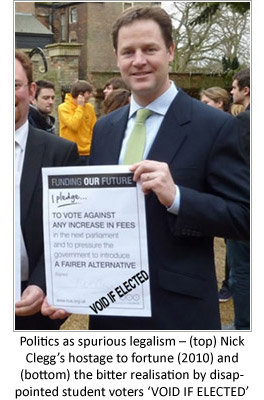
It’s the sort of politics as spurious-legalism that got Nick Clegg into so much trouble over his signed pledge (below) not to raise University tuition fees.
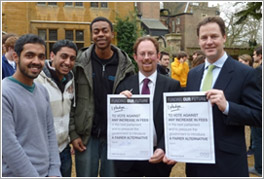
august002august003 Unfairness is written into the proposed contract from the start, by asking the elected members to attend a specified percentage of all public meetings in their constituencies. Those whose political patches contain many residents’ associations, neighbourhood watches, and other local gatherings will be required to jump over a much higher hurdle than those in sleepy Clochemerles, where nothing happens.

Judging by percentages leaves out all discretion on the part of the councillors, MPs, MEPs etc. It is mathematicalising the non-mathematical; standardising what should be un-standardised; taking spontaneity and good judgment from what should be the core of civic commitment.

Down with phoney legalism. It’s up to political parties to choose good candidates. And then for electorates to judge them. The ungracious folly of candidates’ unenforceable quasi-contracts, made and adjudged by their own political parties, has been proposed.

But – no! This sort of petty monitoring should be rejected. There are far more important and urgent problems facing politicians today than worrying over whether they have attended the right percentage of neighbourhood watch meetings this year. Trust is earned by good deeds not by percentage-pledges.

For further discussion, see Twitter

To read other discussion-points, please click here

To download Monthly Blog 22 please click here

https://www.penelopejcorfield.com/wp-content/uploads/2020/12/P.J.C.png 0 0 Penelope J. Corfield https://www.penelopejcorfield.com/wp-content/uploads/2020/12/P.J.C.png Penelope J. Corfield2012-08-01 12:00:012021-01-12 18:54:25MONTHLY BLOG 22, TO TRUST OR NOT TO TRUST?

MONTHLY BLOG 21, HISTORICAL PERIODISATION – PART 1

1 July 2012/in History, Monthly Blog/by Penelope J. Corfield

If citing, please kindly acknowledge copyright © Penelope J. Corfield (2012)

It was fascinating to meet with twenty-three others on a humid June afternoon to debate what might appear to be abstruse questions of Law & Historical Periodisation. We were attending a special conference at Birkbeck College, London University – an institution (founded in 1823 as the London Mechanics Institute) committed as always to extending the boundaries of knowledge. The participants came from the disciplines of law, history, philosophy, and literary studies. And many were students, including, laudably, some interested undergraduates who were attending in the vacation.

At stake was not the question of whether we can generalise about different and separate periods of the past. Obviously we can and must to some extent. Even the most determined advocate of history as ‘one and indivisible’ has to accept some sub-divisions for operative purposes, whether in terms of days, years, centuries or millennia.

But the questions really coalesce about temporal ‘stages’, such as the ‘mediaeval’ era. Are such concepts relevant and helpful? Is history rightly divided into successive stages? and do they follow in regular sequence in different countries, even if at different times? Or is there a danger of reifying these epochs – turning them into something more substantive and distinctive than was actually the case?

Studies like H.O. Taylor’s The Medieval Mind (1919 and many later edns), Benedicta Ward’s Miracles and the Medieval Mind (1982), William Manchester’s The Medieval Mind and the Renaissance (Boston, 1992), and Stephen Currie’s Miracles, Saints and Superstition: The Medieval Mind (2006), all imply that there were common properties to the mind-sets of millions of Europeans who lived between (roughly) the fifth-century fall of Rome and the fifteenth-century discovery of the New World – and that these mindsets differed sharply from the ‘modern mind’. Yet are these historians justified in choosing this formula within their titles? Or partly justified? or absolutely misleading? Are there common features within human consciousness and experiences that refute these periodic cut-off points? Do we want to go to the other end of the spectrum, to endorse the view of those Evolutionary Psychologists who aver that human mentalities have not changed since the Stone Age? Forever he, whether Tarzan, Baldric or Kevin? forever she, whether Jane, Elwisia or Tracey?

Two papers by Kathleen Davis (University of Rhode Island) and Peter Fitzpatrick (Birkbeck College) formed the core of the conference, both focusing upon the culture of jurisprudence and its standard definition of the medieval. Both give stimulating critiques of conventional legal assumptions, based upon stark dichotomies. In bare summary, the ‘medieval’ is supposed to be Christianised, feudal, and customary, while the ‘modern’ is supposedly secular, rights-based, and centred around the sovereign state. For good measure, the former is by implication backward and oppressive, while the latter is progressive and enlightened. Yet the long history of legal pluralism goes against any such dichotomy in practice. Historians like Helen Cam, who in 1941 wrote What of Medieval England is Alive in England Today? would have rejoiced at these papers, and at the sharp questions from the conference participants.

For my part, I was asked to give a final summary, based upon my position as a critic of all simple stage theories of history.1 My first point was to stress again how difficult it is to rethink periodisation, because so many cardinal assumptions are built not only into academic language but also into academic structures. Many specialists name themselves after their periods – as ‘medievalists’, ‘modernists’ or whatever. Those who call themselves just ‘historians’ are seen as too vague – or suffering from folie de grandeur. There are mutterings about the fate of Arnold Toynbee, once hailed as the twentieth-century’s greatest historian-philosopher – now virtually forgotten. Academic posts within departments of History and Literary Studies are generally defined by timespans. So are examination papers; many academic journals; many conferences; and so forth. Publishers in particular, who pay great attention to book titles, often endorse traditional nomenclature and stage divisions.

True, there are now increasing calls for change. My second point therefore highlights the new diversity. Conferences and seminars are held not only across disciplinary boundaries but also across epochal divisions. An increasing number of books are published with unusual start and end dates; and the variety of dates attached to the traditional periods continues to multiply, often confusingly. In addition, some scholars now study ‘big’ (long-term) history from the start of the world, or at least from the start of human history. Their approaches do not always manage to avoid traditional schema but the aim is to encourage a new diachronic sweep. And other pressures for change are coming from scholars in new fields of history, such as women’s history or (not the same thing) the history of sexuality.

Shedding the old period terminology is mentally liberating. So the Italian historian Massimo Montanari, previously a ‘medievalist’, wrote in 1994 of the happiness that followed his discarding of all the labels of ‘ancient’, ‘medieval’ and ‘modern: ‘In the end, I felt freed as from a restrictive and artificial scaffolding …’2

Lastly, then, what of the future? The aim is not to replace one set of period terms and dates with another. Any rival set will run into the same difficulties of detecting precise cut-off points and the risk of stereotyping the different cultures and societies on either side of a period boundary. It is another example of dichotomous thinking, which glosses over the complexities of the past. Above all, all stage theories fail to incorporate the elements of deep continuity within history (see my November 2010 discussion-point).

We need a new way of thinking about the intertwining of persistence and change within history. It is chiefly a matter of understanding. But it will also entail a change of language. I don’t personally endorse the Foucauldian view that language actually determines consciousness. For me, primacy in the relationship is the other way round. A changing consciousness can ultimately change language. Yet I do recognise the confining effects of existing concepts and terminology upon patterns of thought. Such an impact is another example of the power of continuity. With several bounds, however, historians can become free. With a new language, we can talk about epochs and continuities, intertwined and interacting in often changing ways. It’s fun to try and also fun to try to convince others. Medievalists, arise. You have nothing to lose but an old name, which survives through inertia. There are more than three steps between ancient – middle – modern, even in European history – let alone around the world. Try a different name to shake the stereotypes. And tell the lawyers too.

1 P.J. Corfield, Time and the Shape of History (2007) and P.J. Corfield, POST-Medievalism/ Modernity/ Postmodernity? Rethinking History, Vol. 14/3 (Sept. 2010), pp. 379-404; also available on publishers’ website Taylor & Francis www.tandfonline.com; and personal website www.penelopejcorfield.co.uk.

2 M. Montanari, The Culture of Food (transl. C. Ipsen (Oxford, 1994), p. xii.

For further discussion, see Twitter

To read other discussion-points, please click here

To download Monthly Blog 21 please click here

https://www.penelopejcorfield.com/wp-content/uploads/2020/12/P.J.C.png 0 0 Penelope J. Corfield https://www.penelopejcorfield.com/wp-content/uploads/2020/12/P.J.C.png Penelope J. Corfield2012-07-01 12:00:272021-01-12 18:54:26MONTHLY BLOG 21, HISTORICAL PERIODISATION – PART 1
Search Search

Monthly Blogs

  • MONTHLY BLOG 184, THE MOON – FAMILIAR FRIEND OR LONELY STRANGER? 2 April 2026
  • MONTHLY BLOG 183, HICKORY DICKORY DOCK! IN MEMORY OF MY LATE BROTHER JULIAN, OUR HAPPY CHILDHOOD TOGETHER, AND HIS LIFELONG SENSE OF DROLL HUMOUR 1 March 2026
  • MONTHLY BLOG 182, TO LAUGH OR CRY? RESPONDING TO ACADEMIC CRITICISMS 2 February 2026
  • MONTHLY BLOG 181, A YEAR OF POEMS 3 January 2026
  • MONTHLY BLOG 180, TIME & INSPIRATION 1 December 2025
  • MONTHLY BLOG 179, IDENTIFYING DIFFERENT ERAS OF TIME: POTENTIAL & PITFALLS … 1 November 2025
  • MONTHLY BLOG 178, THINKING THROUGH TIME AT ARTHUR’S STONE IN HEREFORDSHIRE 1 October 2025
  • MONTHLY BLOG 177, SONGS ABOUT TIME 3 September 2025

Categories

  • 2026 – Year of Poetry
  • Autobiography
  • Civics
  • Current Affairs
  • Family Memories
  • History
  • Monthly Blog
  • Notices
  • Personal
  • Reviews
  • Skills
  • Time

Archives

Tags

academics agenda ancestry battersea britain christianity continuity degree diagenesis dialectical discussion education eighteenth century ethnicity Georgian government historian historians history humanities humans knowledge labour labour party language London metamorphosis paradigm shift Penelope J Corfield poet policy politicians politics professor research students teachers time traditions transformation universities university vocational voters writing

Penelope J. Corfield

Penelope J. Corfield is a historian, lecturer and education consultant. She recently served as the President of the International Society for Eighteenth-Century Studies (ISECS).

Recent Posts

  • MONTHLY BLOG 184, THE MOON – FAMILIAR FRIEND OR LONELY STRANGER? 2 April 2026
  • MONTHLY BLOG 183, HICKORY DICKORY DOCK! IN MEMORY OF MY LATE BROTHER JULIAN, OUR HAPPY CHILDHOOD TOGETHER, AND HIS LIFELONG SENSE OF DROLL HUMOUR 1 March 2026

CONTACT

Penelope J. Corfield Historian
contact me here

SEARCH THIS SITE

Search Search

SHARE THIS

QUICK LINKS

© Copyright - Penelope J Corfield 2026. All rights reserved. | Dancing Dates Film by Edwina Hannam | Site by Starling Design
  • Link to X
  • Link to Rss this site
  • Link to Mail
Scroll to top Scroll to top Scroll to top

This site uses cookies. By continuing to browse the site, you are agreeing to our use of cookies.

OKLearn more

Cookie and Privacy Settings


How we use cookies

We may request cookies to be set on your device. We use cookies to let us know when you visit our websites, how you interact with us, to enrich your user experience, and to customize your relationship with our website.

Click on the different category headings to find out more. You can also change some of your preferences. Note that blocking some types of cookies may impact your experience on our websites and the services we are able to offer.

Essential Website Cookies

These cookies are strictly necessary to provide you with services available through our website and to use some of its features.

Because these cookies are strictly necessary to deliver the website, refusing them will have impact how our site functions. You always can block or delete cookies by changing your browser settings and force blocking all cookies on this website. But this will always prompt you to accept/refuse cookies when revisiting our site.

We fully respect if you want to refuse cookies but to avoid asking you again and again kindly allow us to store a cookie for that. You are free to opt out any time or opt in for other cookies to get a better experience. If you refuse cookies we will remove all set cookies in our domain.

We provide you with a list of stored cookies on your computer in our domain so you can check what we stored. Due to security reasons we are not able to show or modify cookies from other domains. You can check these in your browser security settings.

Google Analytics Cookies

These cookies collect information that is used either in aggregate form to help us understand how our website is being used or how effective our marketing campaigns are, or to help us customize our website and application for you in order to enhance your experience.

If you do not want that we track your visit to our site you can disable tracking in your browser here:

Other external services

We also use different external services like Google Webfonts, Google Maps, and external Video providers. Since these providers may collect personal data like your IP address we allow you to block them here. Please be aware that this might heavily reduce the functionality and appearance of our site. Changes will take effect once you reload the page.

Google Webfont Settings:

Google Map Settings:

Google reCaptcha Settings:

Vimeo and Youtube video embeds:

Other cookies

The following cookies are also needed - You can choose if you want to allow them:

Accept settingsHide notification only