
Penelope J Corfield
  • HOME
    • Index to Blogs
    • Monthly Blogs
    • CONTACT
    • Key to Dancing Dates Film
  • CURRENT
    • President International Association C18 Studies
    • Lectures on offer
    • London University’s Long C18 History Seminar
    • Living in Battersea
    • Career at a Glance
    • PJC Publications
  • BRITISH HISTORY
    • Long C18 Overviews
    • Society & Culture
    • Town Life
    • Electoral History
    • Radical Poets
    • The Professions
    • Religion & Irreligion
  • GLOBAL
    • Urban History Through Time
    • C18 European History Overviews
    • Gender History
    • ‘Racial’ Classifications as Pseudo-Science
    • Responding to Climate Change
    • Advance of the International Sphere
  • TIME & HISTORY
    • Time & The Shape of History (2007)
    • Rethinking Historical Periodisation
    • Dimensions of The Long Term
    • Returning to Big History
  • HISTORY-MAKING
    • Why History Matters
    • History of History
    • Fellow Historians
    • Arts of Academic Assessment
    • Pleasures of Intellectual Life
  • REVIEWS
    • History Book Reviews
      • Social History
      • Approaches to History
      • Big History
    • Theatre Reviews
    • Civic/Political Commentaries
    • Personal Portraits
  • Menu Menu

Tag Archive for: secular

MONTHLY BLOG 151, Reflections upon Roaming in Rome, after a Return Visit to The City

13 July 2023/in Current Affairs, Monthly Blog/by Penelope J. Corfield

If citing, please kindly acknowledge copyright © Penelope J. Corfield (2023)
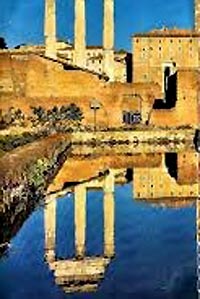
Reflected Images of Classical Rome –
in the Classical Forum (2023)

Rome is a matchless city for reflective walkers.1 Ok – best to choose a time of year when the heat is not too intense. And essential not to be in a hurry. But for those who like to stroll, to take in the views, and to reflect upon the workings of time, Rome is matchless.

Superb buildings of all eras are juxtaposed. Some are grand and justly famous. Other beautiful edifices remain relatively unknown, although elsewhere they would be celebrated tourist attractions in their own right. Everywhere there are new vistas to admire; new angles to explore.

Some areas are very crowded – try the zippy evening atmosphere of Trastevere, situated just across the river from the old centre – but there are also high places that offer peaceful panoramas of the cityscape as a whole.

Famously, the city was built upon the ‘seven hills’ of Rome, clustered together in a big bend of the River Tiber. In reality, however, there are more than seven vantage points, as other hills form an irregular wider ring around the centre. My personal favourite is the Gianicolo Hill (the Roman Janiculum). It is situated behind Trastevere, to the west of the old centre. It is not too crowded with visitors. And the views from the top are stunning – try checking the scene from the hilltop piazza with a huge bronze equestrian statue of Giuseppe Garibaldi.

Monuments in Rome are both secular and religious, offering reminders of its past role as an imperial capital – and its continuing role as the headquarters of an international faith, Indeed, the Vatican City was granted jurisdictional autonomy in 1870, when the previous Paper Sates were absorbed into the newly united Kingdom of Italy. Walkers through the Roman streets are thus reminded everywhere of the power that spiritual beliefs can generate.

And, to underline the point, Rome is awash with churches. My personal favourite is the Santa Maria d’Aracoeli. It is one of the oldest Christian churches in the city – and it was pointedly sited on top of the Capitoline Hill, at the physical heart of the Roman Empire. Moreover, the Romanesque edifice features columns that were scavenged from nearby imperial ruins. It was here in 1764, whilst listening to monks chanting in this church, and simultaneously gazing at the surrounding ruins of the once-mighty imperial capital, that the English historian Edward Gibbon first conceived his plan of writing an in-depth analysis of The Decline and Fall of the Roman Empire (1776).2

Yet the twists and turns of fortune remain unending. Between 1885 and 1935, successive Italian governments supported a further massive new construction adjacent to the same Capitoline Hill. It is named the Monument to Victor Emmanuel II (the first king of united Italy) – also known as the Vittoriano – and sometimes – irreverently – as the ‘wedding cake’. This eye-catching edifice, with its grand flights of stairs, colonnades, and statues, dominates the site and skyline as a secular neo-classical tribute to celebrate Italian Unification. The king himself is not buried here. Instead, the building contains the tomb of Italy’s ‘unknown soldier’.

But what has happened to the old church? It is still there but not easily visible. It’s set back, tucked up and behind the west flank of the Vittoriano. Walkers have to go round the Vittoriano to find a long flight of steps and then climb up to visit the unadvertised church in its historic glory. So historians can now ponder the fluctuating fortunes of townscapes and monuments, as well as those of empires, kingdoms, and religions.

Lastly, walkers in Rome must keep their eyes open. The pavements are irregular and often narrow. They may give way to uneven steps. Stone pathways can be slippery. Tourist crowds can jostle. Traffic is unpredictable. Yet everywhere there are fountains by which to linger – and bars selling fine Italian ice-cream. My favourite place for an evening drink is the Piazza Navona. Its Baroque splendour is superimposed upon the unchanged layout of the sporting stadium built for the Roman Emperor Domitian. Another great monument to time and change! ‘Eternal’ Rome survives by constant updating: not to stay the same; nor to shed the past; but to stay both historic and alive.

ENDNOTES:

1 See the classic account by Stendhal (1783-1842), Promenades dans Rome (Paris, 1829), available in English as A Roman Journal, ed. and transl. by H. Chevalier (London, 1959). And for a contemporary guide, see J. Fort and R. Piercey, Rome Walks (London, 2011).

2 For E. Gibbon (1737-94), author of The History of the Decline and Fall of the Roman Empire, 6 volumes (1776-88), see C. Roberts, Edward Gibbon and the Shape of History (Oxford, 2014); plus K. O’Brien and B. Young (eds), The Cambridge Companion to Edward Gibbon (Cambridge, 2018).

For further discussion, see Twitter

To read other discussion-points, please click here

To download Monthly Blog 151 please click here

https://www.penelopejcorfield.com/wp-content/uploads/2023/07/BLOG151.1-Rome-forum-reflections-1.jpg 299 200 Penelope J. Corfield https://www.penelopejcorfield.com/wp-content/uploads/2020/12/P.J.C.png Penelope J. Corfield2023-07-13 10:13:492023-08-02 15:19:50MONTHLY BLOG 151, Reflections upon Roaming in Rome, after a Return Visit to The City
Search Search

Monthly Blogs

  • MONTHLY BLOG 184, THE MOON – FAMILIAR FRIEND OR LONELY STRANGER? 2 April 2026
  • MONTHLY BLOG 183, HICKORY DICKORY DOCK! IN MEMORY OF MY LATE BROTHER JULIAN, OUR HAPPY CHILDHOOD TOGETHER, AND HIS LIFELONG SENSE OF DROLL HUMOUR 1 March 2026
  • MONTHLY BLOG 182, TO LAUGH OR CRY? RESPONDING TO ACADEMIC CRITICISMS 2 February 2026
  • MONTHLY BLOG 181, A YEAR OF POEMS 3 January 2026
  • MONTHLY BLOG 180, TIME & INSPIRATION 1 December 2025
  • MONTHLY BLOG 179, IDENTIFYING DIFFERENT ERAS OF TIME: POTENTIAL & PITFALLS … 1 November 2025
  • MONTHLY BLOG 178, THINKING THROUGH TIME AT ARTHUR’S STONE IN HEREFORDSHIRE 1 October 2025
  • MONTHLY BLOG 177, SONGS ABOUT TIME 3 September 2025

Categories

  • 2026 – Year of Poetry
  • Autobiography
  • Civics
  • Current Affairs
  • Family Memories
  • History
  • Monthly Blog
  • Notices
  • Personal
  • Reviews
  • Skills
  • Time

Archives

Tags

academics agenda ancestry battersea britain christianity continuity degree diagenesis dialectical discussion education eighteenth century ethnicity Georgian government historian historians history humanities humans knowledge labour labour party language London metamorphosis paradigm shift Penelope J Corfield poet policy politicians politics professor research students teachers time traditions transformation universities university vocational voters writing

Penelope J. Corfield

Penelope J. Corfield is a historian, lecturer and education consultant. She recently served as the President of the International Society for Eighteenth-Century Studies (ISECS).

Recent Posts

  • MONTHLY BLOG 184, THE MOON – FAMILIAR FRIEND OR LONELY STRANGER? 2 April 2026
  • MONTHLY BLOG 183, HICKORY DICKORY DOCK! IN MEMORY OF MY LATE BROTHER JULIAN, OUR HAPPY CHILDHOOD TOGETHER, AND HIS LIFELONG SENSE OF DROLL HUMOUR 1 March 2026

CONTACT

Penelope J. Corfield Historian
contact me here

SEARCH THIS SITE

Search Search

SHARE THIS

QUICK LINKS

© Copyright - Penelope J Corfield 2026. All rights reserved. | Dancing Dates Film by Edwina Hannam | Site by Starling Design
  • Link to X
  • Link to Rss this site
  • Link to Mail
Scroll to top Scroll to top Scroll to top

This site uses cookies. By continuing to browse the site, you are agreeing to our use of cookies.

OKLearn more

Cookie and Privacy Settings


How we use cookies

We may request cookies to be set on your device. We use cookies to let us know when you visit our websites, how you interact with us, to enrich your user experience, and to customize your relationship with our website.

Click on the different category headings to find out more. You can also change some of your preferences. Note that blocking some types of cookies may impact your experience on our websites and the services we are able to offer.

Essential Website Cookies

These cookies are strictly necessary to provide you with services available through our website and to use some of its features.

Because these cookies are strictly necessary to deliver the website, refusing them will have impact how our site functions. You always can block or delete cookies by changing your browser settings and force blocking all cookies on this website. But this will always prompt you to accept/refuse cookies when revisiting our site.

We fully respect if you want to refuse cookies but to avoid asking you again and again kindly allow us to store a cookie for that. You are free to opt out any time or opt in for other cookies to get a better experience. If you refuse cookies we will remove all set cookies in our domain.

We provide you with a list of stored cookies on your computer in our domain so you can check what we stored. Due to security reasons we are not able to show or modify cookies from other domains. You can check these in your browser security settings.

Google Analytics Cookies

These cookies collect information that is used either in aggregate form to help us understand how our website is being used or how effective our marketing campaigns are, or to help us customize our website and application for you in order to enhance your experience.

If you do not want that we track your visit to our site you can disable tracking in your browser here:

Other external services

We also use different external services like Google Webfonts, Google Maps, and external Video providers. Since these providers may collect personal data like your IP address we allow you to block them here. Please be aware that this might heavily reduce the functionality and appearance of our site. Changes will take effect once you reload the page.

Google Webfont Settings:

Google Map Settings:

Google reCaptcha Settings:

Vimeo and Youtube video embeds:

Other cookies

The following cookies are also needed - You can choose if you want to allow them:

Accept settingsHide notification only