Penelope J Corfield
  • HOME
    • Index to Blogs
    • Monthly Blogs
    • CONTACT
    • Key to Dancing Dates Film
  • CURRENT
    • President International Association C18 Studies
    • Lectures on offer
    • London University’s Long C18 History Seminar
    • Living in Battersea
    • Career at a Glance
    • PJC Publications
  • BRITISH HISTORY
    • Long C18 Overviews
    • Society & Culture
    • Town Life
    • Electoral History
    • Radical Poets
    • The Professions
    • Religion & Irreligion
  • GLOBAL
    • Urban History Through Time
    • C18 European History Overviews
    • Gender History
    • ‘Racial’ Classifications as Pseudo-Science
    • Responding to Climate Change
    • Advance of the International Sphere
  • TIME & HISTORY
    • Time & The Shape of History (2007)
    • Rethinking Historical Periodisation
    • Dimensions of The Long Term
    • Returning to Big History
  • HISTORY-MAKING
    • Why History Matters
    • History of History
    • Fellow Historians
    • Arts of Academic Assessment
    • Pleasures of Intellectual Life
  • REVIEWS
    • History Book Reviews
      • Social History
      • Approaches to History
      • Big History
    • Theatre Reviews
    • Civic/Political Commentaries
    • Personal Portraits
  • Menu Menu

Tag Archive for: solidarity

MONTHLY BLOG 163, DO PARTISAN IDENTITIES ADD A PLEASANT FLAVOUR TO DAILY LIVING – OR DO THEY REALLY CONSTITUTE A TRAP THAT UNDERMINES TRUE HUMAN SOLIDARITY?

2 July 2024/in Civics, Monthly Blog/by Penelope J. Corfield

If citing, please kindly acknowledge copyright © Penelope J. Corfield (2024)

Fig.1: Shutterstock (2024) – Tug of War

This BLOG is copy of my review, published in The Political Quarterly, Vol. 95/2 (April-June 2024), pp. 376-77, under the title ‘Uniting the Human Race’.

The book under review = Yascha Mounk, The Identity Trap:A Story of Ideas and Power in Our Time (Allen Lane, London, 2023), pp. 401. See link = http://doi.org/10.1111/1467-923X.13393.

Note: I was invited by the journal to contribute this review, since I have already written on the subject of ‘Identities’ in one of my most widely read and quoted BLOGs to date.1

The truth is that all individuals have more than one identity. They can be classified under many headings – whether by age, citizenship, class, education, ethnicity, gender, intelligence, language, region, religion, or sexuality … to name some commonly invoked criteria. If an identity is chosen voluntarily – for example as fan of a football club or pop group – it can be a delightful thing to own and to share with fellow fans. How much importance to attach to this identity then becomes a matter of choice.

Yet, if one special aspect of an individual’s existence is singled out and harshly attacked, then that one identity can quickly become all-preoccupying – whether in defiant pride or fearful resentment. Subjective emotions quickly overtake dispassionate analysis. Little wonder that political campaigners often appeal to simplified sectoral identities – and stoke the stereotypes, to keep the polemical fires burning. Human solidarity is undermined.

That danger is the core message of Yascha Mounk’s new book on The Identity Trap. He himself is of Polish parentage, born and reared in Germany, educated in Britain and the USA, and currently working in the USA. As a result, he lives with the complexities of identity. He has described himself, for example, as a native German-speaker who never felt at home in Germany. And in this book, he takes up his pen to warn the world against crude over-simplifications.

Mounk’s writing style is chatty and accessible. Each chapter ends with a useful list of key points. At the same time, his arguments are buttressed by ample documentation. His purpose is deadly serious.

An opening peroration explains both ‘the lure and the trap’ of identity politics (pp.1-21). The story gathers force by examining the American Civil Rights movement of the1960s. Insofar as the book has a (muted) hero, he is the Rev. Dr. Martin Luther King Junior. He sought to forge an ecumenical campaign, endorsed by people of all skin colours and backgrounds. In his famous speech ‘I have a Dream’ (August 1963), he expressed the hope that one day: ‘little black boys and girls will be holding hands with little white boys and girls’. A colour-blind universalism and egalitarianism will prevail.

However, some colleagues began to fear that King’s soaring idealism lacked hard-edged realism. They called instead for ‘Black Power’ to deliver a more immediate route to remedy injustices. And, over time, as progressive reforms came only slowly, others on the American political Left began to lose faith in universalist solutions to deep-rooted inequalities.

Accordingly, Part 1 of this book (pp. 23-81) examines the genesis of what Mounk calls the ‘identity synthesis’, whereby universalist/liberal values are exchanged for sectional ‘affinities’. After the Second World War – with the growing awareness of the Holocaust and the advent of the atomic bomb – faith in grand visions of the progressive unfolding of history began to falter. Thinkers like Michel Foucault (1926-84) argued that knowledge systems were nothing more (or less) than expressions of power. And Jean-François Lyotard (1924-98) proclaimed, equally firmly, that the era of ‘Modernity’ had ended. Instead, people were living in a new ‘Age of Postmodernity’, in which absolute values were yielding to relative ones.

Critics of universalism thus argued that legal systems were not benevolently impartial. They were instead ‘cloaks for privilege’. One radical maxim stated that ‘Neutrality is political’. Another declared that: ‘Racism is permanent’. Action to help society’s most disadvantaged groups (especially those defined by race, gender and sexuality) was urgently needed. Separate ‘identities’ were thus not to be denied. Instead, they were to be embraced – and each group should be helped separately, secure in the validity of its own ‘lived experience’. A ‘proud pessimism’ (pp. 69-71) had arrived.

After that, Mounk devotes Part 2 (pp. 83-126) to demonstrating how the ‘identity synthesis has swept through American Universities – and begun to influence corporate, philanthropic, and political life as well. The impact of social media simultaneously encourages the sharing of confessional narratives. In addition, Mounk notes the human capacity for ‘group think’, especially on emotive issues. Furthermore, the Presidency of Donald Trump fuelled a surge of frustration and anger amongst the American political Left. Radical zeal was channelled into immediate campaigns on the ‘identity’ frontier, where local successes could raise morale.

Having recognised the ‘lure’ of identity politics, Mounk turns in Part 3 (pp. 129-235) to refute its claims. Here he pulls no punches. The ‘identity synthesis’ has too many internal contradictions to constitute a coherent philosophy. For a start, disadvantaged people do not always agree among themselves. Then societies are not all perennially divided into mutually uncomprehending groups. There is much overlapping and sharing. Thus it is historically erroneous to think that each type of cultural output belongs exclusively to one specific group and cannot be adopted or adapted by others. Moreover, a ‘cancel’ culture that halts free discussion of such issues risks fuelling despotism rather righting injustices.

Building upon those criticisms, Mounk in Part 4 (pp. 239-90) ends with a rousing defence of liberal democratic values. With care and empathy, people can understand and help one another. Universalist programmes to provide good health care, housing, education, job opportunities, access to transport, peaceful neighbourhoods, and freedom from discrimination, can – given time and commitment – work wonders. ‘Progressive separatism’ is not actually progressive. Instead, it inculcates a negative pessimism.

These debates are likely to continue. But Mounk now detects a growing readiness among critics of the ‘identity synthesis’ to voice their objections – as he has decided to do in this admirably thoughtful book.

In that spirit, this reviewer wishes to add one further point that is not fully covered by Mounk. At one stage (p.100), he cites (disapprovingly) the case of an eminent American University where students are discouraged from stating that: ‘There is only one race, the human race’. Elsewhere, too, Mounk refers to racial classifications as ‘dubious’ (p. 262).

But let’s be franker. The attempt at establishing a so-called ‘scientific racism’ led into an intellectual blind alley. Experts could not even agree on the number of separate ‘races’. Today, geneticists confirm that all people carry variants of one biological template, known as the human genome.2 Hence individuals from all branches of the human family can inter-marry and breed fertile offspring – the fundamental test of one common species. Mounk does himself refer to the ever-growing number of so-called ‘mixed-race’ individuals (p.14), who do not fit into simple ‘racial’ classifications. But are they fully human? Of course, they are.

True, some people today maintain strongly racist attitudes. That’s an urgent problem for societies to address. Yet it’s not a good reason for endorsing the separatists. Humanity must avoid the ‘identity trap’ and walk with Martin Luther King. He sought to transform: ‘the jangling discords of our nation into a beautiful symphony of brotherhood’ [or: siblinghood!] King was brutally cut down in his prime. But his cause and his optimism are needed today more than ever. Can the human family get its global act together, at this time of climate crisis? That’s another huge and urgently-unfolding story … but anyone immediately seeking a measured faith in liberal human universalism should read Yascha Mounk.

ENDNOTES:

1 PJC, ‘Being Assessed as a Whole Person: A Critique of Identity Politics’, BLOG no.121 (Jan. 2021).

2 See esp. L. Cavalli-Sforza and F. Cavalli-Sforza, The Great Human Diasporas: The History of Diversity and Evolution (London, 1996).

For further discussion, see Twitter

To read other discussion-points, please click here

To download Monthly Blog 163 please click here

https://www.penelopejcorfield.com/wp-content/uploads/2024/07/163-1-TUG-OF-WAR-001.jpg 412 412 Penelope J. Corfield https://www.penelopejcorfield.com/wp-content/uploads/2020/12/P.J.C.png Penelope J. Corfield2024-07-02 21:04:392024-07-08 15:23:11MONTHLY BLOG 163, DO PARTISAN IDENTITIES ADD A PLEASANT FLAVOUR TO DAILY LIVING – OR DO THEY REALLY CONSTITUTE A TRAP THAT UNDERMINES TRUE HUMAN SOLIDARITY?

MONTHLY BLOG 79, 2017 – ANOTHER SUMMER OF LOVE?

1 July 2017/in Civics, Monthly Blog/by Penelope J. Corfield

If citing, please kindly acknowledge copyright © Penelope J. Corfield (2017)

Youth, youth: ‘it’s wasted on the young’, etc. But not this time. Having in my BLOG/78 (June 2017) chastised the young for not voting,1 it’s only right now to applaud their mass re-entry into electoral politics at the June 2017 General Election. It makes a huge difference across the board. And I’m not writing that purely as a Labour Party grass-root (though the majority of new young voters did vote Labour). I’m writing that because systemic non-participation of those who can potentially play a role is bad for the wider community, generating a simmering mood of distrust, cynicism, negativism and alienation. Are we ready for another summer of love, fifty years after 1967?
2017-07 No1 Aurora Goddess of Dawn by Heidi Wastweet 2003

Aurora Goddess of Dawn
© Heidi Wastweet (2003)

Of course, there is an electoral proviso. In 2017, youth turnout was 57 per cent among 18 to 19 year-olds, 59 per cent among 20 to 24 year-olds, and 64 per cent among 25 to 29 year-olds.2 All those figures marked significant increases over comparable levels in 2015, when turnout by those aged 18-24 was somewhere between 43-44 percent.3 Yet there is still room for more. And there was no doubt much regional variation, with especially high youth participation in constituencies with many students on the electoral roll, and lower participation elsewhere. But, hey, no complaints: it is a great development, from the point of view of a properly functioning democracy, full stop. And the return to the language of solidarity and love, after recent atrocities, is a splendid antidote to years of political emphasis upon atomised individuals.

Many of the young electors in their 20s who joined the Labour campaign in Battersea 2017 remind me of my own peer group in our 20s when we joined the Labour Party in the later 1960s.4 We too were full of energy and optimism. Also slightly naïve, in retrospect. But full of collective and individual confidence that we could resolve the problems of the world.5

In sociological terms, there are similarities too: lots of well educated activists, coming from middle-class backgrounds or from rising families, one generation up from the working class. However, one visible difference now, in London at any rate, is a welcome one: the ethnic composition of young Labour activists is much more relaxedly mixed than it was in our youth – reflecting long-term changes in the broader society – and changes among our friends and within our own families too.

What happened to the current of youth optimism and participation in the 1960s? It achieved quite a lot, especially in cultural, gender and ethnic politics. But it got diverted in the 1970s into a rampant individualism in lifestyles (‘tune in, drop out and do your own thing’) which eventually led to a form of anti-politics. Youth protests fizzled out. Moreover, the leftish youth politics of the 1960s triggered a militant counter-cultural resistance from the right, which fostered the successes in the 1980s of Thatcher in the UK and Reagan in the USA. Their hostility to ‘the Sixties’ was, in its way, a compliment to the impact of youth culture. Their successful counter-attack, however, simultaneously revealed how vulnerable, divided, and disorganised the Sixties cultural moment was and remained. It lacked the capacity to organise and survive.

Will the current youth involvement also fade away and eventually become dissipated? It’s an obvious risk. It’s hard for a mass movement to remain radiantly optimistic all the time, especially when encountering defeats as well as victories. On the other hand, there’s no necessity for history to repeat itself. The anti-state, anti-regulation, laissez-faire nostrums of the hard political right are now in trouble. The time is ripe for a Zeitgeist shift, which is already happening.

Furthermore, the young electorate today has a lot of really practical issues upon which to focus: the cost of education; the lack of available housing; the degradation of work conditions in the gig-economy; the need to surmount ethnic, class and religious divisions; and so forth. Such issues should help to keep the political focus strongly upon the immediate and the practical. I hope that lots of youthful activists will stand for office, locally and nationally; and/or work in community and political organisations on the ground, to prevent the current surge of involvement from becoming atomised and dissipated.

Oh yes, and another thing: those who really want to achieve changes have to dig in for the long haul. It means getting into organisations and sticking with them. And that means working with the continuing ‘golden oldies’ from successive generations, who were once themselves optimistic youth. Let everyone, who wishes to be a youthful activist, be allowed to be one, without age discrimination.

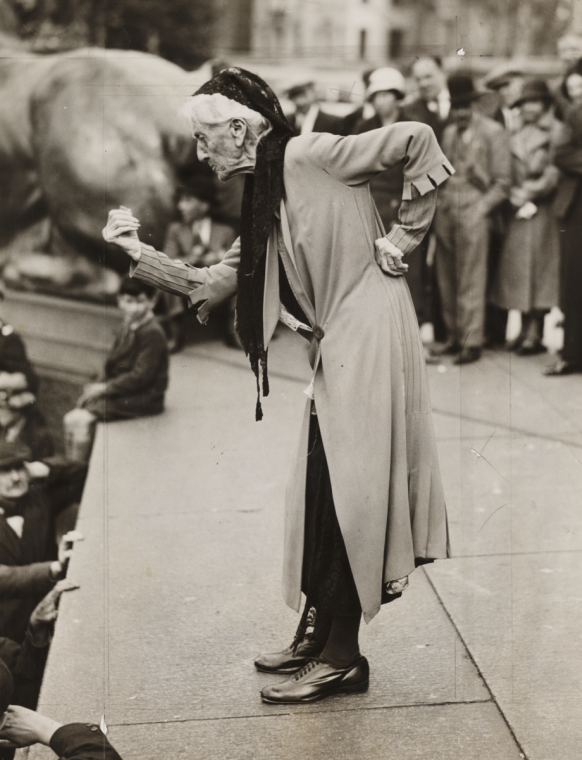
Battersea Labour provides a sterling example. Charlotte Despard (1844-1939) campaigned for many causes during her long lifetime, after becoming triggered into grass-roots activism at the age of 40. Among other things, she was a suffragette, a founder of Labour in Battersea, and an advocate of non-violent resistance, who influenced Gandhi and Martin Luther King.6 Charlotte Despard’s last public engagement saw her addressing a mass anti-fascist rally in Trafalgar Square in June 1933. She was then a young old lady aged 89. Let’s hope that we all stay as committed and indefatigable as was Despard, so that Solidarity and Love last for more than a summer.

2017-07 No2 Despard in Trafalgar Square 1933

Charlotte Despard, at the age of 89, addressing an Anti-Fascist Rally in Trafalgar Square in June 1933: photo by James Jarché for the Daily Herald

1 P.J. Corfield, ‘Who Cares? Getting People to Vote’, Monthly BLOG/78 (June 2017)

2 Voters by Age from YouGov survey, as reported in The Independent, 14 June 2017: http://www.independent.co.uk/news/uk/politics/election-2017-labour-youth-vote-under-40s-jeremy-corbyn-yougov-poll-a7789151.html

3 From Ipsos/MORI survey, as reported by Intergenerational Foundation (2015): http://www.if.org.uk/wp-content/uploads/2015/05/How-did-young-people-vote-at-the-2015-general-election.pdf

4 We appear in DVD Red Battersea: One Hundred Years of Labour, 1908-2008 (2008), directed by M. Marchant; scripted by P.J. Corfield. Available on YouTube: http://youtu.be/ahKt1XoI-II; and also via Battersea Labour Party website: http://www.battersealabour.co.uk/redbattersea

5 A. Marwick, The Sixties: Cultural Revolution in Britain, France, Italy and the United States, c.1958-74 (Oxford, 1998); T. Gitlin, The Sixties: Years of Hope, Days of Rage (New York, 1993); J.S. Baugess and A.A. Debolt (eds), Encyclopedia of the Sixties: A Decade of Culture and Counterculture (Oxford, 2012).

6 See P.J. Corfield, ‘Commemorating Battersea’s Charlotte Despard … in Battersea’, Battersea Matters, ed. J. Sheridan (Autumn, 2016), p. 11; M. Mulvihill, Charlotte Despard: A Biography (1989).

For further discussion, see Twitter

To read other discussion-points, please click here

To download Monthly Blog 79 please click here

https://www.penelopejcorfield.com/wp-content/uploads/2017/07/2017-07-No1-Aurora-Goddess-of-Dawn-by-Heidi-Wastweet-2003.jpg 640 514 Penelope J. Corfield https://www.penelopejcorfield.com/wp-content/uploads/2020/12/P.J.C.png Penelope J. Corfield2017-07-01 12:00:052021-01-12 18:53:03MONTHLY BLOG 79, 2017 – ANOTHER SUMMER OF LOVE?
Search Search

Monthly Blogs

  • MONTHLY BLOG 184, THE MOON – FAMILIAR FRIEND OR LONELY STRANGER? 2 April 2026
  • MONTHLY BLOG 183, HICKORY DICKORY DOCK! IN MEMORY OF MY LATE BROTHER JULIAN, OUR HAPPY CHILDHOOD TOGETHER, AND HIS LIFELONG SENSE OF DROLL HUMOUR 1 March 2026
  • MONTHLY BLOG 182, TO LAUGH OR CRY? RESPONDING TO ACADEMIC CRITICISMS 2 February 2026
  • MONTHLY BLOG 181, A YEAR OF POEMS 3 January 2026
  • MONTHLY BLOG 180, TIME & INSPIRATION 1 December 2025
  • MONTHLY BLOG 179, IDENTIFYING DIFFERENT ERAS OF TIME: POTENTIAL & PITFALLS … 1 November 2025
  • MONTHLY BLOG 178, THINKING THROUGH TIME AT ARTHUR’S STONE IN HEREFORDSHIRE 1 October 2025
  • MONTHLY BLOG 177, SONGS ABOUT TIME 3 September 2025

Categories

  • 2026 – Year of Poetry
  • Autobiography
  • Civics
  • Current Affairs
  • Family Memories
  • History
  • Monthly Blog
  • Notices
  • Personal
  • Reviews
  • Skills
  • Time

Archives

Tags

academics agenda ancestry battersea britain christianity continuity degree diagenesis dialectical discussion education eighteenth century ethnicity Georgian government historian historians history humanities humans knowledge labour labour party language London metamorphosis paradigm shift Penelope J Corfield poet policy politicians politics professor research students teachers time traditions transformation universities university vocational voters writing

Penelope J. Corfield

Penelope J. Corfield is a historian, lecturer and education consultant. She recently served as the President of the International Society for Eighteenth-Century Studies (ISECS).

Recent Posts

  • MONTHLY BLOG 184, THE MOON – FAMILIAR FRIEND OR LONELY STRANGER? 2 April 2026
  • MONTHLY BLOG 183, HICKORY DICKORY DOCK! IN MEMORY OF MY LATE BROTHER JULIAN, OUR HAPPY CHILDHOOD TOGETHER, AND HIS LIFELONG SENSE OF DROLL HUMOUR 1 March 2026

CONTACT

Penelope J. Corfield Historian
contact me here

SEARCH THIS SITE

Search Search

SHARE THIS

QUICK LINKS

© Copyright - Penelope J Corfield 2026. All rights reserved. | Dancing Dates Film by Edwina Hannam | Site by Starling Design
  • Link to X
  • Link to Rss this site
  • Link to Mail
Scroll to top Scroll to top Scroll to top

This site uses cookies. By continuing to browse the site, you are agreeing to our use of cookies.

OKLearn more

Cookie and Privacy Settings


How we use cookies

We may request cookies to be set on your device. We use cookies to let us know when you visit our websites, how you interact with us, to enrich your user experience, and to customize your relationship with our website.

Click on the different category headings to find out more. You can also change some of your preferences. Note that blocking some types of cookies may impact your experience on our websites and the services we are able to offer.

Essential Website Cookies

These cookies are strictly necessary to provide you with services available through our website and to use some of its features.

Because these cookies are strictly necessary to deliver the website, refusing them will have impact how our site functions. You always can block or delete cookies by changing your browser settings and force blocking all cookies on this website. But this will always prompt you to accept/refuse cookies when revisiting our site.

We fully respect if you want to refuse cookies but to avoid asking you again and again kindly allow us to store a cookie for that. You are free to opt out any time or opt in for other cookies to get a better experience. If you refuse cookies we will remove all set cookies in our domain.

We provide you with a list of stored cookies on your computer in our domain so you can check what we stored. Due to security reasons we are not able to show or modify cookies from other domains. You can check these in your browser security settings.

Google Analytics Cookies

These cookies collect information that is used either in aggregate form to help us understand how our website is being used or how effective our marketing campaigns are, or to help us customize our website and application for you in order to enhance your experience.

If you do not want that we track your visit to our site you can disable tracking in your browser here:

Other external services

We also use different external services like Google Webfonts, Google Maps, and external Video providers. Since these providers may collect personal data like your IP address we allow you to block them here. Please be aware that this might heavily reduce the functionality and appearance of our site. Changes will take effect once you reload the page.

Google Webfont Settings:

Google Map Settings:

Google reCaptcha Settings:

Vimeo and Youtube video embeds:

Other cookies

The following cookies are also needed - You can choose if you want to allow them:

Accept settingsHide notification only