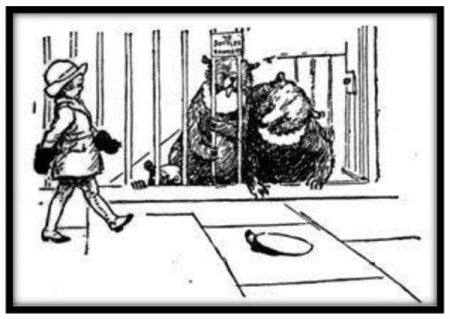
MONTHLY BLOG 184, THE MOON – FAMILIAR FRIEND OR LONELY STRANGER?

If citing, please kindly acknowledge copyright © Penelope J. Corfield (2026)

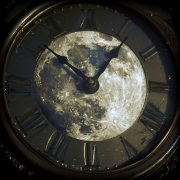
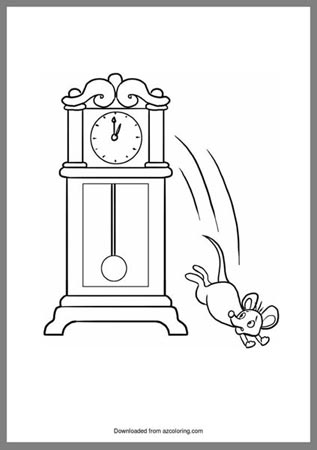
‘The Moon has a face like the clock in the hall;
She shines on thieves on the garden wall,
On streets and fields and harbour quays,
And birdies asleep in the forks of the trees …’Robert Louis Stevenson (1885)

One cold, crisp, cloudless night recently revealed a massive silver Moon, looking down impartially upon the sprawling metropolis of London. Everything looked superbly wonderful in its gleaming light. I greatly enjoyed the spectacle.

What’s more, the Moon did appear to have a familiar face, reminding me of our childish belief that the lunar contours did indeed portray the ‘Man in the Moon’.

Robert Louis Stevenson’s poem (quoted above) captures that sense of familiarity. ‘The Moon has a face like the clock in the hall’. And the poem continues to salute both the night-life that routinely flourishes under the light of the Moon, even while children and flowers ‘close their eyes’ until daylight.

But I equally love the alternative vision that sees the Moon, not as a familiar friend, but as a lonely stranger. Here the seminal poem is that by Percy Bysshe Shelley (published posthumously, 1822).

It addresses a question directly ‘To the Moon’, which is viewed as a lonely and elusive celestial wanderer:

‘Art thou pale for weariness
Of climbing heaven and gazing on the earth,
Wandering companionless
Among the stars that have a different birth, —
And ever changing, like a joyless eye
That finds no object worth its constancy?’

The beauty of the poem is so haunting that I capitulate entirely. The Moon is not only a familiar friend, but is also a forlorn solitary object, ‘wandering companionless’ through the skies. Nothing can hold its interest. Its eye is permanently joyless.

From that point of view, the intermittent human ‘race for the Moon’ is an appalling intrusion into the space of Planet Earth’s nearest neighbour. It does not intrude into human life, even though, on clear nights, it does throw a cold silvery light upon our nocturnal doings.

There are far more poems about the Moon than I have ever read … or will find time to read.1 But they all acknowledge that it’s a major fixture – even if an enigmatic moving fixture – in the close environs of Planet Earth. So it must be treated with due respect. The Moon, whether familiar or lonely – is not a toy; not a reservoir of raw materials to be used by some humans and kept from others; not a potential military base; and certainly not a potential battle-ground or killing-field.2

Global citizens have a global interest in respecting the Moon as an integral feature of global existence. It is inescapably wedded to our Planet. The Moon does not belong to anyone. But it does share its celestial journeys intimately with us all. The Moon, in all its beauty, is the ‘familiar stranger’ that is known to all humanity. And long may it flourish as such!

ENDNOTES:

1 See various options within helpful websites:  https://poets.org/poems-about-moon and https://www.poemhunter.com/poems/moon (viewed 30 March 2026).

2 See e.g. essays in Melanie Vandenbrouck, Megan Barford, Louise Devoy and Richard Dunn (eds), The Moon: A Celebration of our Celestial Neighbour (2019); O. Morton, The Moon: A History for the Future (2019); and M. Shindell (ed.), with D. Sobel, Lunar: A History of the Moon in Myths, Maps and Matter (2024).

For further discussion, see

To read other discussion-points, please click here

To download Monthly Blog 184 please click here

MONTHLY BLOG 183, HICKORY DICKORY DOCK! IN MEMORY OF MY LATE BROTHER JULIAN, OUR HAPPY CHILDHOOD TOGETHER, AND HIS LIFELONG SENSE OF DROLL HUMOUR

If citing, please kindly acknowledge copyright © Penelope J. Corfield (2026)

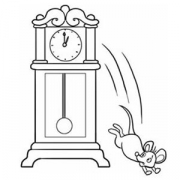
Fig.1. ‘Hickory Dickory Dock!’ – classic nursery rhyme:

‘Hickory Dickory Dock!
The mouse ran up the clock.
The clock struck one!
The mouse ran down …
Hickory Dickory Dock!’

Hickory Dickory Dock! My late brother, Julian Corfield, who died on 1 January 2026 at the age of 77, loved clocks. So this is the rhyme that I choose to introduce my memories of him – not that I ever remember seeing a mouse on any of his clocks. (But that’s borrowing too much from Julian’s own literalism! … It’s totally childish song that infallibly reminds me of our happy childhood together).

Julian, also known as Jules, Julo, and (when we were very young) as Julie, was immensely consistent throughout his life. He was serious-minded, clever, meticulous, and focused. He loved mathematics, chess and precise music (eg. anything by Bach). He was personally reserved and reticent; and, as an adult, he spent long times on his own, content with his own company. At the same time, Jules was also kind, considerate, decent-minded, gentle, and caring. He worked well with others, and enjoyed the companionship of his colleagues and former students at the School where he taught maths; his friends in his chess club; his fellow workers in the charity Southend Age Concern; and his neighbours in St John’s Court.1

Above all, too, Julian had a droll and dry sense of humour, which initially could take people by surprise. He did not look like the sort of person who was constantly cracking jokes. (And his jokes were certainly not bawdy. Nor were they sardonic or hostile). But Jules could always see the funny side of life’s ups and downs – and manage to laugh, however dryly. He also loved shared jokes and shared catch-phrases, at which he could laugh knowingly with others.

My own shared joke-phrase with him was ‘Pawn to King4’, which is a classic opening move in chess.  Goodness knowns when and how this little sort-of-joke originated, But it remained our little joke-phrase. Therefore, whenever I phoned him, I would greet him: ‘Hello, Jules: Pawn to King4’, so that he knew immediately which sister was now plaguing him. And whenever, by phone or mail, I varied this phrase, by suggesting some other opening gambit, then Jules would instantly tell me, or send me an email, to let me know how much danger my pawn was in – and how many moves it would take for him to check-mate me. (I’m not a chess-player myself but I quickly learned which opening moves to avoid!)

One thing that always impressed me was how well Jules got on with the brother who came between the two of us in age. He was Adrian, usually known as Ady, who, sadly, died at the age of 44. The two of them could not have been more different. Adrian was out-going, gregarious, hating to be alone. Jules was the reverse. Adrian was very clever, but slapdash and casual about any task he was set. Julian – also very clever – was totally meticulous about everything he did. Adrian, as an adult, had a sequence of feisty girl-friends; and he loved passionately. By contrast, Julian was celibate by choice.

Yet, as kids, the two brothers – just two years apart by age – always got on very well and played happily together. Perhaps they appreciated their mutual ‘otherness’. As they got older, Julian did seek his own quiet space, away from Adrian, who was always restless and ‘on the go’. Yet that did not detract from their mutual affection, which was based on long familiarity. And certainly, when we heard of Ady’s death, Julian displayed the greatest distress and anguish that I have ever seen from him, throughout his life. (I was also distraught – and we shared our grief together).

Fig.2

A fine recent photo of
Julian Corfield (2025),
shared with the Corfield family by
a young Southend friend,
Olivia Holbrook-Morris

A final anecdote, which became a family classic. Jules, by the way, always disputed the details of this story. But I was a witness and I’m pretty confident that it’s correct. The context was an early morning Sunday ritual, when we kids went into the parental bedroom and shared a family snuggle, all of us together in or on the big bed. These were always happy times for us all. Our father made up amusing stories to recount to us; and he played silly games with us, such as tossing us up and down in the blankets. Meanwhile, our mother smiled benignly, and enjoyed the pot of tea that I (as the oldest child) brought up for them, as soon as I was old enough to be entrusted with the task. It was her special Sunday morning treat. Usually, she was the busy one, rushing around to look after us all. But on Sunday mornings, she savoured her tea in bed, whilst all the family sat close by, smiling at her!

Anyway, at some point on one Sunday morning our father asked Julian if he would turn on the taps to run him a bath. Julian unhesitatingly left for the nearby bathroom and came back reporting that he had obeyed. It was a big, deep, old-fashioned bathtub that would not fill instantly. So some slow moments passed before our father asked Julian to check whether the bathtub was full. He came back, saying: No. Two further trips followed, each time Julian returning with another negative verdict.

Finally, our exasperated father asked just how much water was in the both?. None replied Julian. And when the paterfamilias gave every sign of exploding with incredulity and wrath, Julian explained, simply: ‘Well, you said: turn on the taps! You didn’t say: put the plug in’.

What a triumph for Julian’s literalism! Was he doing it because that is how he copes with the world? Or was he being sly, in effect teaching our father the perils of not being fully explicit? Julian was aged about nine or ten at the time. I am sure that he was just being himself – that is, totally literal-minded – and certainly not consciously seeking to annoy. That was not his style! Eventually, our father, who was usually quick to laugh, was persuaded to see the funny side … and the story became a family classic. What’s more, it remains a testament to the quietly quirky individualism that Julian maintained, unbrokenly, all his life! Julian Corfield: RIP. [And Pawn to K4].

ENDNOTES:

1 It’s a great pleasure to acknowledge here the warmth and positive input from the fifty or so friends from Southend, who came to our local commemoration of Julian’s life. The event was held on Saturday 7 February 2026, at the Westcliff Hotel, Westcliff Parade, Southend. We started with an informal buffet lunch and then proceeded to an Open Session, when anyone who wished was welcome to stand up and share with us their thoughts and feelings about Julian. There was absolutely no shortage of speakers. And the outcome was truly moving. There was no doubt that we were all talking about the same unassuming, modest person, who was so widely loved and appreciated. He was a reticent person. But Julian lived not in isolation but within many networks of true friendships.

For further discussion, see

To read other discussion-points, please click here

To download Monthly Blog 183 please click here

MONTHLY BLOG 182, TO LAUGH OR CRY? RESPONDING TO ACADEMIC CRITICISMS

If citing, please kindly acknowledge copyright © Penelope J. Corfield (2026)

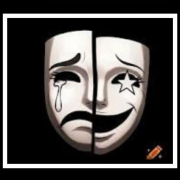
Fig.1. Laugh or Cry – song lyrics by Roger Taylor (1981):

‘You just gotta laugh or cry
Right till the day you die.
Just open up your heart,
Or open up your eyes …
Laugh or cry!’

A few days ago, I had the strange experience of hearing my life’s work dissected by a panel of critical experts, in front of a large and knowledgeable audience, and in my presence. I was part thrilled, part gobsmacked. The speakers were excellent – incisive and thoughtful. Hearing my work put into the historical context of the evolution of History as a research subject was also salutary.

The whole experience has given me much to think about. One striking theme is the relationship of academics to debate and criticism. Of course, the world of academe is not the only one that thrives upon continual arguments. Politicians, for example, have to become quickly accustomed to debates on all sides. They regularly argue not only with rivals in other political parties but also with colleagues within their own. And they may too be assailed on all sides by the general public.

So academics are not unique. But they have an interesting double relationship with assessment. They themselves are constant assessors. They regularly have piles of students’ essays to mark, as well as occasional examination scripts. Many academics also review new books, whether in published journals or in confidential pre-publication assessments for publishers. The task requires giving an objective summary of each book’s contents plus a favourable or critical response, as appropriate. And it goes on: when listening to lectures, academics try to be ready with at least one pertinent question – again, favourable or hostile, according to taste.

Simultaneously, however, academics are also on the receiving end of a constant stream of criticism. If they seek to publish a book or an essay (and the pressures to publish are these days very great), academics get a double whammy of debate. Before a book or essay is accepted for publication, it goes to anonymous readers (usually fellow academics) for prior assessment. Then, once past that potential barrier, published books and essays are often publicly reviewed in print – sometimes by more than one critical colleague. Such assessments can again be either favourable or hostile. And the barrage of responses can continue for a long period.

Meanwhile, all academics are subject to yearly internal reviews. Many institutions regularly survey student opinion about the skills and abilities of their lecturers. And academic promotion generally depends upon getting good reports not only for teaching but also for publishing well-received books and essays in sufficient quantity.

Without doubt, the old days of the doddering don, who did absolutely nothing whilst enjoying the status of being an eminent professor, have long gone.

As a result, academics live in a permanent atmosphere of potential criticism – which they both give and receive. It all helps to brace the intellect. Indeed, really good criticism can ultimately be very helpful – particularly it if arrives before the research work in question has got into print. An accurate critique, phrased tactfully, allows academics to clarify and/or to sharpen the expression of their thoughts; to remove inconsistencies; to strengthen (or perhaps to adapt) their arguments; and, if need be, to insert a rousing defence of their case against fundamental objections.

In all, to repeat a phrase: it’s bracing. Whether a given individual’s response is to laugh or to cry is a matter for personal judgment. Pointed criticisms, if they are really spot-on, can be taken badly. Colleagues sometimes cry or sulk; and refuse to continue with any further revisions of their work. (Mistakenly).

Anonymous criticisms in particular are supposed to be worded kindly, even if critically. Every now and then, however, assessors get carried away by the cloak of anonymity. They launch into personal attacks, alongside the criticisms. But all assessments, whether anonymous or otherwise, are supposed to be couched in impartial and objective terms. So if, every now and then, someone takes unfair advantage of the system of anonymity, much the best response is to ignore it completely. Laugh it off!

(By the way, anyone seeking an audit of their own personal behaviour should talk to a frank but trusty friend, who can deliver home truths constructively).

All in all, living in a bracing barrage of potential criticism is something that I personally enjoy. As a research student, I was influenced by two doughty arguers. One was the social/cultural historian, E.P, Thompson;1 and the other my PhD supervisor at the LSE, F.J. Fisher, who was an expert in London economic history.2

With each one of these two masters of dialectics, I engaged in lengthy and searching debates. And, gradually, I learned to hold my own – though I don’t think that, in either case, I ever delivered an intellectually knock-out blow.

To laugh or cry at pointed criticisms? First of all, don’t cry. It drives one into loops of negativism and does not improve the work in question. So laugh instead. Laugh because someone cared sufficiently to engage with your work. And, simultaneously, don’t ignore the criticisms. They may not always be right. But they challenge the recipients to assess for themselves. Then, if needed, corrections can be made. And, if corrections are not needed, then a rousing defence of the core argument can be inserted instead. Academic debates can be both fun and fruitful. Laugh loudly; and keep the debates going – without personal abuse – but with the critical intellect fully engaged!

ENDNOTES:

1 See P.J.C., ‘E.P. Thompson, The Historian\: An Appreciation’, first pub. in New Left Review, 201 (1993), pp. 10-17; and in slightly amplified text (2018) in PJC website: https://www.penelopejcorfield.com/history-making/fellow-historians/6.3.5 PDF45.

2 See P.J.C., ‘F.J. Fisher (1908-88) and the Dialectic of Economic History’, first pub. in P.J. Corfield and N.B. Harte (eds), London and the English Economy, 1500-1700: Essays by F.J. Fisher (London, 1990), pp. 3-22; and in shorter and punchier text (2018) in PJC website: https://www.penelopejcorfield.com/history-making/fellow-historians/6.3.1 PDF46.

For further discussion, see

To read other discussion-points, please click here

To download Monthly Blog 182 please click here

MONTHLY BLOG 181, A YEAR OF POEMS

If citing, please kindly acknowledge copyright © Penelope J. Corfield (2026)

Fig.1. Rudbeckia Birta –

flower commonly known as ‘Black-Eyed Susan’

1st January 2026: I’m now recovering from a spectacular black-eye, caused by falling down stairs at home, when hurrying and carrying a tray – so being unable to put my hands out to break fall. As I plummeted downwards, I felt a surge of extreme annoyance: annoyance at having to miss that evening’s party with friends; annoyance at putting everything on the tray at risk, including a smart china teapot (which broke, irretrievably); and, especially, acute annoyance at the vivid sensation of my own life and limbs being beyond my control.

Philosophy has since calmed me down. No bones broken (went next day into hospital for check). Many people have to put up with far worse injuries and illnesses. The fact that we missed one jolly neighbourhood Christmas party is a shame but really not the end of the world. And my partner Tony was very concerned to look after me and, when I suggested, amidst groans, that he should continue to the party without me, he refused very firmly.

Thereafter, having to rest and to take things easy over the festive period was quite calming and pleasant in its way. And I have resolved henceforth to watch my footing at all times – a wise decision, which will stand me in good stead for years to come.

My theme for this year’s BLOGs is Poetry. And there are lots of splendid and witty poems about feet.1 But nothing quite matched my personal experience. So here’s my own doggerel rhyme about falling and getting a black eye:

My dancing feet

They missed the beat;

I fell downstairs,

Spite all my cares.


I felt robust,

But got concussed.

My face went slack;

One eye turned black.


I felt a fool!

So my new rule:

On stairs or street,

Watch the damn feet!
 

ENDNOTES:

1 For a wonderful array of poems about human Feet, consult the Hello Poetry website: https://hellopoetry.com/tag/feet (viewed 31 Dec. 2025).

For further discussion, see

To read other discussion-points, please click here

To download Monthly Blog 181 please click here