

MONTHLY BLOG 79, 2017 – ANOTHER SUMMER OF LOVE?
If citing, please kindly acknowledge copyright © Penelope J. Corfield (2017)
Youth, youth: ‘it’s wasted on the young’, etc. But not this time. Having in my BLOG/78 (June 2017) chastised the young for not voting,1 it’s only right now to applaud their mass re-entry into electoral politics at the June 2017 General Election. It makes a huge difference across the board. And I’m not writing that purely as a Labour Party grass-root (though the majority of new young voters did vote Labour). I’m writing that because systemic non-participation of those who can potentially play a role is bad for the wider community, generating a simmering mood of distrust, cynicism, negativism and alienation. Are we ready for another summer of love, fifty years after 1967?

| Aurora Goddess of Dawn © Heidi Wastweet (2003) |
Of course, there is an electoral proviso. In 2017, youth turnout was 57 per cent among 18 to 19 year-olds, 59 per cent among 20 to 24 year-olds, and 64 per cent among 25 to 29 year-olds.2 All those figures marked significant increases over comparable levels in 2015, when turnout by those aged 18-24 was somewhere between 43-44 percent.3 Yet there is still room for more. And there was no doubt much regional variation, with especially high youth participation in constituencies with many students on the electoral roll, and lower participation elsewhere. But, hey, no complaints: it is a great development, from the point of view of a properly functioning democracy, full stop. And the return to the language of solidarity and love, after recent atrocities, is a splendid antidote to years of political emphasis upon atomised individuals.
Many of the young electors in their 20s who joined the Labour campaign in Battersea 2017 remind me of my own peer group in our 20s when we joined the Labour Party in the later 1960s.4 We too were full of energy and optimism. Also slightly naïve, in retrospect. But full of collective and individual confidence that we could resolve the problems of the world.5
In sociological terms, there are similarities too: lots of well educated activists, coming from middle-class backgrounds or from rising families, one generation up from the working class. However, one visible difference now, in London at any rate, is a welcome one: the ethnic composition of young Labour activists is much more relaxedly mixed than it was in our youth – reflecting long-term changes in the broader society – and changes among our friends and within our own families too.
What happened to the current of youth optimism and participation in the 1960s? It achieved quite a lot, especially in cultural, gender and ethnic politics. But it got diverted in the 1970s into a rampant individualism in lifestyles (‘tune in, drop out and do your own thing’) which eventually led to a form of anti-politics. Youth protests fizzled out. Moreover, the leftish youth politics of the 1960s triggered a militant counter-cultural resistance from the right, which fostered the successes in the 1980s of Thatcher in the UK and Reagan in the USA. Their hostility to ‘the Sixties’ was, in its way, a compliment to the impact of youth culture. Their successful counter-attack, however, simultaneously revealed how vulnerable, divided, and disorganised the Sixties cultural moment was and remained. It lacked the capacity to organise and survive.
Will the current youth involvement also fade away and eventually become dissipated? It’s an obvious risk. It’s hard for a mass movement to remain radiantly optimistic all the time, especially when encountering defeats as well as victories. On the other hand, there’s no necessity for history to repeat itself. The anti-state, anti-regulation, laissez-faire nostrums of the hard political right are now in trouble. The time is ripe for a Zeitgeist shift, which is already happening.
Furthermore, the young electorate today has a lot of really practical issues upon which to focus: the cost of education; the lack of available housing; the degradation of work conditions in the gig-economy; the need to surmount ethnic, class and religious divisions; and so forth. Such issues should help to keep the political focus strongly upon the immediate and the practical. I hope that lots of youthful activists will stand for office, locally and nationally; and/or work in community and political organisations on the ground, to prevent the current surge of involvement from becoming atomised and dissipated.
Oh yes, and another thing: those who really want to achieve changes have to dig in for the long haul. It means getting into organisations and sticking with them. And that means working with the continuing ‘golden oldies’ from successive generations, who were once themselves optimistic youth. Let everyone, who wishes to be a youthful activist, be allowed to be one, without age discrimination.
Battersea Labour provides a sterling example. Charlotte Despard (1844-1939) campaigned for many causes during her long lifetime, after becoming triggered into grass-roots activism at the age of 40. Among other things, she was a suffragette, a founder of Labour in Battersea, and an advocate of non-violent resistance, who influenced Gandhi and Martin Luther King.6 Charlotte Despard’s last public engagement saw her addressing a mass anti-fascist rally in Trafalgar Square in June 1933. She was then a young old lady aged 89. Let’s hope that we all stay as committed and indefatigable as was Despard, so that Solidarity and Love last for more than a summer.
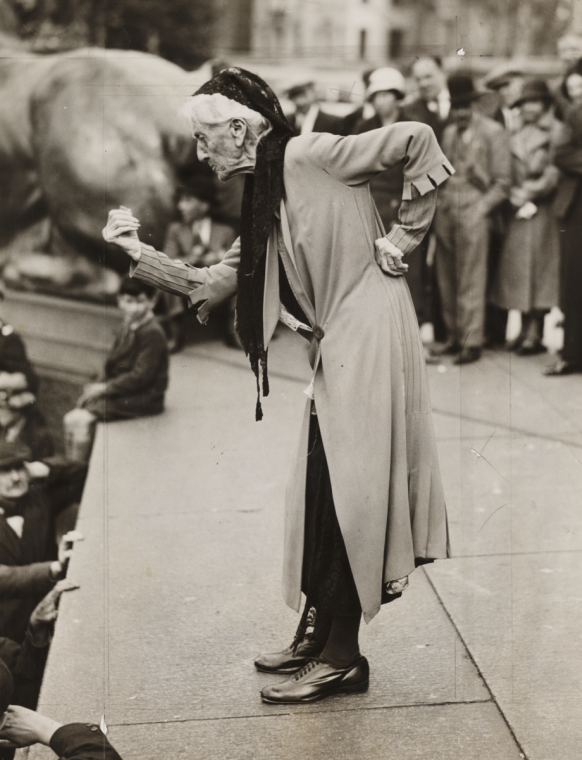
| Charlotte Despard, at the age of 89, addressing an Anti-Fascist Rally in Trafalgar Square in June 1933: photo by James Jarché for the Daily Herald |
1 P.J. Corfield, ‘Who Cares? Getting People to Vote’, Monthly BLOG/78 (June 2017)
2 Voters by Age from YouGov survey, as reported in The Independent, 14 June 2017: http://www.independent.co.uk/news/uk/politics/election-2017-labour-youth-vote-under-40s-jeremy-corbyn-yougov-poll-a7789151.html
3 From Ipsos/MORI survey, as reported by Intergenerational Foundation (2015): http://www.if.org.uk/wp-content/uploads/2015/05/How-did-young-people-vote-at-the-2015-general-election.pdf
4 We appear in DVD Red Battersea: One Hundred Years of Labour, 1908-2008 (2008), directed by M. Marchant; scripted by P.J. Corfield. Available on YouTube: http://youtu.be/ahKt1XoI-II; and also via Battersea Labour Party website: http://www.battersealabour.co.uk/redbattersea
5 A. Marwick, The Sixties: Cultural Revolution in Britain, France, Italy and the United States, c.1958-74 (Oxford, 1998); T. Gitlin, The Sixties: Years of Hope, Days of Rage (New York, 1993); J.S. Baugess and A.A. Debolt (eds), Encyclopedia of the Sixties: A Decade of Culture and Counterculture (Oxford, 2012).
6 See P.J. Corfield, ‘Commemorating Battersea’s Charlotte Despard … in Battersea’, Battersea Matters, ed. J. Sheridan (Autumn, 2016), p. 11; M. Mulvihill, Charlotte Despard: A Biography (1989).
For further discussion, see Twitter
To read other discussion-points, please click here
To download Monthly Blog 79 please click here