
MONTHLY BLOG 98, HOW SHOULD YOU APPROACH THE PhD VIVA?
If citing, please kindly acknowledge copyright © Penelope J. Corfield (2019)
Asked by a friend about my extensive experience
of helping candidates through PhD vivas,
I’ve distilled my advice as follows:
Anticipation
Participation
Progression
1: Anticipation
I won’t call this preparation, since everything that you have researched, debated and written about during the entire research period has been preparation for the thesis and viva. But it’s worth undertaking a thoughtful process of anticipation. After a break from the research, return to the thesis and reread it. Then prepare a short statement about your thesis aims and conclusions.
Examiners often invite candidates to start the proceedings with such a succinct statement. If they don’t in your case, then keep it up your sleeve. It’s bound to be useful at a later point in the discussions.
As you reread the thesis, note (as judiciously as you can) the good points within your thesis – and also consider where criticisms and challenges might be made. Some authors love everything that they have written; others detest their own prose. Try to keep a balance.
Having noted areas for criticism and challenge, then think carefully and be ready with answers. It’s not invariably true that authors are their own best critics. Nonetheless, they can often tell where the shoe pinches. Your supervisor will also help with this process.
In the British academic system, the viva is a serious hurdle. So don’t assemble your friends and family to wait outside the examination room. Whatever the outcome, you will need some time for quiet reflection immediately afterwards. It’s important to absorb the prior debate, alongside the examiners’ verdict. And either then or not long afterwards, you need a quick debriefing with your supervisor; and a timetable for corrections and revisions (if any). However, it’s fine to keep friends and family on hold for a celebration later in the day. By the way, in some other academic systems, e.g. in France, the critical vetting takes place before and the viva is a public confirmation of success. That’s a different process, hence processed very differently.
Either way, the viva is a big, big hurdle. Anticipate with care and relish.
2: Participation
Once in the appointed examination venue, treat the viva as a high-powered research consultancy. You are coming to talk with fellow scholars, so don’t be obsequious and deferential. On the other hand, it is your work that is under the spot-light, so don’t display either too much swagger (off-putting) or fear (disappointing).
These days, vivas are approached by all parties in a thoroughly professional way. They are intense affairs; and candidates often don’t remember much detail afterwards. So if you have the option of inviting in your supervisor (not all Universities allow this), then do so. S/he does not intervene at all – often sitting at the back of the room – but can keep useful notes on the discussion.
After a short opening statement from the candidate (depending on the decision of the examiners), a prolonged and detailed discussion ensues. It covers points both small and large, in something of a barrage. The candidate’s task is to assess the examiner’s input and take an instant decision. If the points raised are crucial to your core message, then you must hold your ground, courteously but firmly, and defend your position. The examiners are testing you. If, on the other hand, the criticisms are well made and are not absolutely central, then it’s fine to give way graciously and promise to amend either in the revised thesis or in a subsequent publication.
Every moment requires a quick assessment and a suitable response. You are on the spot throughout, which is why vivas are commonly experienced as both exciting and tiring.
Either at the very start (less common these days) or at the very end (becoming the usual practice), the examiners give you their verdict. As the discussion unfolds, do not try to second-guess the examiners’ intentions. Some will be stony-faced. Some will nod and smile continually. But their facial expressions may not reflect their private thoughts. Furthermore, the examiners have not been asked whether they like you; or even whether they agree with your argument and conclusions. Their task in a History viva is to assess whether you have made an original contribution to historical knowledge, which is well argued, well substantiated, and presented to a publishable standard. No more, and no less.
Your task therefore is not to study the examiners but to concentrate upon fielding their comments/questions and to keep the ball in play (essential advice for all interviews, incidentally).
The options for final assessments by the examiners vary, depending upon the specific regulations of each University. The main categories, however, are pretty standardised, as follows:
- Pass, with no changes required. (Excellent.)
- Pass, with minor corrections.(Good. The most common result. Make changes swiftly, exactly as required.)
- Reference back, with considerable corrections required. (Initially a disappointing verdict; but, viewed in the right light, it gives chance for revisions to make the required improvements and to head off criticisms before the thesis becomes public.)
- Offer to award degree at lower academic level: usually M.Phil. rather than PhD. (Certainly disappointing. Candidate may be given chance to decide whether to accept this award or not. If accepting, then be pleased to have gained a good research qualification, even if not at the level initially desired. If deciding against acceptance, then, depending upon University regulations, it may be possible to resubmit after major improvements. In which case, give it a serious go. But check very carefully before deciding.)
- Fail outright, without chance of resubmitting. (This outcome should not happen, as internal Departmental or Faculty review mechanisms should have halted the candidacy before getting to the viva. In the rare event of outright failure, the candidate, in consultation with the supervisor, should reassess and consider what alternative outcomes, including publications, can be made of the research material.)
Whatever the verdict, accept it with good grace. The outcome may well require talking things over with your supervisor, after the meeting. In extremis, you may even wish to challenge the verdict on procedural grounds. But that can’t be done during the meeting.
By the way, challenges to PhD vivas are very rare; and rarely successful, unless a University has seriously failed to follow its own procedures. These days, all examinations are done carefully, by the book. Much of the solemnity of a viva thus comes from its finality. It is the ‘live’ encapsulation of everything that you have worked for during your long years of research.
3: Progression
Passing the viva is a real rite de passage. You are no longer a research apprentice but have submitted your master-work. Once your thesis is passed, perhaps after revisions, you have joined the community of accredited scholars. After all, a doctorate is a known qualification which is sincerely admired by academics world-wide as well as generally respected by the wider public.
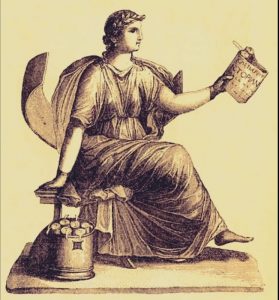
| Clio, the Muse of History, in a Victorian print. |
The examiners will give you a full report, which you should discuss with your supervisor. If s/he has been in attendance, s/he will also have notes and suggestions for you. The examiners may also have made specific suggestions for publication, though they are not required to do so.
Once having passed the viva, take a deep breath; enjoy to the full; and commit to proceeding to at least one publication arising from the thesis. You have produced an original contribution to historical knowledge. That’s the definitional criterion of a History doctorate. It will be consulted by many specialists over the years.
Yet there is one further step which is mightily to be encouraged. The viva is not an ending but a moment of progression. After your many years of work, you should draw from your doctorate to achieve at least one publication. The step into print will give you an additional and well deserved public badge of scholarly honour. It allows you to contact a wider readership. And it may launch you into further publications, once having broken your duck.
So … there we are. You’ve undertaken a long, long haul. You’ve experienced an intellectual adventure as well as episodes of boredom, uncertainty, and angst. Passing the viva, after finally completing and if necessary correcting a doctoral thesis, is a great, unrepeatable moment. Bravo!
For further discussion, see Twitter
To read other discussion-points, please click here
To download Monthly Blog 98 please click here