
Penelope J Corfield
  • HOME
    • Index to Blogs
    • Monthly Blogs
    • CONTACT
    • Key to Dancing Dates Film
  • CURRENT
    • President International Association C18 Studies
    • Lectures on offer
    • London University’s Long C18 History Seminar
    • Living in Battersea
    • Career at a Glance
    • PJC Publications
  • BRITISH HISTORY
    • Long C18 Overviews
    • Society & Culture
    • Town Life
    • Electoral History
    • Radical Poets
    • The Professions
    • Religion & Irreligion
  • GLOBAL
    • Urban History Through Time
    • C18 European History Overviews
    • Gender History
    • ‘Racial’ Classifications as Pseudo-Science
    • Responding to Climate Change
    • Advance of the International Sphere
  • TIME & HISTORY
    • Time & The Shape of History (2007)
    • Rethinking Historical Periodisation
    • Dimensions of The Long Term
    • Returning to Big History
  • HISTORY-MAKING
    • Why History Matters
    • History of History
    • Fellow Historians
    • Arts of Academic Assessment
    • Pleasures of Intellectual Life
  • REVIEWS
    • History Book Reviews
      • Social History
      • Approaches to History
      • Big History
    • Theatre Reviews
    • Civic/Political Commentaries
    • Personal Portraits
  • Menu Menu

Tag Archive for: fiddler

MONTHLY BLOG 135, A YEAR OF GEORGIAN CELEBRATIONS – 3: THE SCOTTISH MUSIC OF NIEL GOW

1 March 2022/in History, Monthly Blog/by Penelope J. Corfield

If citing, please kindly acknowledge copyright © Penelope J. Corfield (2022)
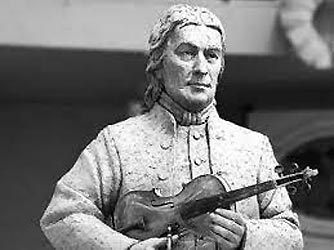
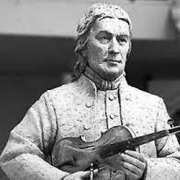
Close-up of sculptor David Annand’s statue of legendary
Scottish fiddler Niel Gow (1727-1807),
erected in 2020 near his childhood home in
Strathbaan, Perthshire.

At a time of international crisis over Ukraine, it seems heartless to continue normal life. And, in particular, it could seem inappropriate to be writing about something as jolly and convivial as the music of eighteenth-century Scotland’s legendary fiddler, Niel Gow (1727-1807). But it helps to stick to routines, which in this case means posting my monthly BLOG.

Music, moreover, is a mighty medium for expressing the full range of human emotions. Niel Gow, born in Strathbaan, Perthshire, came from a modest background to become feted as a composer and fiddler.1 And, among his output, are some famous laments. Indeed, in the long eras before the advent of the radio, musicians had to be ready to switch quickly in style from sad to jolly, from slow to brisk, from simple to intricate, as occasion required. They provided their listeners with a soundtrack for both daily life and special events.

Gow initially began his working life as a weaver. Yet his manual dexterity and his musicality were, between them, sufficiently notable that he soon began to make a name as a fiddler. (A fiddle is the demotic name for a violin, when the instrument is used for ‘folk’ music). He then won some local competitions – which were taken seriously in Perthshire, a ‘big county’ that cherishes its musical traditions. And, once he found a well-connected patron, Gow was able to work as a professional musician.

James Murray, 2nd Duke of Atholl (1690-1764), was a successful Scottish politician, who lived down the Jacobite affiliations of his older brother (who lost his title and lands after 1715), and thereafter prospered as a solid pro-Unionist. He called upon the services of Gow to play music at balls and dances, held by the Scottish nobility. Such gatherings were, for Atholl, handy ways of shoring up pro-Hanoverian social networks.

For Gow, such employment was a break-through. It gave him access to a world of Scottish lairds who were ready to pay for his services at their social gatherings. The role of a professional musician was a new and potentially risky one. But he was able to flourish, and continued to do so, long after the Duke’s death in 1764. Gow meanwhile lived simply and brought up his large family in a traditional single-story stone cottage in Inver, near Dunkeld. Outside the village, on the banks of the Tay, is the massive oak tree, where he was reported to sit composing music.2 Yet Inver was also well placed for working trips into urban centres like Perth and Dundee. They gave him access to music publishers – and, via the press, to the wider world.

Scotland’s fast-expanding Lowland economy from the mid-eighteenth century onwards was becoming sufficiently wealthy to support not only the growth of towns, trade and industry but the parallel expansion of a new service economy.3 Musicians were among the emergent new professions. They provided a ‘whole Tribe of Singers and Scrapers’, fitted for ‘this Musical Age’, as one occupational handbook observed, somewhat wryly, in 1747.4 It was in that context, that Gow’s son Nathaniel was able to follow in his father’s footsteps. So he too played and composed for the fiddle.

Especially prominent among the output of Niel Gow were his Scottish country dances. Many are still played at ceilidhs and festive events today. Some were new compositions. Others were rearrangements or ‘borrowings’ (often unacknowledged) from older dance music.5 There was then, however, no stigma attached to such reworkings. Robert Burns similarly adapted older verses and tunes in his own prolific output, which also combined both old and new.6

Their audiences positively relished the consolidation of a proud ‘Scottish’ poetic and musical tradition.7 It brought old legacies into the mainstream.  Any separatist tinge of association with the outlawed Jacobites – supporters of the exiled Stuart kings – was shed, whilst a living cultural heritage was enhanced.

So rich is this updated repertoire that English-speaking audiences to this day continue to enjoy Scottish dances and Highland laments. In part, global enthusiasm was boosted by the widespread Scottish diaspora. Yet music has always had the power to transcend ethnic and cultural boundaries.

To honour one notable creator of Scotland’s musical tradition, an annual Niel Gow Festival has been hosted each March since 2004, in the village of Dunkeld & Birnam (Perth & Kinross). The next will be held on 18-20 March 2022.8 This place is often described as a ‘Gateway to the Highlands’. Conversely, changing the motto, it might also be said that the music of Niel Ross constituted a cultural bridge from the Highlands to the wider world … Let that be a happy portent that out of old conflicts can come sustained peace and fertile creativity.

ENDNOTES:

1 For Niel Gow (1727-1807), see https://en.wikipedia.org/wiki/Niel_Gow [accessed 28 Feb. 2022]; and H. Jackson,  Niel Gow’s Inver (Perth, 2000). Gow’s first name was sometimes rendered as Neil or Neal.

2 Now a tourist attraction: see https://en.wikipedia.org/wiki/Niel_Gow’s_Oak [accessed 28 Feb. 2022].

3 D. Allen, Scotland in the Eighteenth Century; Union and Enlightenment (Harlow, 2002).

4 R. Campbell, The London Tradesman … (1757), p. 93. For context, see also C. Ehrlich, The Music Profession in Britain since the Eighteenth Century: A Social History (Oxford, 1985), pp. 1-53.

5 See tunes by Niel Gow, played on his own fiddle, in CD Album recorded by Pete Clark, Even Now: The Music of Niel Gow (Smiddymade Recordings SMD615, Perthshire, Scotland, 1999). And context in D. Johnson, Scottish Fiddle Music in the Eighteenth Century: A Music Collection and Historical Study (Edinburgh, 1984).

6 See e.g. C. Campbell and others, Burns and Scottish Fiddle Tradition (Edinburgh 2000); C.E. Andrews, The Genius of Scotland: The Cultural Production of Robert Burns, 1785-1834 (Leiden, 2015).

7 S. McKerrell and G. West (eds), Understanding Scotland Musically: Folk, Tradition and Policy (2018); F.M. Collinson, The Traditional and National Music of Scotland (2021).

8 For details, see https://www.niel-gow.co.uk.

For further discussion, see Twitter

To read other discussion-points, please click here

To download Monthly Blog 135 please click here

https://www.penelopejcorfield.com/wp-content/uploads/2022/03/BLOG_135-Niel-Gow-copy.jpg 250 334 Penelope J. Corfield https://www.penelopejcorfield.com/wp-content/uploads/2020/12/P.J.C.png Penelope J. Corfield2022-03-01 19:48:292022-03-04 01:07:45MONTHLY BLOG 135, A YEAR OF GEORGIAN CELEBRATIONS – 3: THE SCOTTISH MUSIC OF NIEL GOW
Search Search

Monthly Blogs

  • MONTHLY BLOG 184, THE MOON – FAMILIAR FRIEND OR LONELY STRANGER? 2 April 2026
  • MONTHLY BLOG 183, HICKORY DICKORY DOCK! IN MEMORY OF MY LATE BROTHER JULIAN, OUR HAPPY CHILDHOOD TOGETHER, AND HIS LIFELONG SENSE OF DROLL HUMOUR 1 March 2026
  • MONTHLY BLOG 182, TO LAUGH OR CRY? RESPONDING TO ACADEMIC CRITICISMS 2 February 2026
  • MONTHLY BLOG 181, A YEAR OF POEMS 3 January 2026
  • MONTHLY BLOG 180, TIME & INSPIRATION 1 December 2025
  • MONTHLY BLOG 179, IDENTIFYING DIFFERENT ERAS OF TIME: POTENTIAL & PITFALLS … 1 November 2025
  • MONTHLY BLOG 178, THINKING THROUGH TIME AT ARTHUR’S STONE IN HEREFORDSHIRE 1 October 2025
  • MONTHLY BLOG 177, SONGS ABOUT TIME 3 September 2025

Categories

  • 2026 – Year of Poetry
  • Autobiography
  • Civics
  • Current Affairs
  • Family Memories
  • History
  • Monthly Blog
  • Notices
  • Personal
  • Reviews
  • Skills
  • Time

Archives

Tags

academics agenda ancestry battersea britain christianity continuity degree diagenesis dialectical discussion education eighteenth century ethnicity Georgian government historian historians history humanities humans knowledge labour labour party language London metamorphosis paradigm shift Penelope J Corfield poet policy politicians politics professor research students teachers time traditions transformation universities university vocational voters writing

Penelope J. Corfield

Penelope J. Corfield is a historian, lecturer and education consultant. She recently served as the President of the International Society for Eighteenth-Century Studies (ISECS).

Recent Posts

  • MONTHLY BLOG 184, THE MOON – FAMILIAR FRIEND OR LONELY STRANGER? 2 April 2026
  • MONTHLY BLOG 183, HICKORY DICKORY DOCK! IN MEMORY OF MY LATE BROTHER JULIAN, OUR HAPPY CHILDHOOD TOGETHER, AND HIS LIFELONG SENSE OF DROLL HUMOUR 1 March 2026

CONTACT

Penelope J. Corfield Historian
contact me here

SEARCH THIS SITE

Search Search

SHARE THIS

QUICK LINKS

© Copyright - Penelope J Corfield 2026. All rights reserved. | Dancing Dates Film by Edwina Hannam | Site by Starling Design
  • Link to X
  • Link to Rss this site
  • Link to Mail
Scroll to top Scroll to top Scroll to top

This site uses cookies. By continuing to browse the site, you are agreeing to our use of cookies.

OKLearn more

Cookie and Privacy Settings


How we use cookies

We may request cookies to be set on your device. We use cookies to let us know when you visit our websites, how you interact with us, to enrich your user experience, and to customize your relationship with our website.

Click on the different category headings to find out more. You can also change some of your preferences. Note that blocking some types of cookies may impact your experience on our websites and the services we are able to offer.

Essential Website Cookies

These cookies are strictly necessary to provide you with services available through our website and to use some of its features.

Because these cookies are strictly necessary to deliver the website, refusing them will have impact how our site functions. You always can block or delete cookies by changing your browser settings and force blocking all cookies on this website. But this will always prompt you to accept/refuse cookies when revisiting our site.

We fully respect if you want to refuse cookies but to avoid asking you again and again kindly allow us to store a cookie for that. You are free to opt out any time or opt in for other cookies to get a better experience. If you refuse cookies we will remove all set cookies in our domain.

We provide you with a list of stored cookies on your computer in our domain so you can check what we stored. Due to security reasons we are not able to show or modify cookies from other domains. You can check these in your browser security settings.

Google Analytics Cookies

These cookies collect information that is used either in aggregate form to help us understand how our website is being used or how effective our marketing campaigns are, or to help us customize our website and application for you in order to enhance your experience.

If you do not want that we track your visit to our site you can disable tracking in your browser here:

Other external services

We also use different external services like Google Webfonts, Google Maps, and external Video providers. Since these providers may collect personal data like your IP address we allow you to block them here. Please be aware that this might heavily reduce the functionality and appearance of our site. Changes will take effect once you reload the page.

Google Webfont Settings:

Google Map Settings:

Google reCaptcha Settings:

Vimeo and Youtube video embeds:

Other cookies

The following cookies are also needed - You can choose if you want to allow them:

Accept settingsHide notification only