

Penelope J Corfield
  • HOME
    • Index to Blogs
    • Monthly Blogs
    • CONTACT
    • Key to Dancing Dates Film
  • CURRENT
    • President International Association C18 Studies
    • Lectures on offer
    • London University’s Long C18 History Seminar
    • Living in Battersea
    • Career at a Glance
    • PJC Publications
  • BRITISH HISTORY
    • Long C18 Overviews
    • Society & Culture
    • Town Life
    • Electoral History
    • Radical Poets
    • The Professions
    • Religion & Irreligion
  • GLOBAL
    • Urban History Through Time
    • C18 European History Overviews
    • Gender History
    • ‘Racial’ Classifications as Pseudo-Science
    • Responding to Climate Change
    • Advance of the International Sphere
  • TIME & HISTORY
    • Time & The Shape of History (2007)
    • Rethinking Historical Periodisation
    • Dimensions of The Long Term
    • Returning to Big History
  • HISTORY-MAKING
    • Why History Matters
    • History of History
    • Fellow Historians
    • Arts of Academic Assessment
    • Pleasures of Intellectual Life
  • REVIEWS
    • History Book Reviews
      • Social History
      • Approaches to History
      • Big History
    • Theatre Reviews
    • Civic/Political Commentaries
    • Personal Portraits
  • Menu Menu

Tag Archive for: Georg Ernst Stahl

MONTHLY BLOG 77, IDEAS TAKING A WRONG TURN

1 May 2017/in History, Monthly Blog/by Penelope J. Corfield

If citing, please kindly acknowledge copyright © Penelope J. Corfield (2017)

2017-05 No1 Rising phoenix tattoo - CopyMeditating about ideas taking a wrong turn (there are a lot of wrong turns around), I was reminded of the eighteenth-century saga of phlogiston – or the spirit of fire. It was a concept that held sway in scientific circles for many years, before it was found to be wrong. Not fruitfully wrong, stimulating fresh research and new developments. Just simply erroneous – in intellectual terms, a wrong turning.

There may be similarly erroneous ideas around in science today: superstring theories in theoretical physics,1 for example, or ‘dark matter’ in astro-physics (let alone ‘dark energy’ and/or ‘dark electromagnetism’).2 Such big concepts are intriguing ‘fillers’, often triggering intense debates. They fill a gap in knowledge, where there is perceived to be a problem but, as yet, no research-based solution with an accompanying explanatory theory. Sometimes such ideas are later empirically substantiated. Equally, however, sometimes not.

In the case of phlogiston, seventeenth- and eighteenth-century scientists were keen to understand what happens in the process of combustion. Some large logs are burned – and all that is left is a small pile of ashes. Hence one apparently logical answer was that combustion had released into the atmosphere a fiery element, almost like the spirit of fire itself, which, once freed, was released into the air. Substances that burned easily were full of this ignitable matter. The idea was formulated in 1667 by a German alchemist and physician, Johann Joachim Becher; and developed in 1703 by his former student Georg Ernst Stahl, a professor of medicine and chemistry. He was not the first to coin the term phlogiston, derived from the Greek for ‘inflaming’; but his analysis propelled the term into scientific currency.3

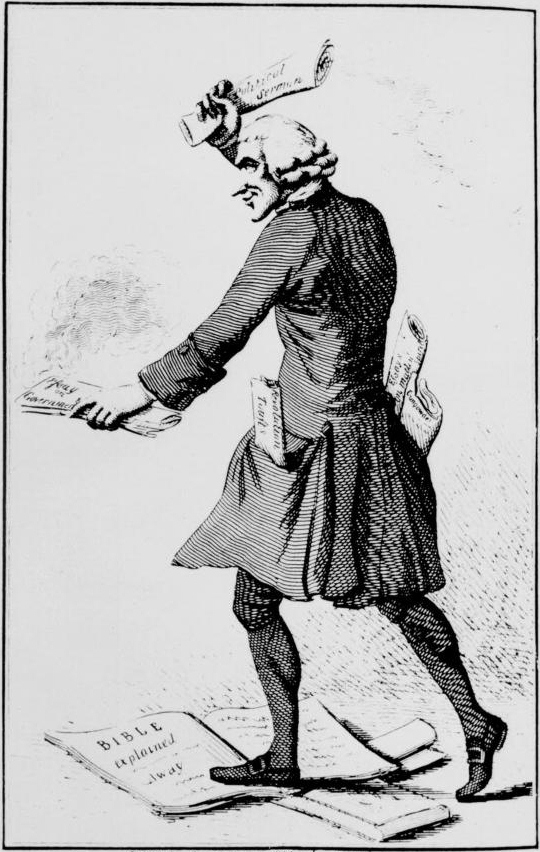
Research doubts, however, began eventually to circulate. Not all physical matter was reduced in weight by combustion. Some metals did the contrary. But somehow the principle of phlogiston as the spirit of fire remained an attractive one. The term remained widely in use among the developing community of researchers in Britain and France. Thus when in 1772 the Scottish chemist and botanist Daniel Rutherford4 managed to isolate and identify nitrogen as a separate gas, he named it ‘phlogisticated air’ (burnt air). The Nonconformist minister-cum-experimental-scientist Joseph Priestley was another who accepted the concept of phlogiston. In his path-breaking explorations of the composition of air, he was one of the first to identify oxygen as a gas. But he stuck with the old vocabulary, calling it ‘dephlogisticated air’. Accordingly, when Priestley was satirised for his radical political ideas, he was shown by the cartoonist as the fiery Dr Phlogiston – trampling underfoot the Bible, whilst simultaneously igniting the laws of England.5
2017-05 No2 priestley phlogiston

Satirical print of Priestley as Dr Phlogiston:
The Priestley Politician or the Political Priestley

However, chemical theories and practice changed fundamentally after 1778. The French chemist Antoine-Laurent de Lavoisier (1743-94) not only identified and named ‘oxygen’ but also showed its key role as an oxidizer during combustion. There was no spirit of fire waiting to be released into the cosmos. References to phlogiston still lingered but were increasingly sidelined. Quietly, the entire theory behind the concept was dropped.6 Lavoisier also identified and named hydrogen (1783).7 The study of chemistry was advanced onto a new footing, aided by the increasingly international pooling of research. Henceforth ‘Air’ was not just air; and ‘Fire’ was not just fire.

Now phlogiston is known in the scientific lexicon as a category error. It commanded belief for a surprising amount of time, despite research doubts. But the concept did not lead to any interesting intellectual outcomes. It held sway and then quietly vanished.

Three morals for later generations. Firstly, there is often a hidden romantic idea (like the spirit of fire) or a cosmic vision behind apparently coldly rationalistic scientific concepts. Secondly, theories, even if very widely and genuinely accepted, remain no more than theories, until they are tested and confirmed empirically. Big organising ideas may become adopted because they are plausible or useful or powerful or attractive. Yet they don’t become world beaters, until they are verified. Thirdly and lastly, wrong turnings make for easy walking, until they suddenly don’t. Maybe that last proposition applies not only in the realm of ideas but in today’s politics too.

1 Compare B.R. Greene, The Elegant Universe: Superstrings, Hidden Dimensions,  Theory, and the Quest for the Ultimate Theory (1999); and L. Smolin, The Trouble with Physics: The Rise of String Theory, the Fall of a Science, and What Comes Next (Boston, 2006).

2 R.H. Sanders, The Dark Matter Problem: A Historical Perspective (Cambridge, 2010).

3 J.H. White, The History of Phlogiston Theory (1932).

4 For Daniel Rutherford (1749-1819), see wikipedia.org/wiki/Daniel_Rutherford.

5 For Joseph Priestley (1733-1804), see R.E. Schofield, The Enlightenment of Dr Priestley: A Study of his Life and Work from 1733-73 (Philadelphia, 1997); idem, The Enlightened of Dr Priestley: A Study of his Life and Work from 1773-1804 (Philadelphia, 2004).

6 J.B. Conant (ed.), The Overthrow of the Phlogiston Theory: The Chemical Revolution of 1775-89 (Harvard, Mass., 1950).

7 F.L. Holmes, Antoine Lavoisier – The Next Crucial Year: Or, the Sources of his Quantitative Method in Chemistry (Princeton, 1998); J. Jackson, A World on Fire: A Heretic, an Aristocrat and the Race to Discover Oxygen (New York, 2005).

For further discussion, see Twitter

To read other discussion-points, please click here

To download Monthly Blog 77 please click here

https://www.penelopejcorfield.com/wp-content/uploads/2017/05/2017-05-No1-Rising-phoenix-tattoo-Copy.jpg 292 158 Penelope J. Corfield https://www.penelopejcorfield.com/wp-content/uploads/2020/12/P.J.C.png Penelope J. Corfield2017-05-01 12:00:162021-01-12 18:53:04MONTHLY BLOG 77, IDEAS TAKING A WRONG TURN
Search Search

Monthly Blogs

  • MONTHLY BLOG 184, THE MOON – FAMILIAR FRIEND OR LONELY STRANGER? 2 April 2026
  • MONTHLY BLOG 183, HICKORY DICKORY DOCK! IN MEMORY OF MY LATE BROTHER JULIAN, OUR HAPPY CHILDHOOD TOGETHER, AND HIS LIFELONG SENSE OF DROLL HUMOUR 1 March 2026
  • MONTHLY BLOG 182, TO LAUGH OR CRY? RESPONDING TO ACADEMIC CRITICISMS 2 February 2026
  • MONTHLY BLOG 181, A YEAR OF POEMS 3 January 2026
  • MONTHLY BLOG 180, TIME & INSPIRATION 1 December 2025
  • MONTHLY BLOG 179, IDENTIFYING DIFFERENT ERAS OF TIME: POTENTIAL & PITFALLS … 1 November 2025
  • MONTHLY BLOG 178, THINKING THROUGH TIME AT ARTHUR’S STONE IN HEREFORDSHIRE 1 October 2025
  • MONTHLY BLOG 177, SONGS ABOUT TIME 3 September 2025

Categories

  • 2026 – Year of Poetry
  • Autobiography
  • Civics
  • Current Affairs
  • Family Memories
  • History
  • Monthly Blog
  • Notices
  • Personal
  • Reviews
  • Skills
  • Time

Archives

Tags

academics agenda ancestry battersea britain christianity continuity degree diagenesis dialectical discussion education eighteenth century ethnicity Georgian government historian historians history humanities humans knowledge labour labour party language London metamorphosis paradigm shift Penelope J Corfield poet policy politicians politics professor research students teachers time traditions transformation universities university vocational voters writing

Penelope J. Corfield

Penelope J. Corfield is a historian, lecturer and education consultant. She recently served as the President of the International Society for Eighteenth-Century Studies (ISECS).

Recent Posts

  • MONTHLY BLOG 184, THE MOON – FAMILIAR FRIEND OR LONELY STRANGER? 2 April 2026
  • MONTHLY BLOG 183, HICKORY DICKORY DOCK! IN MEMORY OF MY LATE BROTHER JULIAN, OUR HAPPY CHILDHOOD TOGETHER, AND HIS LIFELONG SENSE OF DROLL HUMOUR 1 March 2026

CONTACT

Penelope J. Corfield Historian
contact me here

SEARCH THIS SITE

Search Search

SHARE THIS

QUICK LINKS

© Copyright - Penelope J Corfield 2026. All rights reserved. | Dancing Dates Film by Edwina Hannam | Site by Starling Design
  • Link to X
  • Link to Rss this site
  • Link to Mail
Scroll to top Scroll to top Scroll to top

This site uses cookies. By continuing to browse the site, you are agreeing to our use of cookies.

OKLearn more

Cookie and Privacy Settings


How we use cookies

We may request cookies to be set on your device. We use cookies to let us know when you visit our websites, how you interact with us, to enrich your user experience, and to customize your relationship with our website.

Click on the different category headings to find out more. You can also change some of your preferences. Note that blocking some types of cookies may impact your experience on our websites and the services we are able to offer.

Essential Website Cookies

These cookies are strictly necessary to provide you with services available through our website and to use some of its features.

Because these cookies are strictly necessary to deliver the website, refusing them will have impact how our site functions. You always can block or delete cookies by changing your browser settings and force blocking all cookies on this website. But this will always prompt you to accept/refuse cookies when revisiting our site.

We fully respect if you want to refuse cookies but to avoid asking you again and again kindly allow us to store a cookie for that. You are free to opt out any time or opt in for other cookies to get a better experience. If you refuse cookies we will remove all set cookies in our domain.

We provide you with a list of stored cookies on your computer in our domain so you can check what we stored. Due to security reasons we are not able to show or modify cookies from other domains. You can check these in your browser security settings.

Google Analytics Cookies

These cookies collect information that is used either in aggregate form to help us understand how our website is being used or how effective our marketing campaigns are, or to help us customize our website and application for you in order to enhance your experience.

If you do not want that we track your visit to our site you can disable tracking in your browser here:

Other external services

We also use different external services like Google Webfonts, Google Maps, and external Video providers. Since these providers may collect personal data like your IP address we allow you to block them here. Please be aware that this might heavily reduce the functionality and appearance of our site. Changes will take effect once you reload the page.

Google Webfont Settings:

Google Map Settings:

Google reCaptcha Settings:

Vimeo and Youtube video embeds:

Other cookies

The following cookies are also needed - You can choose if you want to allow them:

Accept settingsHide notification only