
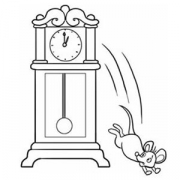
MONTHLY BLOG 183, HICKORY DICKORY DOCK! IN MEMORY OF MY LATE BROTHER JULIAN, OUR HAPPY CHILDHOOD TOGETHER, AND HIS LIFELONG SENSE OF DROLL HUMOUR
If citing, please kindly acknowledge copyright © Penelope J. Corfield (2026)
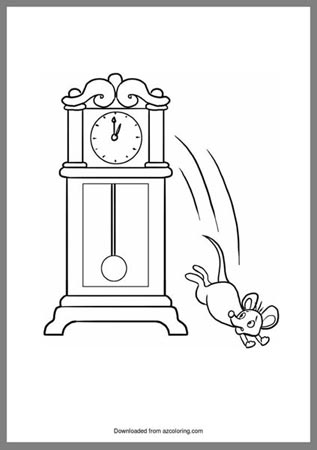
| Fig.1. ‘Hickory Dickory Dock!’ – classic nursery rhyme:
‘Hickory Dickory Dock! |
Hickory Dickory Dock! My late brother, Julian Corfield, who died on 1 January 2026 at the age of 77, loved clocks. So this is the rhyme that I choose to introduce my memories of him – not that I ever remember seeing a mouse on any of his clocks. (But that’s borrowing too much from Julian’s own literalism! … It’s totally childish song that infallibly reminds me of our happy childhood together).
Julian, also known as Jules, Julo, and (when we were very young) as Julie, was immensely consistent throughout his life. He was serious-minded, clever, meticulous, and focused. He loved mathematics, chess and precise music (eg. anything by Bach). He was personally reserved and reticent; and, as an adult, he spent long times on his own, content with his own company. At the same time, Jules was also kind, considerate, decent-minded, gentle, and caring. He worked well with others, and enjoyed the companionship of his colleagues and former students at the School where he taught maths; his friends in his chess club; his fellow workers in the charity Southend Age Concern; and his neighbours in St John’s Court.1
Above all, too, Julian had a droll and dry sense of humour, which initially could take people by surprise. He did not look like the sort of person who was constantly cracking jokes. (And his jokes were certainly not bawdy. Nor were they sardonic or hostile). But Jules could always see the funny side of life’s ups and downs – and manage to laugh, however dryly. He also loved shared jokes and shared catch-phrases, at which he could laugh knowingly with others.
My own shared joke-phrase with him was ‘Pawn to King4’, which is a classic opening move in chess. Goodness knowns when and how this little sort-of-joke originated, But it remained our little joke-phrase. Therefore, whenever I phoned him, I would greet him: ‘Hello, Jules: Pawn to King4’, so that he knew immediately which sister was now plaguing him. And whenever, by phone or mail, I varied this phrase, by suggesting some other opening gambit, then Jules would instantly tell me, or send me an email, to let me know how much danger my pawn was in – and how many moves it would take for him to check-mate me. (I’m not a chess-player myself but I quickly learned which opening moves to avoid!)
One thing that always impressed me was how well Jules got on with the brother who came between the two of us in age. He was Adrian, usually known as Ady, who, sadly, died at the age of 44. The two of them could not have been more different. Adrian was out-going, gregarious, hating to be alone. Jules was the reverse. Adrian was very clever, but slapdash and casual about any task he was set. Julian – also very clever – was totally meticulous about everything he did. Adrian, as an adult, had a sequence of feisty girl-friends; and he loved passionately. By contrast, Julian was celibate by choice.
Yet, as kids, the two brothers – just two years apart by age – always got on very well and played happily together. Perhaps they appreciated their mutual ‘otherness’. As they got older, Julian did seek his own quiet space, away from Adrian, who was always restless and ‘on the go’. Yet that did not detract from their mutual affection, which was based on long familiarity. And certainly, when we heard of Ady’s death, Julian displayed the greatest distress and anguish that I have ever seen from him, throughout his life. (I was also distraught – and we shared our grief together).

|
Fig.2 A fine recent photo of |
A final anecdote, which became a family classic. Jules, by the way, always disputed the details of this story. But I was a witness and I’m pretty confident that it’s correct. The context was an early morning Sunday ritual, when we kids went into the parental bedroom and shared a family snuggle, all of us together in or on the big bed. These were always happy times for us all. Our father made up amusing stories to recount to us; and he played silly games with us, such as tossing us up and down in the blankets. Meanwhile, our mother smiled benignly, and enjoyed the pot of tea that I (as the oldest child) brought up for them, as soon as I was old enough to be entrusted with the task. It was her special Sunday morning treat. Usually, she was the busy one, rushing around to look after us all. But on Sunday mornings, she savoured her tea in bed, whilst all the family sat close by, smiling at her!
Anyway, at some point on one Sunday morning our father asked Julian if he would turn on the taps to run him a bath. Julian unhesitatingly left for the nearby bathroom and came back reporting that he had obeyed. It was a big, deep, old-fashioned bathtub that would not fill instantly. So some slow moments passed before our father asked Julian to check whether the bathtub was full. He came back, saying: No. Two further trips followed, each time Julian returning with another negative verdict.
Finally, our exasperated father asked just how much water was in the both?. None replied Julian. And when the paterfamilias gave every sign of exploding with incredulity and wrath, Julian explained, simply: ‘Well, you said: turn on the taps! You didn’t say: put the plug in’.
What a triumph for Julian’s literalism! Was he doing it because that is how he copes with the world? Or was he being sly, in effect teaching our father the perils of not being fully explicit? Julian was aged about nine or ten at the time. I am sure that he was just being himself – that is, totally literal-minded – and certainly not consciously seeking to annoy. That was not his style! Eventually, our father, who was usually quick to laugh, was persuaded to see the funny side … and the story became a family classic. What’s more, it remains a testament to the quietly quirky individualism that Julian maintained, unbrokenly, all his life! Julian Corfield: RIP. [And Pawn to K4].
ENDNOTES:
1 It’s a great pleasure to acknowledge here the warmth and positive input from the fifty or so friends from Southend, who came to our local commemoration of Julian’s life. The event was held on Saturday 7 February 2026, at the Westcliff Hotel, Westcliff Parade, Southend. We started with an informal buffet lunch and then proceeded to an Open Session, when anyone who wished was welcome to stand up and share with us their thoughts and feelings about Julian. There was absolutely no shortage of speakers. And the outcome was truly moving. There was no doubt that we were all talking about the same unassuming, modest person, who was so widely loved and appreciated. He was a reticent person. But Julian lived not in isolation but within many networks of true friendships.
For further discussion, see Twitter
To read other discussion-points, please click here
To download Monthly Blog 183 please click here

