
Tag Archive for: history

MONTHLY BLOG 180, TIME & INSPIRATION

If citing, please kindly acknowledge copyright © Penelope J. Corfield (2025)

Fig.1. Time Flies, illustrated by Hour-Glass with Wings,
vector design Generative AI:

© Dreamtime 2025

The relentless passage of Time is at once a threat and an inspiration.1 Of course, in one way, it’s menacing: Time flies! Time, once lost, cannot be retrieved! Time travels onwards and does not come back!

Yet that very fact can also provide an inspiration. As Abraham Lincoln once remarked: In the end, it’s not the years in your life that count – it’s the life in your years’. Time is a finite resource; and therefore is best not squandered.

Charles Darwin expressed that very thought rather sternly, as befits an earnest Victorian: ‘A man who dares to waste one hour of Time, has not discovered the value of life’.

Or as the lyrics of Pink Floyd’s song on Time (1973), written by bass-guitarist Roger Waters, wryly noted:

‘Ticking away the moments that make up a dull day,
You fritter and waste the hours in an off-hand way. …
And then, one day, you find ten years have got behind you,
No-one told you when to run – you missed the starting gun.

It’s necessary, therefore, to accept the brute fact that Time moves ever onwards. However much people may wish to ‘call back yesterday, bid Time return’, as one character in Shakespeare’s Richard II eloquently declaims,2 they cannot.

So the ever-moving passage of Time poses a bonny challenge. Optimists like the American essayist, Ralph Waldo Emerson, gave those prone to gloom some uplifting advice: ‘Write it on your heart that every day is the best day in the year’. And Benjamin Franklin was somewhat less exuberant but equally emphatic, as he warned that: ‘You may delay, but Time will not’. In other words, use Time, don’t waste it.

On the positive side, too, there’s a potential learning curve. Thus the eighteenth-century poet and moralist, Alexander Pope, observed sagely that: ‘No one should be ashamed to admit he is wrong, which is but saying, in other words, that he is wiser today than he was yesterday.’

Thus humans can look back at the past, not just with emotions that range from nostalgia to horror, but also to learn. And it’s essential that we do. The past – or rather the human study of the past – has generated a massive stock of information and expertise. Some things, it is true, are learned in the immediate moment. But we cannot learn from the future that has not yet happened.

Evidence, analysis, expertise and inspiration – surviving from the past, and tempered by perceptions and evaluations today – together provide the operating stock of knowledge that is needed for living successfully in Time.3 Without such a resource, humanity would face the same troubles that afflict individuals who have lost all memories and cannot function unaided. So the point is not just: don’t waste Time! But, crucially: learn from it! That wise advice was given by the world’s most renowned expert on temporal challenges, Albert Einstein. He urged: ‘Learn from yesterday, live for today, hope for tomorrow’. Action stations for us all! Learn and live! Proverbially: There’s no Time like the present!

ENDNOTES:

1 This BLOG concludes PJC’s year of Time-BLOGS (2025). For more, see too P.J. Corfield, Time and the Shape of History (2007); and idem, Time-Space: We Are All in it Together (2025).

2 Earl of Salisbury in Shakespeare’s Richard II (written c.1595/6; first pub. 1597), Act 3. sc.2.

3 For the multifarious debates on these complex issues, see C. Callender (ed.), The Oxford Handbook of Philosophy of Time (2011).

For further discussion, see

To read other discussion-points, please click here

To download Monthly Blog 180 please click here

MONTHLY BLOG 179, IDENTIFYING DIFFERENT ERAS OF TIME: POTENTIAL & PITFALLS …

If citing, please kindly acknowledge copyright © Penelope J. Corfield1 (2025)

Dandelion in the wind @ Shutterstock 2025

There is a perennial conflict between, on the one hand, looking at history in terms of specific periods (for example: ‘ancient’, ‘medieval’, ‘modern’) and, on the other, trying to interpret past events without using any of these pre-set concepts. To lump or to split?

The advantage of pre-set periods is partly descriptive. It is much more economical to write ‘in medieval England’ than it is to write ‘in England during the years from the fifth century AD to the later fifteenth century’.

But, once the deed is done, and centuries of history are clumped together, questions instantly multiply: Was there one medieval period? (Scholars disagree). If so, are those the right dates for it? Why is it sometimes divided into the ‘Low Middle Ages’ and the ‘High Middle Ages’? Is the concept basically fractured?

Moreover, if it is one period, then what are its major characteristics? Is the medieval era one of chronic ignorance and backwardness? Or it is a vanished era of romance and chivalry? Or, perhaps, neither of those options? What other alternatives are there??2 And did the wider sequence of stages within which it is allegedly embedded really exist either?3

Yet without any aggregative terms for big periods of time, then historical accounts risk becoming an undifferentiated list of ‘one damned thing after another’ – with the emphasis on the adjective ‘damned’.

Attitudes among historians often shift between doubt and grand certainties. In the nineteenth century, at least for many in the West, history was seen as an unstoppable ‘March of Progress’.4 And some still cling to that vision today.

Meanwhile, for Marxists, history proceeded not by slow evolution but by dramatic leaps. The inevitable class struggle generated many stormy internal tensions that each time led to a revolutionary breakdown, after which a new stage of history emerged, only to be followed by a further revolutionary breakdown, and the advent of a ‘higher’ stage of history. Thus ‘feudalism’ would be followed by ‘capitalism’, to be followed by ‘communism’.5 But neither ‘Progress’ nor the ‘Marxist dialectic’ has worked out precisely as foretold.

In Western intellectual circles in the 1980s and 1990s, doubt rather than certainty became the new mood-music (although of course, there were always dissentient voices). Above all, theorists of ‘postmodernism’ became influential among many disillusioned left-wingers. This viewpoint extended the stages of history from ‘feudal’ to ‘modern’ to ‘postmodern’. And the postmodern stance stressed the problematic nature of all knowledge about the past.

One central tenet of this attitude was an ‘incredulity towards meta-narratives’, as proclaimed by the French social philosopher Jean-François Lyotard.6 Grand sweeping stories about the march of history were at a discount. Time’s arrow did not point in any specific direction, it seemed. It was not sure where it was going.

Taking scepticism yet further, the French philosopher and literary destructionist, Jacques Derrida, asserted that temporality itself has no independent reality. For him, time is a concept which ‘belongs entirely to metaphysics’. (And, clearly, that formulation was not meant as a compliment). Instead, an a-temporal spatiality prevails throughout the cosmos.7

Postmodernist super-scepticism, however, was closely followed by a justified intellectual recoil. Historians, while these days tending to reject schematic grand narratives, have not gone to the other extreme. They do not accept that the past has no meaning, or that studies of history are purely subjective.8

Paradoxically, the postmodernists’ claim – that an old era of so-called confident ‘modernity’ has been superseded by a new age of sceptical ‘postmodernity’ –  does in itself assert that the course of history can be deciphered. In other words, their critique of meta-narratives did not inhibit them from producing an alternative meta-narrative of their own.

Times have moved on. Some writers boldly assert the ‘end of postmodernism’ and define the new era as ‘Post-Postmodern’.9 Others ask sceptically whether such an era was ever really there at all?10

Belief in the heresy of ‘time denial’ was never espoused by more than a tiny minority of philosophers and physicists. History as a subject of study remains immensely popular and important.

Therefore historians around the world continue these research and debates. They seek long-term interpretations that avoid over-simplification and embrace complexity – but that are, simultaneously, not so complex that no meaning can be extracted from the torrent of detail. There are specific periods of history that have a distinctive identity – but there are also long-term evolutionary trends as well as deep continuities, that extend through millennia. The whole mix is as complex as life. It’s also important and endlessly instructive. As a result, it’s fascinating and sometimes infuriating! Come and research the past (choosing any time-period, long or short) and join the non-stop debates! Time-space: it’s what we all live in!

ENDNOTES:

1 Contributing to PJC’s year of Time-BLOGS (2025). For more, see too P.J. Corfield, Time and the Shape of History (2007); and idem, Time-Space: We Are All in it Together (2025).

2 See N. Cantor, Inventing the Middle Ages: The Lives, Works and Ideas of the Great Medievalists of the Twentieth Century (1991); and A. Murray, ‘Should the Middle Ages be Abolished?’ in Essays in Medieval Studies, 21 (2004), pp. 1–22.

3 See esp. P.J. Corfield, ‘POST-Medievalism/Modernity/Postmodernity?’ Rethinking History, Vol. 14 (2010), pp. 379-404. Also available via PJC website, www.penelopejcorfield.co.uk/what_is_history?/Pdf20.

4 See J.B. Bury, The Idea of Progress: An Enquiry into its Origin and Growth (1921); C. Lasch, The True and Only Heaven: Progress and its Critics (1991); G.A. Almond and others, Progress and its Discontents (2022).

5 See variously T.B. Bottomore, Karl Marx (1956); idem (ed.), Modern Interpretations of Marx (1981); D. Conway, A Farewell to Marx: An Outline and Appraisal of his Theories (1987); J.H. Moore (ed.), Legacies of the Collapse of Marxism (1995); G. Therborn, From Marxism to Post-Marxism? (2010).

6 See J-F. Lyotard, The Postmodern Condition: A Report on Knowledge, transl. by G. Bennington and B. Massumi (1979); M. Drolet (ed.), The Postmodernism Reader: Foundational Texts (2004); and popularisation of these arguments in D. Harvey, The Condition of Postmodernity: An Enquiry into the Origins of Cultural Change (1989); F. Jameson, Postmodernism: The Cultural Logic of Late Capitalism (1991); and H. Bertens, The Idea of the Postmodern: A History (1995).

7 See J. Hodge, Derrida on Time (2007); and, as an example of the debates, J.M. Lehmann, Deconstructing Derrida: A Post-Poststructuralist Critique (1993).

8 For a variety of historians’ responses, see R. Evans, In Defence of History (1997); F. Spier, Big History and the Future of Humanity (2010); D. Armitage and J. Guldi, The History Manifesto (2014).

9 For examples, see A. Kirby, ‘The Death of Postmodernism and Beyond’, Philosophy Now, Vol. 58 (2006); J.T. Nealon, Post-Postmodernism: Or, the Cultural Logic of Just-in-Time Capitalism (2012); B. Kuzniarz, Farewell to Postmodernism: Social Theories of the Late Left (2015); A. Gibbons, ‘Postmodernism is Dead. What Comes Next?’ Times Literary Supplement, 14 June 2017.

10 See e.g. S. Redhead, We Have Never Been Postmodern: Theory at the Speed of Light (2011); R. Kramer, Are we Postmodern Yet? And Were We Ever? (2019).

For further discussion, see

To read other discussion-points, please click here

To download Monthly Blog 179 please click here

MONTHLY BLOG 178, THINKING THROUGH TIME AT ARTHUR’S STONE IN HEREFORDSHIRE

If citing, please kindly acknowledge copyright © Penelope J. Corfield (2025)

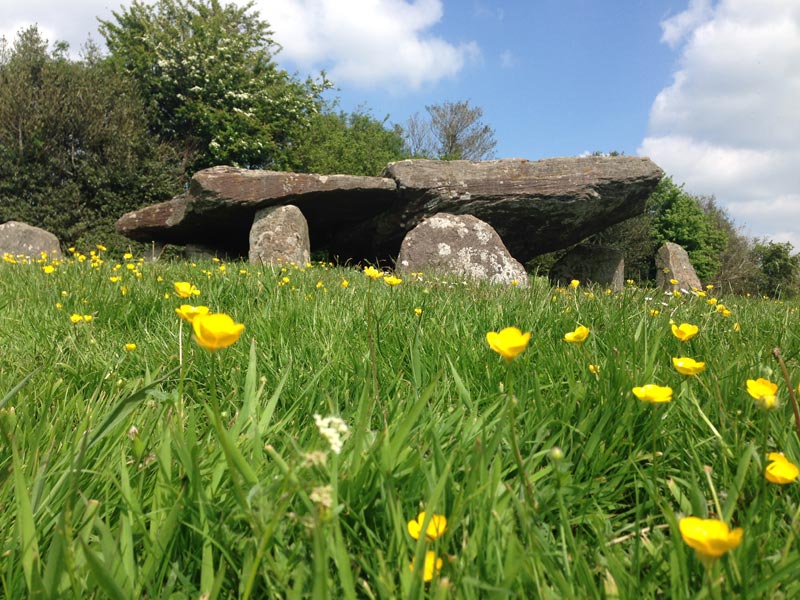
Fig.1 Arthur’s Stone (Herefordshire), constructed c. 3,000 BCE Photo © Tony Belton 2016

Fig.1 Arthur’s Stone (Herefordshire),
constructed c. 3,000 BCE
Photo © Tony Belton 2016

Great rings of giant standing stones, dating from primeval times – such as England’s Stonehenge and Brittany’s Carnac Stones – are wonderful prompts to sweeping thoughts about the length of Time and History.Yet small ancient monuments can be just as striking in their own way. On a very pleasant visit to Herefordshire in summer 2016, my partner and I decided, on the spur of the moment, to follow a signpost to view a historic burial tomb, named Arthur’s Stone. It proved to be wonderfully thought-provoking.

Arthur’s Stone (today guarded by English Heritage)is set high on a ridge between the Wye and Golden Valleys. The site is magnificent. The Stone burial chamber, which was constructed in c. 3,000 BCE, is somewhat dilapidated but that through-Time quality adds to its authenticity. Its impact is dignified without being grandiose. Interested visitors attend in small numbers rather than in great crowds. Yet the simplicity and venerability of the monument, and the tranquillity of its location, together give the Stone great resonance.

In the first place, it is evidence of serious intent on the part of those who placed the Stone high on the ridge. It may have been installed as an astronomical observation point – a function which is claimed (and debated) in the case of many ancient stone monuments. Certainly, none of these sites were constructed out of the blue. They indicate the existence of societies capable of planning, organising and implementing big communal projects. And they were ingenious makers and users of flint tools. Hence it’s not surprising that in the vicinity of Arthur’s Stone, there’s evidence of prior human labour in the form of numerous even older flint flakes and arrow-heads.

Whether this particular monument was built as a tomb, or instead as some form of storage chamber, is unknown. There are other similar monuments in the region, which are known as the ‘Severn-Cotswold’ group of chambered tombs. And there would have been regular communication links between these sites. Thus, while research has yet to reveal the precise functions of all these carefully-positioned great stones, it is clear that they had a significant role for those who manoeuvred them into their special sites. From the start, they had meaning.

A further intriguing train of thought is prompted by the attempts of later generations to ‘domesticate’ these historical markers by associating them with famous personages.So at some stage, long before the thirteenth century CE, this monument, like many other historic stones and relics, became associated in popular legend with the feats of King Arthur. Stories abounded. One reported that he had won a battle there. Another story recounted that he’d met a giant there and triumphantly slain him. Either way, Arthur’s Stone was being given a place in the epic history of the legendary British king. And the name has stuck.

Thereafter, the site has seen some real documented drama as well. In the fifteenth century, a knight was killed there in a fatal duel. And in September 1645 the embattled King Charles I dined at the Stone with his Royalist troops. Perhaps he intended the occasion as a symbolic gesture, although it did not confer upon him sufficient pseudo-Arthurian lustre to defeat Cromwell and the Roundheads. Charles I’s fleeting visit thus did not enter local folklore.

Then at some stage (the precise date is unknown), the site became a focal point for locally popular festivities at midsummer. Villagers in the nearby settlements of Dorstone and Bredwardine gathered in the sloping field in front of Arthur’s Stone, where they engaged in uninhibited drinking, dancing and ‘high jinks’  – away from the inquisitorial eye of the local clergy and magistrates. It was obviously fun, because the popular tradition continued well into Victorian times.

As a sober counter-balance, too, the local Baptists began in the nineteenth century to organise an ecumenical religious service there in high summer. Implicitly, they were saluting the Stone’s sacral reputation, whilst simultaneously purging its more recent pagan associations.

On my own visit there, I met by complete chance a charming senior citizen who lived locally.4   She told me of her personal memories, as a child before World War II, when she joined her school-fellows to sing hymns at the services held there each midsummer. It was a stirring occasion for them all.

The special nature of the place was (and is) undoubted. Throughout its five thousand years of existence, Arthur’s Stone has had multiple meanings and uses for the witnessing generations who both live nearby and visit from afar. Its story is protean. Whether the site is used for astronomy, royal burial, knightly duelling, open-air royal dining, unorthodox popular festivities, community religious services, or (today) for tourist visiting, Arthur’s Stone cannot be locked away into a wrongly named ‘pre-history’.

It does not spring from a long-gone era whose name implies that it pre-dates ‘real’ History.On the contrary. Arthur’s Stone has always been fully within History, which continues to unfold steadily, as long as Time itself does likewise. The great cosmic story is one that welds together both deep continuities and recurrent change. Local monuments do the same. In other words, Arthur’s Stone silently signals Time’s diachronic power to persist and to update simultaneously. And long may it continue to do so!

ENDNOTES:

1 For more on Time & History, see P.J. Corfield, Time-Space: We Are All in it Together (London, 2025).

2 See https://www.english-heritage.org.uk/visit/places/arthurs-stone.

3 For further information, see also A. Watkins, ‘Arthur’s Stone’, Transactions of the Woolhope Naturalists’ Field Club (1928), pp. 149-51; L.V. Grinsell, Folklore of Prehistoric Sites in Britain (1976); and J. Sant, Stone Spotting in Herefordshire (2000);

4 With reiterated thanks and warm appreciation to Ionwen E. Williams (née Davies).

5 For a further critique of the concept of ‘Prehistory’, see PJC, ‘Primevalism: Saluting a Renamed Prehistory’, in A. Baysal, E.L. Baysal and S. Souvatzi (eds), Problematising Time and History in Pre-History (2019), pp. 265-82.

For further discussion, see

To read other discussion-points, please click here

To download Monthly Blog 178 please click here

MONTHLY BLOG 168, ANTWERP DIAMONDS: THREE BEAUTIFUL ASPECTS OF ANTWERP – DIAMOND CAPITAL OF THE WORLD

If citing, please kindly acknowledge copyright © Penelope J. Corfield (2024)

Fig.1 An Antwerp diamond ring –
symbol of the great City of Diamonds

Well, I didn’t get my diamond ring. But, better still, I became acquainted with a great and enchanting city- which I’d never visited before. (Even though it is quite near to my home-town of London – 196 miles (315km) as the crow flies – and readily accessible by the Eurostar train network).

The Conference that I attended in Antwerp on ‘Time and Prophecies’ was productive and stimulating (see BLOG/167 November 2024). And my partner Tony and I extended our stay in order to have some extra time to enjoy the city life. Here are my three personal diamonds.

Firstly, Antwerp has a number of superb art museums – commemorating the Flemish artistic tradition, which dates back to the sixteenth century. If you like any combination of the works of Rubens, Van Dyck, and the Pieter Breugels (Elder & Younger), plus many others, then Antwerp is the art-capital for you.

My personal favourite is the Printing-House Museum (Plantin-Moretus Museum) in the Friday Market.1 It is housed in the former residence-cum-printing establishment of two sixteenth-century printers. The exhibits take visitors through all the stages of printing, from setting the type, to printing the text, to viewing priceless historic books, and admiring handsome libraries with wooden shelves from floor to ceiling – crammed with yet more books. And all these exhibits are accompanied by the heavy creaking of the house’s original wooden floors. One cannot glide around this Museum in silence. Instead, all the visitors make and share the creaks and groans of the wooden flooring, as it has creaked and groaned since the sixteenth century.

Next, my second diamond must be the criss-crossing streets and squares in the centre of old Antwerp.2 These are surrounded by town houses of all eras, which co-exist harmoniously together in a veritable architectural historian’s delight. And, most importantly, city planning policy has ensured that the central residential area is dominated by town houses of five or six storeys – rather than by twentieth-century tower blocks. Churches and the impressive Cathedral thus rise above the dense town housing in an intimate, neighbourly way.

Added to that, many of the central streets are semi-pedestrianised. Consequently, they are chaotically crammed with a hotch-potch of walkers, cyclists, scooters. trams, buses, a few slow-moving cars, and a rare but highly artistic horse-drawn carriage.

Antwerp pedestrians therefore get a really good impression of what it must have been like to walk the streets of a sixteenth-century city centre. Admittedly, the transport technology has changed somewhat over the intervening years. Admittedly, too, there are no ubiquitous piles of horse manure as might have been expected in the days when transport was al horse-drawn. Nonetheless, the hustle and bustle of city life, on an intimate and accessible scale, is excellently well-conveyed by central Antwerp. Top spot in all this urban beauty? Walking round the busy GroenPlaats square, gazing up at the soaring Cathedral nearby, listening to the street buskers and their accordions, dodging the traffic, and patting the nose of a large, handsome and patient black horse, awaiting passengers seeking a ride in his antique carriage.

So what then is my third diamond? Reference might justly be made at this point to Antwerp’s shops and markets; to its huge variety of bars and restaurants; as well as its many monuments; and to its riverside walk (in process of upgrading) by the broad expanse of the River Scheldt.

But my third diamond is awarded to a rare gesture of social recognition. It is a sculpture in the heart of the city – located at the foot of Antwerp’s impressive Gothic Cathedral – close to its main entrance. That great building’s construction began in 1352; and since then, the church has undergone numerous repairs and reconstructions.3 And the unusual sculpture shows four men at work. The gesticulating figure is the architect; and the others represent the unsung builders who raised the immense edifice. Well done to the Belgian sculptor Jef Lambeaux! Very well done, to the Cathedral authorities who presumably commissioned the piece! And excellently well done to the entire building workforce! Respect! Diamonds all round!

Fig.2 Statue Commemorating Achievements of
Antwerp Cathedral Workforce (1935):
located at foot of Cathedral, close to Main Entrance –
photo © Tony Belton October 2024

ENDNOTES:

1 Since 2005, this Museum has been listed by UNESCO as a World-Heritage site. For its own website, see https://museumplantinmoretus.be/en; plus the survey in Wikipedia: https://en.wikipedia.org/wiki/Plantin%E2%80%93Moretus_Museum (viewed 30 Nov. 2024).

2 See e.g. C. Stahl (ed.), The Flaneur: Walking through Antwerp (2019) – multi-lingual edition.

3 See P. Rynck, The Cathedral of Our Lady in Antwerp (Ghent, 2005).

For further discussion, see

To read other discussion-points, please click here

To download Monthly Blog 168 please click here

MONTHLY BLOG 160, WHO MADE THE CLAPHAM OMNIBUS SO FAMOUS?

If citing, please kindly acknowledge copyright © Penelope J. Corfield (2024)

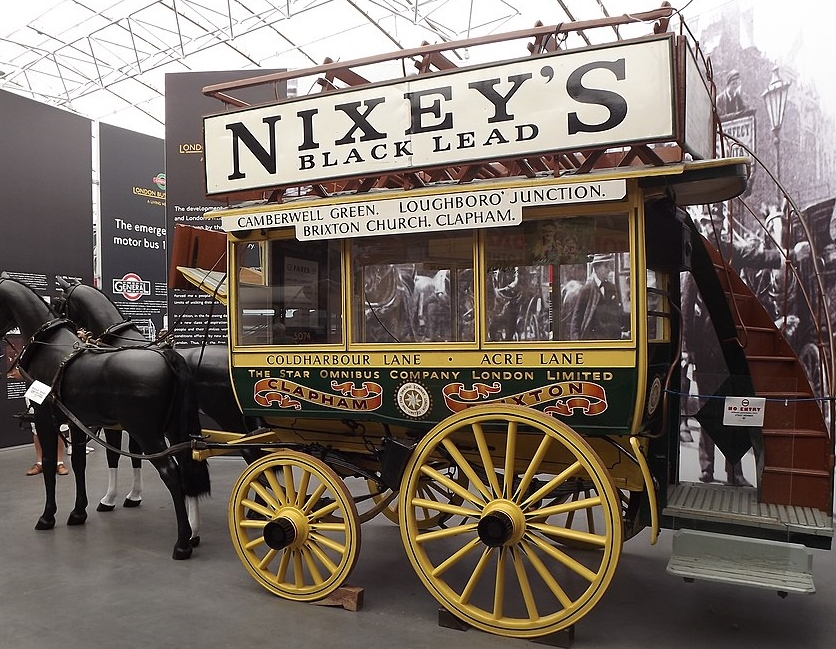
Fig. 1: Horse-Drawn Clapham Omnibus,
running from Camberwell Green to Clapham (1880s),
on display in London Bus Museum,
Cobham Hall, Brooklands Rd, Weybridge, Surrey.

In mid-March, I was delighted to give an illustrated talk to the Clapham Society. The packed audience kindly laughed at my jokes – and asked great questions. And the event was held in a venue, wittily named The Clapham Omnibus.1 Which set me wondering about the origins of naming ‘The Man on the Clapham Omnibus’ as the (fictional) embodiment of a ‘reasonable citizen’.

The phrase was first recorded in an English court of law in 1903; and, this formulation (with local variations) has remained current in the parlance of the Anglophone legal system. Its original wording was attributed to Charles Bowen, an erudite and witty Victorian judge.2

A person on the Clapham omnibus (these days we would include women as readily as men) would not be taken as a major leader of style and fashion. But, equally, such a person would not come ‘from the back of beyond’. The south London suburb of Clapham was manifestly not a key centre of either industry or international commerce. Yet it was no backwater. It was a hub of circulating news and information, being located on the Portsmouth Road (now classified as the A3 trunk road), running between the City of London and Portsmouth. And there were other main radial routs crossing through the parish, such as the Brighton Road (now the A24) – all taking goods and people into and out of town, along with news and information as a matter of course.

Would Charles Bowen have travelled on these south London routes? Undoubtedly yes. He made his legal career in London; but in 1872 he purchased a country residence named Colwood House – near to Cuckfield in the West Surrey hills – not far from the London to Brighton Road. Whether he actually rode on a Clapham omnibus (pictured above) remains unknown. But he must have traversed through Clapham many times.

And here’s a further thought. What had Clapham to do with the formation of public opinion? Nothing officially, of course. But in the early nineteenth century, the leading group of anti-slavery campaigners became renowned as the ‘Clapham Sect’ or (more sarcastically) as the ‘Clapham Saints’.3 Their media-savvy campaign was one major contributing factor (though not the only one) in changing British public opinion from indifference to support for anti-slavery.4  So the name of Clapham already had resonance. When Charles Bowen was coining a witty phrase to signify a reasonable citizen, aware of the issues of the day – even if not an expert – he could imagine that individual to be travelling on the Clapham omnibus with complete plausibility.

Amusingly enough, for a Battersea resident like myself, two leading figures in the ‘Clapham Sect’ actually lived in the neighbouring parish of Battersea. They were William Wilberforce, with a house on Broomwood Road,5 and his cousin, the banker Henry Thornton, resident on Battersea Rise.6 But the Battersea Society is not trying to rename these ardent campaigners as the ‘Battersea Sect’. They walked or drove a mile across Clapham Common to worship at the Holy Trinity Church, sited within the north-east corner of the Common, attracted by the evangelical preaching of its Anglican minister John Venn.7 Fittingly enough, therefore, the campaigners were, unofficially, named after the parish whose church acted as their initial focal point.

How much the resonance of that association influenced Charles Bowen remains unknown. Yet the result is that Clapham is famous both for the anti-slavery campaigners8 – and for the people on its omnibus. Good luck to them all!

ENDNOTES:

1 For the Omnibus Theatre, 1 Clapham Common Northside, SW4 0QW, see https://www.omnibus-clapham.org.

2 Charles Synge Christopher Bowen, Baron Bowen (1835-94) of Colwood (Sussex): see https://en.wikipedia.org/wiki/Charles_Bowen,_Baron_Bowen (viewed 31 March 2024); and an admiringly affectionate memoir by H.S. Cunningham, Lord Bowen: A Biographical Sketch … (London, 1897).

3 See E.E.F. Smith, Clapham Saints and Sinners (Extract from Clapham Antiquarian Society, 1987); M. Bryant, The Clapham Sect (Clapham Society, 2003); S. Tomkins, The Clapham Sect: How Wilberforce’s Circle Changed Britain (Oxford, 2010).

4 See discussion in B. Hilton, The Age of Atonement: The Influence of Evangelicalism on Social and Economic Thought, 1795-1865 (Oxford, 1988).

5 A plaque (affixed in 1906) today adorns the side of 111 Broomwood Road, at the junction with Wroughton Road (SW11), where Broomwood House, quondam residence of William Wilberforce, stood until 1904. For an overview of Wilberforce (1759-1833) and his impact, see W. Hague, William Wilberforce: The Life of the Great Anti-Slave Trade Campaigner (London 2007).

6 Henry Thornton (1760-1815) lived in a grand residence named Battersea Rise House (demolished 1907), on Battersea Rise, SW11, and was buried in St Paul’s Church, Clapham, as recorded by a commemorative plaque. For his life and times, see S. Meacham, Henry Thornton of Clapham, 1760-1815 (Cambridge, Mass., 1964).

7 For John Venn (1759-1813), who was actually himself born in Clapham, see M.M. Hannell, John Venn and the Clapham Sect (London, 1958); re-issued, 2003).

8 The campaigns continue to this day, as there are still globally millions of people living in slavery or neo-slavery, despite official United Nations prohibitions: for details and membership, see https://www.antislavery.org.

For further discussion, see

To read other discussion-points, please click here

To download Monthly Blog 160 please click here

MONTHLY BLOG 157, HOW THE GEORGIANS CELEBRATED MIDWINTER (*)

If citing, please kindly acknowledge copyright © Penelope J. Corfield (2024)

Variety was the spice of Midwinter festivities under the Georgians. There was no cultural pressure to conform to one standard format. Instead, people responded to diverse regional, religious and family traditions. And they added their own preferences too. Festivities thus ranged from drunken revelries to sober Puritan spiritual meditation, with all options in between.

It was the Victorians from the 1840s onwards – with the potent aid of Charles Dickens – who standardised Christmas as a midwinter family festivity. They featured Christmas trees, puddings, cards, presents, carol services, and ‘Father Christmas’. It’s a tradition that continues today, with some later additions. Thus, on Christmas Days in Britain since 1932, successive monarchs have recorded their seasonal greetings to the nation, by radio (and later TV).

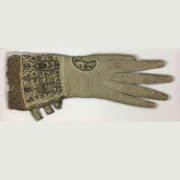
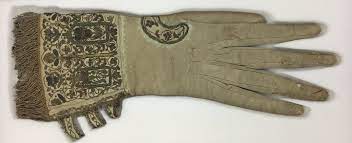
Georgian variety, meanwhile, was produced by a continuance of older traditions, alongside the advent of new ones. Gift-giving at Christmas had the Biblical sanction of the Three Wise Men, bringing to Bethlehem gifts of gold, frankincense and myrrh. So the Georgians substituted their own luxury items. An appreciated gift, among the wealthy, was a present of fine quality gloves. But, interestingly, that custom, which was well established by 1700, was already on the wane by 1800 as fashions in clothing changed. Embroidered gloves, made of lambskin, doeskin, or silk, were given to both men and women, as Christmas or New Year gifts. These luxury items may be said therefore to have symbolised the hand of friendship.

Fig.1: Add MS 78429, John Evelyn’s Doe-Skin Gloves,
17th century, British Library. Public domain.

The first illustration shows a fringed and embroidered glove once owned by the diarist John Evelyn. It was presented to him by the young Russian Tsar, Peter the Great. He had, during his semi-clandestine stay in England in 1698, resided in a property at Deptford, owned by Evelyn. The headstrong visitor caused considerable damage. So Peter’s farewell gift to Evelyn might be seen not so much as a mark of friendship but as something of a royal brush-off.

Presents can, after all, convey many messages. In the Georgian era, it was customary also for clients or junior officials to present gloves as Christmas or New Year gifts to their patrons or employers. The offering could be interpreted as thanks for past services rendered – or even as a bribe for future favours. That was especially the case if the gloves contained money, known in the early eighteenth century as ‘glove money’.

For example, the diarist Samuel Pepys, who worked for the Admiralty Board, had a pleasant surprise in 1664. A friendly contractor presented Pepys’ wife with gloves, which were found to contain within them forty pieces of gold. Pepys was overjoyed. (Today, by contrast, strict policies rightly regulate the reception of gifts or hospitality by civil servants and by MPs).

Meanwhile, individuals among the middling and lower classes in Georgian Britain did not usually give one another elaborate presents at Christmas. Not only did they lack funds, but the range of commercially available gifts and knick-knacks was then much smaller.

Instead, however, there was a flow of charitable giving from the wealthy to the ‘lower orders’. Churches made special Christmas collections for poor families. Many well-to-do heads of household gave financial gifts to their servants; as did employers to their workers. In order to add some grace to the transaction, such gifts of money were presented in boxes. Hence the Georgians named the day-after-Christmas as ‘Boxing Day’ (later decreed as a statutory holiday in 1871). Such activities provide a reminder that midwinter was – then as today – a prime time for thanking workers for past services rendered – as well as for general charitable giving.

Innovations were blended into older Midwinter traditions. Houses interiors in 1700 might well be festooned with old-style holly and ivy. By 1800, such decorations were still enjoyed. But, alongside, a new fashion was emerging. It was borrowed from German and Central European customs; and the best-known pioneer in Britain was George III’s Queen Charlotte of Mecklenburg-Strelitz. In 1800, she placed a small yew tree indoors and hung it with decorations. Later, a small fir was substituted, becoming the Victorians’ standard ‘Christmas Tree’, as it remains today.

Overlapping customs were, however, feted in the cheery Christmas carol, ‘Deck the Hall(s) with Boughs of Holly’. It was an ancient Welsh ballad, Nos Galan, habitually sung on New Year’s Day. Child singers were then treated by gifts of skewered apples, stuck with raisins. ‘Deck the Hall(s)’ was later given English lyrics in 1862 by a Scottish bard. And it’s still heartily sung – long after holly has lost its decorative primacy.

Many famous Christian hymns were also newly written in the Georgian era. They included: While Shepherds Watched … (1703); Hark! The Herald Angels Sing! (1739); and Adeste Fideles/ O Come All Ye Faithful (Latin verses 1751; English lyrics 1841). These all appeared in the 1833 publication of Christmas Carols, Ancient & Modern, edited by the antiquarian William Sandys/ He had recovered many of these songs from the oral tradition. Now they were all recorded in print for future generations.

Notably, a number of the so-called Christmas carols were entirely secular in their message. Deck the Hall(s) with Boughs of Holly explained gleefully: ’Tis the season to be jolly/ Fa la la la la la la la la. No mention of Christ.

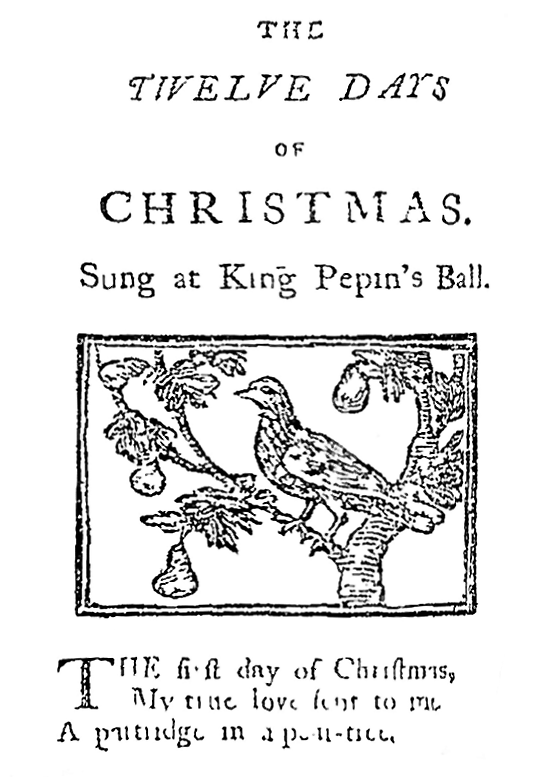
Similarly, the carol entitled The Twelve Days of Christmas (first published in London in 1780) records cumulative gifts from ‘my true love’ for the twelve-day festive period. They include ‘five gold rings; …  two turtle doves’ and a ‘partridge in a pear tree’. None are obviously Christian icons.

Fig.2: Anonymous (1780). Mirth without Mischief. London:
Printed by J. Davenport, George’s Court, for C. Sheppard, no. 8, Aylesbury Street, Clerkenwell.
pp. 5–16

And as for Santa Claus (first mentioned in English in the New York press, 1773), he was a secularised Northern European variant of Saint Nicholas, the patron saint of 26 December. But he had shed any spiritual role. Instead, he had become a plump ‘Father Christmas’, laughing merrily Ho! Ho! Ho! (Songs about his reindeers followed in the twentieth century).

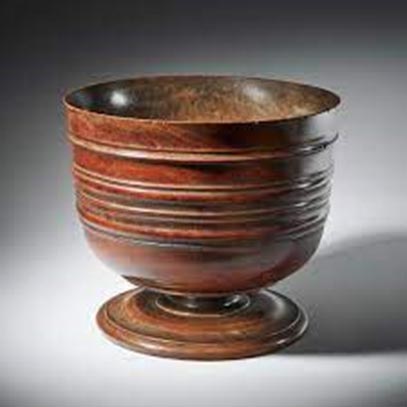
Given this utterly eclectic mix of influences, it was not surprising that more than a few upright Christians were shocked by the secular and bacchanalian aspects of these midwinter festivities. Puritans in particular had long sought to purify Christianity from what they saw as ‘Popish’ customs. And at Christmas, they battled also against excesses of drinking and debauchery, which seemed pagan and un-Christian. One example was the rural custom of ‘wassailing’. On twelfth night, communities marched to orchards, banging pots and pans to make a hullabaloo. They then drank together from a common ‘wassail’ cup. The ritual, which did have pagan roots, was intended to encourage the spirits to ensure a good harvest in the coming year. Whether the magic worked or not, much merriment ensued.

Fig.3: A Fine and Rare 17th Century Charles II Lignum Vitae
Wassail Bowl, Museum Grade – Height: 21.5 cm (8.47 in)   Diameter: 25 cm (9.85 in).
Sold by Alexander George, Antique Furniture Dealer, Faringdon, Oxfordshire:
https://alexandergeorgeantiques.com/17th-century-charles-ii-lignum-vitae-wassail-bowl-museum-grade/

For their opposition to such frolics, the Puritans were often labelled as ‘Kill-Joys’. But they strove sincerely to live sober, godly and upright lives. Moreover, there was no Biblical authority for licentious Christmas revelries. Such excesses were ‘an offence to others’ and, especially, a ‘great dishonour of God’. So declared a 1659 law in the Massachusetts Bay Colony, specifying penalties for engaging in such ‘superstitious’ festivities.

Zealous opposition to riotous Christmases was especially found among Nonconformist congregations such as the Presbyterians, Congregationalists, Baptists and Quakers. They treated 25 December, if it fell upon a weekday, just like any other day. People went soberly about their business. They fasted rather than feasted. Sober Christmases thus became customary in Presbyterian Scotland and in the Puritan colonies of New England. It was true that, over time, the strictest rules were relaxed. The Massachusetts ban was repealed in 1681 by a Royalist Governor of the colony. But ardent Puritans long distrusted all forms of ‘pagan’ Christmas excess.

One consequence was that people sought other outlets for midwinter revelry. A great example is Scotland’s joyous celebration of New Year’s Eve or Hogmanay. (The name’s origin is obscure). One ancient custom, known as ‘first footing’, declares that the first stranger to enter a house after midnight (or in the daytime on New Year’s Day) will be a harbinger of good or bad luck for the following year. An ideal guest would be a ‘tall dark stranger’, bearing a small symbolic gift for the household – such as salt, food, a lump of coal, or whisky. General festivities then ensue.

All these options allowed people to enjoy the ‘festive season’, whether for religious dedication – or to celebrate communally the midwinter and the hope of spring to come – or for a mixture of many motives.

No doubt, some Georgians then disliked the fuss. (Just as today, a persistent minority records a positive ‘hatred’ of Christmas). All these critics could share the words of Ebenezer Scrooge – the miser memorably evoked by Dickens in A Christmas Carol (1843). Scrooge’s verdict was: ‘Bah! Humbug!

Yet many more give the salute: ‘Merry Christmas!’ Or on New Year’s Eve (but not before) ‘Happy Hogmanay!’ And, as for Scrooge: at the novel’s finale, he mellows and finally learns to love all his fellow humans. Ho! Ho! Ho!

ENDNOTES:

(*) First published in Yale University Press BLOG, December 2023: https://yalebooksblog.co.uk/2023/12/08/how-the-georgians-celebrated-christmas-by-penelope-j-corfield/

For further discussion, see

To read other discussion-points, please click here

To download Monthly Blog 157 please click here

MONTHLY BLOG 151, Reflections upon Roaming in Rome, after a Return Visit to The City

If citing, please kindly acknowledge copyright © Penelope J. Corfield (2023)

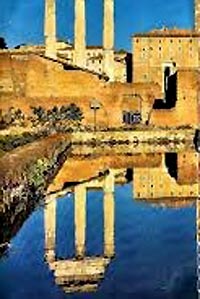
Reflected Images of Classical Rome –
in the Classical Forum (2023)

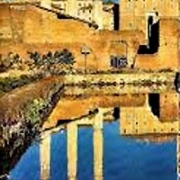
Rome is a matchless city for reflective walkers.1 Ok – best to choose a time of year when the heat is not too intense. And essential not to be in a hurry. But for those who like to stroll, to take in the views, and to reflect upon the workings of time, Rome is matchless.

Superb buildings of all eras are juxtaposed. Some are grand and justly famous. Other beautiful edifices remain relatively unknown, although elsewhere they would be celebrated tourist attractions in their own right. Everywhere there are new vistas to admire; new angles to explore.

Some areas are very crowded – try the zippy evening atmosphere of Trastevere, situated just across the river from the old centre – but there are also high places that offer peaceful panoramas of the cityscape as a whole.

Famously, the city was built upon the ‘seven hills’ of Rome, clustered together in a big bend of the River Tiber. In reality, however, there are more than seven vantage points, as other hills form an irregular wider ring around the centre. My personal favourite is the Gianicolo Hill (the Roman Janiculum). It is situated behind Trastevere, to the west of the old centre. It is not too crowded with visitors. And the views from the top are stunning – try checking the scene from the hilltop piazza with a huge bronze equestrian statue of Giuseppe Garibaldi.

Monuments in Rome are both secular and religious, offering reminders of its past role as an imperial capital – and its continuing role as the headquarters of an international faith, Indeed, the Vatican City was granted jurisdictional autonomy in 1870, when the previous Paper Sates were absorbed into the newly united Kingdom of Italy. Walkers through the Roman streets are thus reminded everywhere of the power that spiritual beliefs can generate.

And, to underline the point, Rome is awash with churches. My personal favourite is the Santa Maria d’Aracoeli. It is one of the oldest Christian churches in the city – and it was pointedly sited on top of the Capitoline Hill, at the physical heart of the Roman Empire. Moreover, the Romanesque edifice features columns that were scavenged from nearby imperial ruins. It was here in 1764, whilst listening to monks chanting in this church, and simultaneously gazing at the surrounding ruins of the once-mighty imperial capital, that the English historian Edward Gibbon first conceived his plan of writing an in-depth analysis of The Decline and Fall of the Roman Empire (1776).2

Yet the twists and turns of fortune remain unending. Between 1885 and 1935, successive Italian governments supported a further massive new construction adjacent to the same Capitoline Hill. It is named the Monument to Victor Emmanuel II (the first king of united Italy) – also known as the Vittoriano – and sometimes – irreverently – as the ‘wedding cake’. This eye-catching edifice, with its grand flights of stairs, colonnades, and statues, dominates the site and skyline as a secular neo-classical tribute to celebrate Italian Unification. The king himself is not buried here. Instead, the building contains the tomb of Italy’s ‘unknown soldier’.

But what has happened to the old church? It is still there but not easily visible. It’s set back, tucked up and behind the west flank of the Vittoriano. Walkers have to go round the Vittoriano to find a long flight of steps and then climb up to visit the unadvertised church in its historic glory. So historians can now ponder the fluctuating fortunes of townscapes and monuments, as well as those of empires, kingdoms, and religions.

Lastly, walkers in Rome must keep their eyes open. The pavements are irregular and often narrow. They may give way to uneven steps. Stone pathways can be slippery. Tourist crowds can jostle. Traffic is unpredictable. Yet everywhere there are fountains by which to linger – and bars selling fine Italian ice-cream. My favourite place for an evening drink is the Piazza Navona. Its Baroque splendour is superimposed upon the unchanged layout of the sporting stadium built for the Roman Emperor Domitian. Another great monument to time and change! ‘Eternal’ Rome survives by constant updating: not to stay the same; nor to shed the past; but to stay both historic and alive.

ENDNOTES:

1 See the classic account by Stendhal (1783-1842), Promenades dans Rome (Paris, 1829), available in English as A Roman Journal, ed. and transl. by H. Chevalier (London, 1959). And for a contemporary guide, see J. Fort and R. Piercey, Rome Walks (London, 2011).

2 For E. Gibbon (1737-94), author of The History of the Decline and Fall of the Roman Empire, 6 volumes (1776-88), see C. Roberts, Edward Gibbon and the Shape of History (Oxford, 2014); plus K. O’Brien and B. Young (eds), The Cambridge Companion to Edward Gibbon (Cambridge, 2018).

For further discussion, see

To read other discussion-points, please click here

To download Monthly Blog 151 please click here

MONTHLY BLOG 150, Tribute to the Gracious International City of Geneva – Historic Home of Three Hegemonc Radical Thinkers – and, Additionally, Thronged with Sparrows

If citing, please kindly acknowledge copyright © Penelope J. Corfield (2023)

Image1 Male House Sparrow in Fine Voice (2023)

Image1 Male House Sparrow
in Fine Voice (2023)

Reflections upon Geneva, prompted by a recent visit (late May 2023): Geneva is a gracious city, situated at the point where the River Rhône rushes headlong out of Lake Geneva en route for its journey to the Mediterranean. The city is full of trees, and the trees are full of sparrows. Their non-stop cheeping, from dawn to dusk, provides an engagingly cheery urban sound-track. It’s almost enough to make visitors forget the eye-wateringly high prices for everything.1 (So costly is this city that many thousands of its work-force live in nearby France and commute to Geneva daily).

Having ruefully noted that point, there is much to celebrate in a city famed for many things – one being its role as the home of three rebellious and controversial Francophone thinkers, whose ideas remain influential to this day.

One was John Calvin (1509-64), born in northern France. In his lifetime, he had a tumultuous relationship with the city. Yet their names are indelibly linked.2 Geneva was the heartland of the radical Protestant movement, known as Calvinism or Presbyterianism. And the Geneva Bible (translated into brisk English in 1560 by William Whittingham and other Calvinist scholars) had major impact across the English-speaking world. In keeping with the Calvinist lack of flamboyance, there are no great physical monuments to Calvin in today’s multi-cultural Geneva.3 Nonetheless, religious legacies are potent. Hence, in the words of one friend who lives locally, ‘In Geneva today, Calvin is everywhere’. Hard to prove – or to disprove. Yet Geneva is undeniably a ‘serious’ city..

Very different in character and intellect was a second great French thinker who moved to Geneva. He was François-Marie Arouet, known universally by his pen-name Voltaire (1694-1778). Born in Paris, he was a prolific controversialist, philosopher, historian, and all-round man of letters. As a fierce advocate for civil liberties and pungent critic of religious intolerance, Voltaire was not an easy ‘subject’ for absolute monarchs to stomach.

So when, in 1754, he was banned by Louis XV of France, Voltaire moved across the border into republican Geneva. There he purchased a fine city mansion, Les Délices. And, since his relationship with the city government was not always easy, Voltaire also established a grand country abode just outside Geneva at Ferney. From this dual base, he flourished as a celebrity intellectual.4 And that international role is celebrated today by the city of Geneva, which maintains the Institut et Musée Voltaire. And this body is housed in the mansion Les Délices itself.5 So visitors can enjoy its impressive library and memorabilia at the very spot where the great thinker planted his banner of intellectual independence. Voltaire chose Geneva and the city today reciprocates the choice.

The third radical thinker, meanwhile, was Jean-Jacques Rousseau (1712-78), the Genevan-born son of a ‘middling-sort’ watch-maker. The young Rousseau had a troubled childhood and, later, spent long periods away from the city. Nonetheless, he often signed his writings as a ‘Citizen of Geneva’. And he won fame as an original educationalist and democratic theorist.6 Among other things, he held that all religions were equally valid if they taught people to live morally as good citizens – a view that outraged Calvinist and Catholic ministers alike – and caused Rousseau’s books to be banned in his native Geneva. At that point, Voltaire offered Rousseau his chateau at Ferney as a refuge (their own intellectual disagreements notwithstanding). But the reply was negative.

Instead, Rousseau embraced a wandering life, in which he often fell out with former friends. He saw himself as a ‘solitary walker’, though his reputation and influence continued to grow. Indeed, in 1794 – sixteen years after his death – Rousseau’s remains were re-interred in the Pantheon at Paris. Revolutionary France thus saluted him posthumously as a prophet of democracy. Geneva meanwhile has a fine statue to Rousseau (installed 1835) on an islet in Lake Geneva. Some city streets are also named after his most famous works. And the Musée Rousseau et Littérature (located in his birth-place in the old city) offers an immersive tour.7 Geneva has long welcomed back its wandering son.

None of these three original thinkers, however, had an easy relationship with the city authorities. All three were too independent to be easily assimilated – and too strong-minded to be intimidated. Collectively, they indicated the power of untrammelled communication: Calvin teaching from the pulpit; Voltaire and Rousseau via print – that modern free-range pulpit – which they used with great versatility.

Geneva’s open society and governance greatly aided all three. The city was then – as it remains – an international communications hub, not subject to close censorship by an autocratic ruler nor to close identification with any one great power. It was a logical venue, later on, for the global headquarters of the new League of Nations (1920-46). Today Geneva continues to flourish, hosting many international enterprises and simultaneously safeguarding its great history but without fussing or fawning. And the cheery sparrows chirp ceaselessly …

ENDNOTES: 

1 But one very helpful feature for visitors, who are booked into approved Genevan hotels, is the free Transport Card, issued by the City of Geneva, which is valid on all buses, trams, and shuttle-boats within the city canton.

2 See R.M. Kingdom, Reforming Geneva: Discipline, Faith and Anger in Calvin’s Geneva (Geneva, 2012); K. Maag, Lifting Hearts to the Lord: Worship with John Calvin in Sixteenth-Century Geneva (Grand Rapids, Mich., 2016).

3 But a statue of Calvin does feature on the ‘Reformation Wall’ (Monument International de la Réformation), located in the grounds of Geneva University. It was constructed in 1906, to commemorate the 400th anniversary of Calvin’s birth and the 350th anniversary of the University’s foundation by Calvin: see en.wikipedia.org/wiki/Reformation_Wall.

4 For context, see R. Pearson, Voltaire Almighty: A Life in Pursuit of Freedom (New York, 2005); and I. Davidson, Voltaire: A Life (London 2010).

5 F. Borda d’Agua and F. Jacob, A Short History of Les Délices: From the Property of St Jean to the Institut et Musée Voltaire (Geneva, 2013).

6 H. Rosenblatt, Rousseau and Geneva: From the First Discourse to the Social Contract, 1749-62 (Cambridge, 1997); L. Damrosch, Jean-Jacques Rousseau: Restless Genius (Boston, Mass., 2005); L.D. Cooper, Dreaming of Justice, Waking to Wisdom: Rousseau’s Philosophic Life (Chicago, 2023).

7 See https://www.geneve.com/en/attractions/maison-rousseau-et-litterature-mrl.

For further discussion, see

To read other discussion-points, please click here

To download Monthly Blog 150 please click here

MONTHLY BLOG 149, Tracking Down The Fugitive History of the Body Louse

If citing, please kindly acknowledge copyright © Penelope J. Corfield (2023)

Image1 Human Body Louse
© Fine Art America 2023

Eighteenth-century Britons knew all about body lice. But – the subject was rarely mentioned. It was not just polite company that avoided any reference; but people in the wider society too. Body lice – those tiny human parasites – were well known as itchy, infernal nuisances. But they were also seen as shameful, which kept people silent on the subject.

One polite eighteenth-century euphemism for a scurrying louse was a ‘little brown gentleman’. Plainer terms that have evolved over time include ‘bugs’; and ‘crabs’ (for public lice); or catchy alliterations like ‘crotch crickets’ and ‘labia lobsters’.1

In fact, body lice commonly lurk in clothing and bedding, where they lay their eggs; and they crawl on human skin chiefly to feast upon human blood. However, lice not only leave a legacy of intense itching, which can in some people generate allergic reactions of deep lethargy and fatigue, but body lice are also carriers of numerous unpleasant fevers, including typhus.2
Scotland’s great bard, Robert Burns, was highly unusual in writing a poem To a Louse (1786).3 Yet he was entirely conventional in heaping abuse on the offending creature, which he glimpsed on a lady’s bonnet, at church.

Ye ugly, creepin’, blastit wonner [wonder],
Detested, shunn’d, by saunt an’ sinner!

And Burns’ poem concluded wryly that the lady’s fine apparel and glossy self-presentation in church was completely negated by the sight of the small creeping louse. Causing him to exclaim, famously:

O wad some Pow’r the giftie gie us
To see oursels as others see us!

Unfortunately for social historians, however, it’s rare to find documentation about how people actually coped with the nuisance of body lice. It was one of those things that was collectively known, but hardly ever put down in writing.

An oblique account does survive in the autobiography of Elizabeth Ham, a Somerset yeoman’s daughter, who later became a governess and author. She recollected a painful episode from her childhood in the 1780s. After scratching herself repeatedly, she instantly sent home, where she was abruptly isolated for several ‘comfortless’ days. She was treated with sulphur, while all her clothes and bedding were burned. It all amounted to a ‘purgatory for purification’, she wrote wryly.4 And, interestingly, while this domestic upheaval was clearly designed to rout an infestation of body lice, Ham herself did not name the offending creatures. Thus her short account – one of very few – remained cautious, almost superstitious, in its unwillingness to mention lice specifically.

That social shame is interesting in itself, for historians. But it makes it difficult to track variations in the day-to-day prevalence of body lice, as well as to understand variations in human responses (if any).

Genetic studies suggest that the body louse – pediculus humanus corporis – may have originated even before homo sapiens had evolved as a distinct branch of the Great Apes. Yet, once humans had become numerous – and especially once they invented clothing for regular use – there was immediately a happy partnership (from the louse viewpoint).5 Thereafter, the two species have co-evolved together – and co-migrated together all over the globe – the success of the body louse being limited only by regular counter-attacks by humans.

Historians are deeply grateful for such scientific insights, especially in the absence of other records. It is likely that the prevalence of body lice was widespread throughout history, being greater in those societies that did not encourage regular bathing, and much lesser in those that did. Furthermore, with the industrial production of soap – and the mass manufacture of readily washable cotton clothing from the later eighteenth century onwards – the assumption became more commonplace, that people should not normally be afflicted by these parasites. In those circumstances, people became more willing to allow strangers close to them – for example, when shaking hands.6

Yet, as Elizabeth Ham and her family discovered, there were sufficient numbers of lice, lurking in bedding and clothing, that infestation was always a possibility. In which case, the family swung immediately into action to counter-attack. They were shocked at the news – but they knew what to do – although, in Ham’s case, the family seem to have prioritised draconian action rather than reassurance for the disconcerted child.

So today lice infestation remains a known problem, with known remedies. The topic remains one that is shrouded in semi-secrecy. But, equally, some general propositions are clear. Body lice are commonly found in places where humans live in poverty and in crowded, insanitary conditions, without the chance to wash and/or to change their clothing regularly. Furthermore, heightened outbreaks can spread rapidly in times of crisis, such as in hastily assembled refugee camps, or among people surviving precariously in the aftermath of natural disasters, when normal sanitation is disrupted.

Biology has established a long-standing association between body lice and humans. It is a ‘natural’ relationship. However, it is clear that humans don’t love every manifestation of untrammelled nature.7 They don’t reciprocate the body louse’s deep and instinctive attachment. Will humans one day eliminate entirely their clinging but unloved friends? It is a logical possibility. Humans can live happily without body lice, whilst they depend entirely upon their human ‘hosts’. (Adult lice cannot live for more than 2-3 days without ingesting human blood). So the louse is vulnerable. But its final demise is, alas, not yet imminent.

1 Another variant parasite is the head louse which infests human scalps and has eggs known as ‘nits’. For distinctions between the various forms of lice that infest humans, see https://en.wikipedia.org/wiki/Body_louse.

2 As first noted in the classic study by H. Zinsser, Rats, Lice and History (Boston, 1935), pp. 167-70.

3 R. Burns, The Collected Poems, with Introduction by T. Burke (Ware, Herts., 2008), pp. 138-9.

4 E. Gillett (ed.), Elizabeth Ham by Herself, 1783-1820 (London, 1945), p. 33.

5 R. Kittler, M. Kayser and M. Stoneking, ‘Molecular Evolution of Pediculus Humanus and the Origin of Clothing’, Current Biology, 19:13 (2003), pp. 1414-17: doi: 10.1016/s0960-9822(03)00507-4.

6 See current research in progress.

7 A personal disclosure: in my student days, when travelling the world cheaply and staying in doss-houses, I woke one morning to find myself itching unbearably. I then attributed the condition to ‘bed bugs’. Eventually, the itching ceased after much washing and sea-bathing, followed by moving to new accommodation. However, I can record that I have been personally attacked (once!) by body lice – and, gentle readers, it was not fun.

For further discussion, see

To read other discussion-points, please click here

To download Monthly Blog 149 please click here

MONTHLY BLOG 148, Tracking down Eighteenth-Century Optimists and Pessimists in order to write The Georgians

If citing, please kindly acknowledge copyright © Penelope J. Corfield (2023) 

Image 1 Laughter, being detail from Hogarth’s Laughing Audience (1733);
and Image 2 Tears, being early C19 cartoon in Getty Images 1179326076

This BLOG is also published on Yale University Press website:

https://yalebooksblog.co.uk/2023/03/23/eighteenth-century-optimists-and-pessimists/

Many people have asked, since the publication of my book on The Georgians1 , why I note on the dust-cover that I am an optimist. There is a reason (apart from the fact that it’s true). But to explain, I need to take a step back. So please bear with me while I tell you first about how I decided to introduce my cast of eighteenth-century Britons.

While studying this fascinating and formative period of history, I long pondered how to start my book. In fact, I begin by defining my operative dates and my choice of book title. Then I quickly outline where the Georgian Britons lived – and in what numbers. But what then? I did not want to proceed with well-known stories about great men or great battles or great inventions – though all those things do come into the analysis at suitable points.

So I decided to provide a cultural overview of what people in the eighteenth century thought of their own era. Obviously, the surviving evidence came chiefly from the literate, who were able to record their views – although I also take note of popular songs and sayings. But I searched widely among the less well known and the completely unknown, as well as among the famous. It was the equivalent of tapping into Georgian journalism, both reflecting and trying to influence contemporary attitudes.

And the method that I used was to collect all the eighteenth-century statements that I could find, which took the form of a dictum: ‘It is an age of xxx’ (a common formulation) or a ‘century of xxx’. All these commentaries had to be made in the moment and of the moment. I was not interested (for this purpose) in people’s retrospective verdicts. But I wanted to know what they thought at the time – without any fore-knowledge of the outcome.

It took me years to amass a collection; but there was great fun in the search, as I looked into eighteenth-century novels, plays, poems, letters, diaries, guide-books, journalism, sermons, songs, sayings, and so forth. Usually, the quest was carried on alongside my ‘normal’ research. And it had the very good effect that I always kept my eyes open and was never bored.

Eventually, I had amassed over 700 ‘ages’, from contemporary observers from the mid-seventeenth century up until the present day (2023). Several hundred of them came from Georgian Britons. I then set myself, without any pre-set assumptions, to review and classify them.

A fairly sizable group defined the times in terms of material goods. And that category became more and more notable in the course of the later nineteenth and twentieth centuries. Thus it’s no surprise to find people writing about ‘a telegraph age’ (1868); ‘the age of television’ (1958); ‘the computer age’ (1963); ‘the age of electronic messages (1990); and so forth. (Note that these claims indicate when innovations were noted, not literally their first invention).

Were there equivalents in the eighteenth century? Yes, there were. Thus an onlooker defined the era in 1736 ‘an age of Equipage’2 – the smart term for a coach and a team of horses; or in 1756 as ‘this age of Vauxhalls and Ranelaghs’,3 referring to the new vogue for attending public pleasure gardens.

But much the largest category throughout the collection was the one I classified as ‘mood’. Some of the most frequently repeated claims were those expressing doubt: as in ‘an age of uncertainty’; ‘an age of anxiety’; ‘worrying times’. One British commentator in 1800 was completely woeful: ‘Never was the world in so calamitous or so perilous a state as at this moment’.4 (Hard not to laugh; but it was written in all seriousness).

Other onlookers, meanwhile, were full of hope, detecting ‘light’; ‘improvement’; even ‘an age in which knowledge is rapidly approaching towards perfection’. (The last quotation came from the philosopher Jeremy Bentham in 1776, when in euphoric vein).5

Reviewing the gamut of ‘mood music’, it was clear that there was a systematic division between optimism and pessimism. Furthermore, while pessimists always remained vocal, the cultural predominance in Georgian Britain was increasingly tilting in favour of optimism. Eighteenth-century identifications of ‘progress’ in particular fields were becoming welded into the nineteenth-century cliché: ‘an age of progress’. One popular song, circulating in 1830, was full of excited anticipation about the march of inventions. It imagined that people could peep into the future, and the chorus urged:6

Open your eyes, and gaze with surprise
On the wonders, the wonders to come!

Details of these contrasting attitudes are explored in Georgian Britain, ch. 3 ‘Voices of Gloom’ (pp. 41-55); and ch. 4 ‘Voices of Optimism’ (pp. 56-70). The classification refers to viewpoints – not necessarily to individuals throughout a lifetime. Some people’s moods veered frequently. Yet these powerful and rival attitudes vividly introduced the adventurous times through which Britons were living – during an unprecedented era of exploration, spreading literacy, applied inventions, parliamentary rule, popular riots, religious pluralism, sexual frankness and experimentation, colonial acquisition, urban and commercial growth, rising global power – and participation in the contentious trade in enslaved Africans. (For more on all these themes, see within The Georgians).

Finally, having outed countless optimists and pessimists (and a few waverers in between),7 I thought that I should out myself as well. In fact, I am not a Panglossian – unlike the character in Voltaire’s Candide (1759), who believes that ‘All is for the best in the best of all possible worlds’. Yet I am psychologically with the growing Georgian mainstream. Let’s innovate for improvement; but, if generating errors (plenty of those in the ei ghteenth century, as the book explains), then let’s speedily reform. And, above all, let’s live with hope. A great motto in itself – and a crucial one for authors!

1 See P.J. Corfield, The Georgians: The Deeds & Misdeeds of Eighteenth-Century Britain (Yale UP, 2022; paperback 2023); and for associated website, entitled Georgian Witnesses, see: www.thegeorgiansdeedsandmisdeeds.com

2 Anon. [E. Jones], Luxury, Pride and Vanity, the Bane of the British Nation (London, 1736), p. 7.

3 J. Buncle [T. Amory], The Life of John Buncle, Esq: Containing Various Observations and Reflections … (London, 1756), Vol. I, p. 460.

4 J. Bowles, Reflections on the Political and Moral State of Society … (London, 1800), p. 128.

5 J. Bentham, A Fragment on Government (London, 1776): preface, opening sentence.

6 Song by W.H. Freeman, Three Hundred Years to Come (c.1835): see https://musescore.com/song/three_hundred_years_to_come_a_comic_song-2326061. One cheerful forecast was that future earthlings would be able to hitch a lift on a passing balloon to attend a party on the moon … Well, not yet!

7 For the debates, see variously T. Harries, The Rule of Optimism (London, 2022); E.C. Gordon, Human Enhancement and Well-Being: The Case for Optimism (London, 2022); but compare with R. Scruton, The Uses of Pessimism and the Dangers of False Hope (London, 2010); and M. van der Lugt, Dark Matters: Pessimism and the Problem of Suffering (Princeton, NJ., 2021).

For further discussion, see

To read other discussion-points, please click here

To download Monthly Blog 148 please click here