
Tag Archive for: inspiration

MONTHLY BLOG 180, TIME & INSPIRATION

If citing, please kindly acknowledge copyright © Penelope J. Corfield (2025)
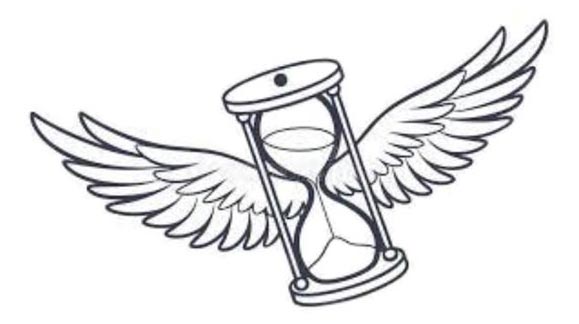
Fig.1. Time Flies, illustrated by Hour-Glass with Wings,
vector design Generative AI:

© Dreamtime 2025

The relentless passage of Time is at once a threat and an inspiration.1 Of course, in one way, it’s menacing: Time flies! Time, once lost, cannot be retrieved! Time travels onwards and does not come back!

Yet that very fact can also provide an inspiration. As Abraham Lincoln once remarked: In the end, it’s not the years in your life that count – it’s the life in your years’. Time is a finite resource; and therefore is best not squandered.

Charles Darwin expressed that very thought rather sternly, as befits an earnest Victorian: ‘A man who dares to waste one hour of Time, has not discovered the value of life’.

Or as the lyrics of Pink Floyd’s song on Time (1973), written by bass-guitarist Roger Waters, wryly noted:

‘Ticking away the moments that make up a dull day,
You fritter and waste the hours in an off-hand way. …
And then, one day, you find ten years have got behind you,
No-one told you when to run – you missed the starting gun.

It’s necessary, therefore, to accept the brute fact that Time moves ever onwards. However much people may wish to ‘call back yesterday, bid Time return’, as one character in Shakespeare’s Richard II eloquently declaims,2 they cannot.

So the ever-moving passage of Time poses a bonny challenge. Optimists like the American essayist, Ralph Waldo Emerson, gave those prone to gloom some uplifting advice: ‘Write it on your heart that every day is the best day in the year’. And Benjamin Franklin was somewhat less exuberant but equally emphatic, as he warned that: ‘You may delay, but Time will not’. In other words, use Time, don’t waste it.

On the positive side, too, there’s a potential learning curve. Thus the eighteenth-century poet and moralist, Alexander Pope, observed sagely that: ‘No one should be ashamed to admit he is wrong, which is but saying, in other words, that he is wiser today than he was yesterday.’

Thus humans can look back at the past, not just with emotions that range from nostalgia to horror, but also to learn. And it’s essential that we do. The past – or rather the human study of the past – has generated a massive stock of information and expertise. Some things, it is true, are learned in the immediate moment. But we cannot learn from the future that has not yet happened.

Evidence, analysis, expertise and inspiration – surviving from the past, and tempered by perceptions and evaluations today – together provide the operating stock of knowledge that is needed for living successfully in Time.3 Without such a resource, humanity would face the same troubles that afflict individuals who have lost all memories and cannot function unaided. So the point is not just: don’t waste Time! But, crucially: learn from it! That wise advice was given by the world’s most renowned expert on temporal challenges, Albert Einstein. He urged: ‘Learn from yesterday, live for today, hope for tomorrow’. Action stations for us all! Learn and live! Proverbially: There’s no Time like the present!

ENDNOTES:

1 This BLOG concludes PJC’s year of Time-BLOGS (2025). For more, see too P.J. Corfield, Time and the Shape of History (2007); and idem, Time-Space: We Are All in it Together (2025).

2 Earl of Salisbury in Shakespeare’s Richard II (written c.1595/6; first pub. 1597), Act 3. sc.2.

3 For the multifarious debates on these complex issues, see C. Callender (ed.), The Oxford Handbook of Philosophy of Time (2011).

For further discussion, see

To read other discussion-points, please click here

To download Monthly Blog 180 please click here

MONTHLY BLOG 111, THREE RULES FOR WRITING A REGULAR BLOG

If citing, please kindly acknowledge copyright © Penelope J. Corfield (2020)


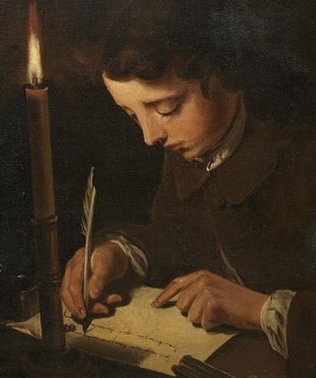
Fig.1 After Henry Robert Morland,
Writing by Candlelight (mid-C18)

Firstly and inevitably: have something to say.1 No point in writing just to fill the blank page. And, more particularly, decide on the topic at least two or three days in advance. That system gives a good chance to mull over ideas, phrases, and half sentences, in quiet moments well before writing. (Such cogitations are good subjects to think about while on a long, non-taxing walk, or while swimming up and down in a quiet pool). Lateral thinking and inventiveness is a great prelude to the sequential progression of writing. And the more that ideas have been mulled over beforehand, the easier the writing becomes. It flows as if from inner dictation. A good style should then be conversational, not didactic.

Secondly: dedicate a quiet place and a good slab of unbroken time for the actual writing process. Ban emails, regular mail, phone-calls, texts, real-life visits, and all other distractions for the duration. Press right on to the end. In the event of any necessary stoppage to check sources or for any other reason, keep the break as short as possible – and don’t use it as an excuse to divert into another task, no matter how urgent. Remember the story of Coleridge in 1797, when he had written 54 lines of his enigmatic poem Kubla Khan. He was disrupted by ‘a person on business from Porlock’. When the visitor departed an hour later, Coleridge found, to his mortification, that the muse had left him.2 The poem remained A Vision in a Dream: A Fragment. Whether it would or would not have been an even greater work if twice the length, and/or whether the ‘person’ was a real visitor or a proxy in Coleridge’s mind for his inability to complete, does not matter. ‘Porlock’ is the codeword for an untimely break in literary concentration. So take care to avoid being Porlocked, while in creative flow. (Writing longer works, which cannot be completed in one session, requires a different strategy. Yet the same principle applies: learn to concentrate. It’s a great ability to acquire, in this era of multiple electronic distractions.)

Thirdly: embed the writing in its context, with footnotes or short references in brackets, if appropriate. The point is not to make a show of learning; or, even less, to bore impatient readers. Nonetheless, it’s helpful for them to know when authors are relying on their own invention and when they are using sources or citing information which can be corroborated. (It’s especially important, when fake news and information are proliferating, to know that authors have not simply made up the evidence that they are quoting in support of their case). In other words, citations supply intellectual scaffolding for original thoughts. New insights build upon the existing stocks of knowledge. Retrospectively, indeed literary detectives can unpick the background building blocks of even the most off-the-wall creative works: John Livingston Lowes did just that in inspired style when sleuthing the origins of Coleridge’s Kubla Khan.3 Writers of BLOGs are considerably more earthbound than was Coleridge. But all are using words to communicate. All with a mixture of originality and authenticated information. Then end with a ‘snappy dictum’, such as the following (ten words): Regular BLOGS need uninterrupted time to fuse inspiration and information.  

ENDNOTES:

1 Please note that there are plenty of web-BLOGPOSTS on this very theme.

2 As recounted by Coleridge in Preface to 1816 edition of his poems: see E.H. Coleridge (ed.), The Poems of Samuel Taylor Coleridge (1912; in 1964 reprint), p. 296.

3 J.L. Lowes, The Road to Xanadu: A Study in the Ways of Imagination (1927; and many later edns).

For further discussion, see

To read other discussion-points, please click here

To download Monthly Blog 111 please click here