Penelope J Corfield
  • HOME
    • Index to Blogs
    • Monthly Blogs
    • CONTACT
    • Key to Dancing Dates Film
  • CURRENT
    • President International Association C18 Studies
    • Lectures on offer
    • London University’s Long C18 History Seminar
    • Living in Battersea
    • Career at a Glance
    • PJC Publications
  • BRITISH HISTORY
    • Long C18 Overviews
    • Society & Culture
    • Town Life
    • Electoral History
    • Radical Poets
    • The Professions
    • Religion & Irreligion
  • GLOBAL
    • Urban History Through Time
    • C18 European History Overviews
    • Gender History
    • ‘Racial’ Classifications as Pseudo-Science
    • Responding to Climate Change
    • Advance of the International Sphere
  • TIME & HISTORY
    • Time & The Shape of History (2007)
    • Rethinking Historical Periodisation
    • Dimensions of The Long Term
    • Returning to Big History
  • HISTORY-MAKING
    • Why History Matters
    • History of History
    • Fellow Historians
    • Arts of Academic Assessment
    • Pleasures of Intellectual Life
  • REVIEWS
    • History Book Reviews
      • Social History
      • Approaches to History
      • Big History
    • Theatre Reviews
    • Civic/Political Commentaries
    • Personal Portraits
  • Menu Menu

Tag Archive for: John Wesley

MONTHLY BLOG 47, WOMEN AND PUBLIC SPEAKING – AND WHY IT HAS TAKEN SO LONG TO GET THERE

1 November 2014/in History, Monthly Blog/by Penelope J. Corfield

If citing, please kindly acknowledge copyright © Penelope J. Corfield (2014)

 It really wasn’t done – for centuries. Women, respectable women especially, did not speak in public from public platforms. They do sometimes, anachronistically, in period films. So the script-writer of The Duchess (dir: Sam Dibb, 2008) decided that the famous eighteenth-century Duchess of Devonshire (played by Keira Knightley) should indicate her political commitment to the Whig reform cause by speaking at the public hustings for the 1784 Westminster election.

But the scene is a flat pancake. That’s no doubt partly because it never happened, giving the script-writer no historical documentation from which to work. The film is good at revealing the extent to which, as an aristocratic woman in the public eye, the Duchess is constrained by her social position. And then suddenly, she appears on a public balcony in her furs and feathers, delivering an impassioned election speech in favour of democracy to the London masses. There’s no sensation. No shock. There’s not even an angry husband, ordering her to desist. [See Fig.1a]

However, the script-writer knows, from evidence discussed in other scenes, that the Duchess was heavily satirised for her political affiliations. In 1784 she undertook the much milder action of canvassing in the Westminster constituency. She was young, charming, rich, high-ranking and a leader of fashion. Yet even she could not get away with it. She was socially pilloried in graphic prints which accused her of lewdly selling kisses to brutish plebeians for votes (see Fig.1b). Not only did the Duchess never venture publicly into politics again, but nor did other high-born ladies. They stuck to behind-the-scenes roles as political hostesses – not without influence, but not in the censorious public eye.

Fig.1a (L) The Duchess of Devonshire as imagined (2008) on the Westminster hustings Fig.1b (R) The Duchess as satirised in 1784 for canvassing the Westminster electors, in a print entitled ‘A New Way to Secure a Majority’

The reasons for this self-effacement were deeply rooted in Christian tradition. Women were seen as domestic helpmeets. They were expected to be modest, docile and, in public, silent. After all, St Paul enjoined that: ‘Let your women keep silence in the churches; for it is not permitted unto them to speak. But they are commanded to be under obedience … And if they will learn anything, let them ask their husbands at home.’1 And he further explained: ‘I suffer not a woman to teach, nor to usurp authority over the man, but to be in silence. For Adam was first formed, then Eve.’2 Christian feminist scholars today debate about St Paul’s own personal attitudes. But the point was not so much his original intention but the meanings internalised by his followers over time. Women, formed from ‘Adam’s rib’, were subordinate beings. Like children, they should be ‘seen but not heard’.

This social convention began to dissipate only slowly in the later nineteenth century, with the campaign for the female franchise. As a result, it is hard to find any major speeches by a British woman on a public platform (especially an outdoor public platform), before the twentieth century. Queen Elizabeth’s speech to her troops at Tilbury docks (August 1588) is the one great exception; and that famous event was legitimated not just by her royal status but by fears of imminent invasion at the time of the Armada.

Of course, there were daring women who did sometimes break with convention. Particularly in times of social tension and political upheaval, there was greater scope for direct action. It was not uncommon for women preachers, often from lower-class backgrounds, to emerge in radical religious movements, such as in the 1640s. If the spirit moved someone to ‘bear witness’, a sincere belief in divine calling could override the Pauline proscription. So early Methodism, which stressed the teachings of the heart, saw many women lay preachers playing an independent role in the 1780s and 1790s.3 One of them was Elizabeth Tomlinson. She became aunt by marriage to the novelist George Eliot, who later drew a highly sympathetic pen-portrait of a Methodist female evangelist in the form of Dinah Morris in Adam Bede (1859). However, the novel ends with Dinah’s withdrawal from public preaching. And the same happened in many real-life cases as nineteenth-century Methodism became more institutionalised and conservative.4

Nonetheless, radical religion and politics remained possible outlets for women speakers. John Wesley himself had expressed the view that treating women only as ‘agreeable playthings’ constituted ‘the deepest unkindness … horrid cruelty … mere Turkish barbarity’.5 By the later nineteenth century, with the spread of literacy and further education, increasing numbers of women began to reject the subordinate role. It was still notable, however that a number of doughty feminists in the early days of the suffragette campaigns continued to express trepidation at speaking on public platforms. One who had no qualms was Charlotte Despard, shown in Fig.2 addressing a mass meeting in Trafalgar Square. She was, however, an exceptional person, emboldened not only by her Anglo-Irish upper-crust background but also, by the 1930s, by her venerable age, doughty personality and long political experience.6

Charlotte Despard at the age of 89, speaking at an anti-fascist rally in Trafalgar Square, 12 June 1933. Photo: James Jarché. © Daily Herald Archive, 1983-5236/11073 One reason for the continuing trepidation was because the art of public speaking does not depend solely on the nerve of the speaker. Successful oratory depends upon an unstated but very real reciprocity. The audience has to be prepared to listen and to respond. If those present are unwilling, then the result can be anything from hostile shouting, jeers, catcalls, obscenities, the throwing of missiles – or simply turning away. Social conventions, in other words, are policed not so much by law (though it may contribute) but by widely-shared conventional beliefs.

Before the twentieth century, the only example known to me of a real-life young woman who spoke publicly at a political rally occurred at the Norwich Guildhall in 1794. The orator was Amelia Alderson (later Opie), the daughter of a respected local physician and a social star among the radical intelligentsia. Her speech was reported in a private letter by a disapproving (if reluctantly admiring) older female witness, Sarah Scott.7 She herself was the author of Millennium Hall (1762), which advocated an elegant female-only community as a means of helping women to escape from domestic subordination. But even a proto-feminist like Scott disapproved of Alderson’s actions. Hence getting both men and women to accept female public speaking remains essential to achieve equality on the soap-box – and (a long-running good cause still not fully resolved today) in the pulpit. Down with biblical literalism! Speak up, everyone, and listen too!

1 Holy Bible, St Paul 1 Corinthians, 14: 34-35.

2 Holy Bible, 1 Timothy, 2: 12-13.

3 See D. Valenze, Prophetic Sons and Daughters: Female Preaching and Popular Religion in Industrial England (Princeton, 1985).

4 P.J. Corfield, Power and the Professions in Britain, 1700-1850 (1995), pp. 105-8.

5 See John Wesley’s Sermon 98: On Visiting the Sick (1786), sect. III, 7: ‘There is neither male nor female in Christ Jesus’: in www.umcmission.org/Find-Resources/John-Wesley-Sermons/Sermon-98-On-Visiting-the-Sick

6 For Charlotte Despard, née French (1844-1939), see M. Mulvihill, Charlotte Despard: A Biography (1989).

7 J. Spencer, ‘Introduction’, in Sarah Scott, Millennium Hall (1762), ed. J. Spencer (1986), pp. ix-x, citing R. Blunt (ed.), Mrs Montagu, ‘Queen of the Blues’: Her Letters and Friendships from 1762 to 1800 (1923), Vol. 2, p. 304.

For further discussion, see Twitter

To read other discussion-points, please click here

To download Monthly Blog 47 please click here
https://www.penelopejcorfield.com/wp-content/uploads/2020/12/P.J.C.png 0 0 Penelope J. Corfield https://www.penelopejcorfield.com/wp-content/uploads/2020/12/P.J.C.png Penelope J. Corfield2014-11-01 12:00:422021-04-05 22:09:58MONTHLY BLOG 47, WOMEN AND PUBLIC SPEAKING – AND WHY IT HAS TAKEN SO LONG TO GET THERE

MONTHLY BLOG 40, HISTORICAL REPUTATIONS THROUGH TIME

1 April 2014/in History, Monthly Blog/by Penelope J. Corfield

If citing, please kindly acknowledge copyright © Penelope J. Corfield (2014)

What does it take to get a long-surviving reputation? The answer, rather obviously, is somehow to get access to a means of endurance through time. To hitch a lift with history.

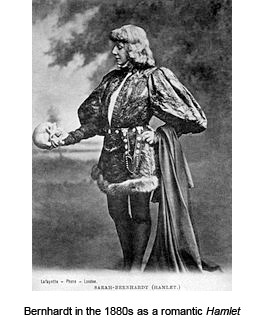
People in sports and the performing arts, before the advent of electronic storage/ replay media, have an intrinsic problem. Their prowess is known at the time but is notoriously difficult to recapture later. The French actor Sarah Bernhardt (1844-1923), playing Hamlet on stage when she was well into her 70s and sporting an artificial limb after a leg amputation, remains an inspiration for all public performers, whatever their field.1  Yet performance glamour, even in legend, still fades fast.

Bernhardt in the 1880s as a romantic HamletWhat helps to keep a reputation well burnished is an organisation that outlasts an individual. A memorable preacher like John Wesley, the founder of Methodism, impressed many different audiences, as he spoke at open-air and private meetings across eighteenth-century Britain. Admirers said that his gaze seemed to pick out each person individually. Having heard Wesley in 1739, one John Nelson, who later became a fellow Methodist preacher, recorded that effect: ‘I thought his whole discourse was aimed at me’.2

Yet there were plenty of celebrated preachers in Georgian Britain. What made Wesley’s reputation survive was not only his assiduous self-chronicling, via his journals and letters, but also the new religious organisation that he founded. Of course, the Methodist church was dedicated to spreading his ideas and methods for saving Christian souls, not to the enshrining of the founder’s own reputation. It did, however, forward Wesley’s legacy into successive generations, albeit with various changes over time. Indeed, for true longevity, a religious movement (or a political cause, come to that) has to have permanent values that outlast its own era but equally a capacity for adaptation.

There are some interesting examples of small, often millenarian, cults which survive clandestinely for centuries. England’s Muggletonians, named after the London tailor Lodovicke Muggleton, were a case in point. Originating during the mid-seventeenth-century civil wars, the small Protestant sect never recruited publicly and never grew to any size.  But the sect lasted in secrecy from 1652 to 1979 – a staggering trajectory. It seems that the clue was a shared excitement of cultish secrecy and a sense of special salvation, in the expectation of the imminent end of the world. Muggleton himself was unimportant. And finally the movement’s secret magic failed to remain transmissible.3

In fact, the longer that causes survive, the greater the scope for the imprint of very many different personalities, different social demands, different institutional roles, and diverse, often conflicting, interpretations of the core theology. Throughout these processes, the original founders tend quickly to become ideal-types of mythic status, rather than actual individuals. It is their beliefs and symbolism, rather than their personalities, that live.

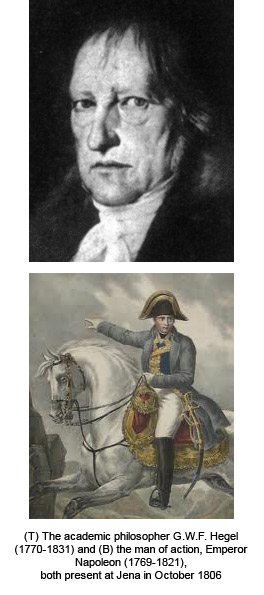
As well as beliefs and organisation, another reputation-preserver is the achievement of impressive deeds, whether for good or ill. Notorious and famous people alike often become national or communal myths, adapted by later generations to fit later circumstances. Picking through controversies about the roles of such outstanding figures is part of the work of historians, seeking to offer not anodyne but judicious verdicts on those ‘world-historical individuals’ (to use Hegel’s phrase) whose actions crystallise great historical moments or forces. They embody elements of history larger than themselves.

Hegel himself had witnessed one such giant personality, in the form of the Emperor Napoleon. It was just after the battle of Jena (1806), when the previously feared Prussian army had been routed by the French. The small figure of Napoleon rode past Hegel, who wrote: ‘It is indeed a wonderful sensation to see such an individual, who, concentrated here at a single point, astride a horse, reaches out over the world and masters it’.4

(L) The academic philosopher G.W.F. Hegel (1770-1831) and (R) the man of action, Emperor Napoleon (1769-1821),  both present at Jena in October 1806The means by which Napoleon’s posthumous reputation has survived are interesting in themselves. He did not found a long-lasting dynasty, so neither family piety nor institutionalised authority could help. He was, of course, deposed and exiled, dividing French opinion both then and later. Nonetheless, Napoleon left numerous enduring things, such as codes of law; systems of measurement; structures of government; and many physical monuments.5  One such was Paris’s Jena Bridge, built to celebrate the victorious battle.

Monuments, if sufficiently durable, can certainly long outlast individuals. They effortlessly bear diachronic witness to fame. Yet, at the same time, monuments can crumble or be destroyed. Or, even if surviving, they can outlast the entire culture that built them. Today a visitor to Egypt may admire the pyramids, without knowing the names of the pharaohs they commemorated, let alone anything specific about them. Shelley caught that aspect of vanished grandeur well, in his poem to the ruined statue of Ozymandias: the quondam ‘king of kings’, lost and unknown in the desert sands.6

So lastly what about words? They can outlast individuals and even cultures, provided that they are kept in a transmissible format. Even lost languages can be later deciphered, although experts have not yet cracked the ancient codes from Harappa in the Punjab.7  Words, especially in printed or nowadays digital format, have immense potential for endurance. Not only are they open to reinterpretation over time; but, via their messages, later generations can commune mentally with earlier ones.

In Jena, the passing Napoleon (then aged 37) was unaware of the watching academic (then aged 36), who was formulating his ideas about revolutionary historical changes through conflict. Yet, through the endurance of his later publications, Hegel, who was unknown in 1806, has now become the second notable personage who was present at the scene. Indeed, via his influence upon Karl Marx, it could even be argued that the German philosopher has become the historically more important figure of those two individuals in Jena on 13 October 1806. On the other hand, Marx’s impact, having been immensely significant in the twentieth century, is also fast fading.

Who from the nineteenth century will be the most famous in another century’s time? Napoleon? Hegel? Marx? (Shelley’s Ozymandias?) Time not only ravages but provides the supreme test.

1  R. Gottlieb, Sarah: The Life of Sarah Bernhardt (New Haven, 2010).

2  R.P. Heitzenrater, ‘John Wesley’s Principles and Practice of Preaching’, Methodist History, 37 (1999), p. 106. See also R. Hattersley, A Brand from the Burning: The Life of John Wesley (London, 2002).

3  W. Lamont, Last Witnesses: The Muggletonian History, 1652-1979 (Aldershot, 2006); C. Hill, B. Reay and W. Lamont, The World of the Muggletonians (London, 1983); E.P. Thompson, Witness against the Beast: William Blake and the Moral Law (Cambridge, 1993).

4  G.W.F. Hegel to F.I. Neithammer, 13 Oct. 1806, in C. Butler (ed.), The Letters: Georg Wilhelm Friedrich Hegel, 1770-1831 (Bloomington, 1984); also transcribed in www.Marxists.org, 2005.

5  See http://napoleon-monuments.eu/Napoleon1er.

6  P.B. Shelley (1792-1822), Ozymandias (1818).

7  For debates over the language or communication system in the ancient Indus Valley culture, see: http://en.wikipedia.org/

For further discussion, see Twitter

To read other discussion-points, please click here

To download Monthly Blog 40 please click here

https://www.penelopejcorfield.com/wp-content/uploads/2020/12/P.J.C.png 0 0 Penelope J. Corfield https://www.penelopejcorfield.com/wp-content/uploads/2020/12/P.J.C.png Penelope J. Corfield2014-04-01 12:00:412021-01-12 18:53:16MONTHLY BLOG 40, HISTORICAL REPUTATIONS THROUGH TIME
Search Search

Monthly Blogs

  • MONTHLY BLOG 184, THE MOON – FAMILIAR FRIEND OR LONELY STRANGER? 2 April 2026
  • MONTHLY BLOG 183, HICKORY DICKORY DOCK! IN MEMORY OF MY LATE BROTHER JULIAN, OUR HAPPY CHILDHOOD TOGETHER, AND HIS LIFELONG SENSE OF DROLL HUMOUR 1 March 2026
  • MONTHLY BLOG 182, TO LAUGH OR CRY? RESPONDING TO ACADEMIC CRITICISMS 2 February 2026
  • MONTHLY BLOG 181, A YEAR OF POEMS 3 January 2026
  • MONTHLY BLOG 180, TIME & INSPIRATION 1 December 2025
  • MONTHLY BLOG 179, IDENTIFYING DIFFERENT ERAS OF TIME: POTENTIAL & PITFALLS … 1 November 2025
  • MONTHLY BLOG 178, THINKING THROUGH TIME AT ARTHUR’S STONE IN HEREFORDSHIRE 1 October 2025
  • MONTHLY BLOG 177, SONGS ABOUT TIME 3 September 2025

Categories

  • 2026 – Year of Poetry
  • Autobiography
  • Civics
  • Current Affairs
  • Family Memories
  • History
  • Monthly Blog
  • Notices
  • Personal
  • Reviews
  • Skills
  • Time

Archives

Tags

academics agenda ancestry battersea britain christianity continuity degree diagenesis dialectical discussion education eighteenth century ethnicity Georgian government historian historians history humanities humans knowledge labour labour party language London metamorphosis paradigm shift Penelope J Corfield poet policy politicians politics professor research students teachers time traditions transformation universities university vocational voters writing

Penelope J. Corfield

Penelope J. Corfield is a historian, lecturer and education consultant. She recently served as the President of the International Society for Eighteenth-Century Studies (ISECS).

Recent Posts

  • MONTHLY BLOG 184, THE MOON – FAMILIAR FRIEND OR LONELY STRANGER? 2 April 2026
  • MONTHLY BLOG 183, HICKORY DICKORY DOCK! IN MEMORY OF MY LATE BROTHER JULIAN, OUR HAPPY CHILDHOOD TOGETHER, AND HIS LIFELONG SENSE OF DROLL HUMOUR 1 March 2026

CONTACT

Penelope J. Corfield Historian
contact me here

SEARCH THIS SITE

Search Search

SHARE THIS

QUICK LINKS

© Copyright - Penelope J Corfield 2026. All rights reserved. | Dancing Dates Film by Edwina Hannam | Site by Starling Design
  • Link to X
  • Link to Rss this site
  • Link to Mail
Scroll to top Scroll to top Scroll to top

This site uses cookies. By continuing to browse the site, you are agreeing to our use of cookies.

OKLearn more

Cookie and Privacy Settings


How we use cookies

We may request cookies to be set on your device. We use cookies to let us know when you visit our websites, how you interact with us, to enrich your user experience, and to customize your relationship with our website.

Click on the different category headings to find out more. You can also change some of your preferences. Note that blocking some types of cookies may impact your experience on our websites and the services we are able to offer.

Essential Website Cookies

These cookies are strictly necessary to provide you with services available through our website and to use some of its features.

Because these cookies are strictly necessary to deliver the website, refusing them will have impact how our site functions. You always can block or delete cookies by changing your browser settings and force blocking all cookies on this website. But this will always prompt you to accept/refuse cookies when revisiting our site.

We fully respect if you want to refuse cookies but to avoid asking you again and again kindly allow us to store a cookie for that. You are free to opt out any time or opt in for other cookies to get a better experience. If you refuse cookies we will remove all set cookies in our domain.

We provide you with a list of stored cookies on your computer in our domain so you can check what we stored. Due to security reasons we are not able to show or modify cookies from other domains. You can check these in your browser security settings.

Google Analytics Cookies

These cookies collect information that is used either in aggregate form to help us understand how our website is being used or how effective our marketing campaigns are, or to help us customize our website and application for you in order to enhance your experience.

If you do not want that we track your visit to our site you can disable tracking in your browser here:

Other external services

We also use different external services like Google Webfonts, Google Maps, and external Video providers. Since these providers may collect personal data like your IP address we allow you to block them here. Please be aware that this might heavily reduce the functionality and appearance of our site. Changes will take effect once you reload the page.

Google Webfont Settings:

Google Map Settings:

Google reCaptcha Settings:

Vimeo and Youtube video embeds:

Other cookies

The following cookies are also needed - You can choose if you want to allow them:

Accept settingsHide notification only