
MONTHLY BLOG 106, Cities Greener Still and Greener
If citing, please kindly acknowledge copyright © Penelope J. Corfield (2019)
|
Scrapbook Silhouettes: available EBay (2019) |
Towns and cities are wonderful human creations. They allow large numbers of people to live together at high density, reasonably successfully, without spreading all over Planet Earth. The mixture of collective and individual organisation that enables this process to happen and to sustain itself is impressive and admirable.1 And, without concentrated cities and towns as living spaces, it would be extremely difficult to accommodate the Earth’s 7.7 billion humans (at the latest count in September 2019) – a demanding species.
Now, however, it’s time for a major step-change in the characteristics of the prevailing urban environment worldwide. All towns and cities must go greener, much, much greener. It’s true that some urban places are already pleasantly green. And all, even the most concrete-based urban settlements have at least some city parks and green spaces, acting as urban lungs.
Yet a programme of Cities Greener Still and Greener needs a complete urban revamp and restructuring. It is required partly for ecological reasons. The impending crisis of global overheating provides the immediate call to action on behalf of all species world-wide. And human-biological needs give a subsidiary impetus to all urban leaders and planners, now that much more is becoming known about the beneficial effects of greenery (trees, plants, wildlife) upon human health and wellbeing.2
A full programme for profound urban ecological change will require structural changes to transportation systems, domestic and industrial heating systems, and so much else besides. Improvements to air quality must be a priority. This BLOG, however, is not the place for a full manifesto on behalf greenery and sustainable cities, although I have no doubt that green policies will, sooner or later, have to be adopted everywhere.3
These thoughts express some immediate hobby-horses, which a personal BLOG provides a chance to exercise. So here are four imperatives relating to planting urban trees/bushes/greenery; sowing/planting grasses and wild plants; restoring lost urban rivers and streams; and adopting permeable paving wherever possible. The aim is to banish unbroken swathes of concrete. That stern and rigid material has manifold uses; but, as currently adopted, it is stifling the earth, which is too important to be so mistreated. Not only does the making of concrete involve harmful processes which add to global warming, but the greyspread of concrete is destroying the natural infrastructure of the soil and hence seriously damaging processes of fertilisation, pollination, flood control, oxygen production and water purification. Environmentalists as well as architects and planners are beginning to warn that massy developments based upon this rigid and impermeable material are storing up problems for the not-very distant suture. ‘Simply pouring concrete is doing more harm than good’.4
Trees and Bushes: it’s not enough to give urban dwellers more opportunities of going out of town to visit forests; and/or to complain about the destruction of forests in the Amazon, although both of those are worthwhile campaigns. But instead trees and bushes should be planted in the cities – everywhere. In every road and courtyard and backyard and corner. And, if there’s no room in the ground, then the trees and bushes should be in big tubs and planters. Absolutely everywhere. Millions and millions of trees and bushes. Old city centres, with a maze of small streets, are great places to walk around. Greater still with tubs of trees and bushes everywhere. New city avenues, boulevards, urban thoroughfares, bypasses – all need trees and greenery. Precisely which species can survive and thrive in each different town or city environment is a matter for tree specialists and urban landscapers to advise. But greenery is the universal requirement, for better air quality, better visual impact, and better lives for humans plus for all forms of urban wildlife.

|
Tree-in-a-tub: from www.fromoldbooks.org (2019) |
Sowing Grasses and Planting Plants: Suitably hardy plants, wild or cultivated, as well as grasses, which grow well without careful tending should be sown in every bit of earth, including in unused large areas of neglected ground and every small patch at the feet of trees or anywhere else, such as railway sidings. Plants and grasses are environmentally favourable for wildlife and insects, as well as pleasant for humans. And where there are opportunities for community gardening, those options should be embraced as well. Already some people spontaneously grow plants at the foot of trees in the roads where they live. And Lambeth Council in London has already begun a creative Biodiversity Policy across the Borough to the same effect (and more). The programme is bringing huge benefits – ecological, cultural, economic, health, and community – for a comparatively small outlay.
Such initiatives deserve not just congratulations but immediate imitation everywhere. In its support, Lambeth Council cites an eminent and idiosyncratic Victorian who lived in the Borough: John Ruskin, the pioneering critic of untrammelled industrialism and environmental degradation. He praised the restorative power of nature: ‘It is written on the arched sky; it looks out from every star. It is the poetry of nature; it is that which uplifts the spirit within us’.5 Well, it’s not the sort of language which is usually found in official documents; but entirely relevant. Ruskin would be proud.

| Wild Flowers © Clipart 2019 |
Restoring Lost Streams and Rivers: Restoring lost rivers is trickier, since in many cases they flow in culverts under roads and buildings. Nonetheless, they are integral parts of the urban environmental ecology and should be respected, uncovered wherever possible, and enjoyed. It’s an excellent as well as urgent new challenge to the ingenuity of engineers and urban landscape designers. Such rethinking is part of a revised attitude to cities and their terrain, which should not be built over heedlessly.6 London is one of many places which have secret watery undergrounds. Its lost rivers have their own devotees; and people eagerly attend talks and join walks along their courses.7
There are also more ambitious plans for river restoration wherever possible. For example, in Lewisham’s Chinbrook Meadows a section of the River Quaggy (great name) has been uncovered, as something beneficial in itself but also as part of a wider water management project.8 The park has gained in amenities and popularity; wildlife has been assisted; and the wetland serves as an overflow area in time of flooding, protecting local homes and businesses. This creative feat of reverse engineering is an admirable portent for a future that is more nature- and human-friendly, as well as more practically sustainable. Not every urban river and stream will be easily restored; and town dwellers have to resolve not to throw litter into running waterways, once visible again. But these challenges are live ones, here and now!
|
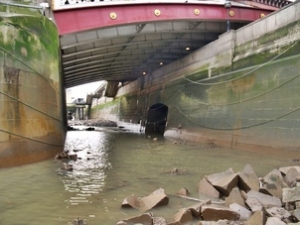
The unremarked outfall of London’s Fleet River under Blackfriars Bridge: image from website for Paul Talling’s zestful exploration of London’s Lost Rivers (2011), |
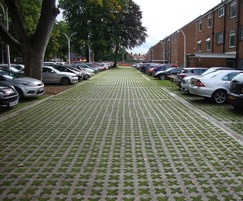
Permeable Paving: It’s depressing to realise that a very ingenious invention which uses concrete and still allows cars to park without stifling the earth has long been known but is not used at all widely. There are numerous forms of permeable paving. One takes the form of a concrete lattice, which allows grass to grow within the grid. (And if the climate does not encourage grass, then earth or sand fill the gaps). Water drains simply and naturally into the ground; and excess runoffs at times of heavy rain or flooding are minimised. Needless to say, this system is not suitable for all terrains and climates; and there are practical limits to the quantity of traffic and load that porous paving can bear. Indeed, a number of alternatives are being developed concurrently, using plastic or asphalt.
So porous paving exists;9 but is not (yet) used sufficiently. It seems clear that more urgent effort is needed, to research and development of such systems, and to make them easier and cheaper to use. Builders and engineers who are currently accustomed to schemes for widespread concretisation (yes, the word exists) will have to rethink their ways. But they represent buccaneering professions which are used to facing challenges. The future now requires working with nature, not stifling or attempting to erase it – for the obvious reason that outraged nature has a very determined way of striking back.
|
Advertisement for Grasscrete ®: Concrete Paver System (2019) |
Envoi: Where has this BLOG come from? I am an urban historian who loves towns and cities, and who has long been meditating on these themes. I first saw grass-crete in Switzerland in the mid-1980s and was sure that I had seen the future – only to find that the universal future of porous paving has been somewhat delayed. Today’s debates about the problems of excess water run-off from concreted land as well as the wider context of the accelerating climate emergency have triggered me into writing down my thoughts.
So where is this BLOG going? It’s my way of bearing witness, of joining the tide of protest at the present dire state of Planet Earth. I believe that human beings are noted problem solvers as well as problem creators. It’s true that urgent action on climate change is needed to accompany the fine words from many (not all) of today’s politicians.
Nonetheless, I am an unrepentant optimist that humans will react positively in response to collective danger.10 Today’s warnings from scientists, campaigners, and many thousands of young people globally cannot be ignored for much longer. Transformative action is needed, learning from past experience to new effect. And that includes local initiatives, in every town and city, where many green micro-improvements will together promote greener still macro-change.
ENDNOTES:
1 For a panoptic historical survey, see collectively the essays in P. Clark (ed.), The Oxford Handbook of Cities in World History (Oxford, 2013).
2 K. Nilsson and others (eds), Forests, Trees and Human Health (Elsevier, 2006; New York, 2010); [US. Dept. of Agriculture/ Forest Service], Urban Nature for Human Health and Well-Being: A Research Summary (Washington DC, 2018); Q. Li, Into the Forest: How Trees can help you Find Health and Happiness (2019).
3 See e.g. new thinking in T. Elkin, Reviving the City: Towards Sustainable Urban Development (1991); and recent work on ecological cities.
4 From J. Watts, ‘Concrete: The Most Destructive Material on Earth’, The Guardian, 25 Feb. 2019: see https://www.theguardian.com/cities/2019/feb/25/concrete-the-most-destructive-material-on-earth. See also a kinder but still warning analysis in A. Forty, Concrete and Culture: A Material History (2012).
5 See details of Lambeth Biodiversity Action Plan, 2019-24, in https://www.lambeth.gov.uk/sites/default/files/lpl-lambeth-biodiversity-action-plan-2019-20.pdf
6 K. Perini and P. Sabbon, Urban Sustainability and River Restoration: Green and Blue Infrastructure (2016); M. Knoll and others (eds), Rivers Lost, Rivers Regained: Rethinking City-River Relations (Pittsburgh, PA, 2017).
7 P. Talling, London’s Lost Rivers (2011) and associated website; T. Bolton, London’s Lost Rivers: A Walker’s Guide (Devizes, 2014).
8 Case Study: Quaggy Flood Alleviation Scheme (2013) in https://restorerivers.eu/wiki/index.php?title=Case_study%3AQuaggy_Flood_Alleviation_Scheme
9 B.K. Ferguson, Porous Pavements (Boca Raton, FL, 2005).
10 P.J. Corfield, ‘Climate Reds: Responding to Global Warming with Relative Optimism’, (2011) with companion piece by M. Levene, ‘Climate Blues: Or How Awareness of the Human End might Re-instil Ethical Purpose to the Writing of History’: PJC essay available on personal website www.penelopejcorfield.co.uk/Pdf21.
For further discussion, see Twitter
To read other discussion-points, please click here
To download Monthly Blog 106 please click here