
Penelope J Corfield
  • HOME
    • Index to Blogs
    • Monthly Blogs
    • CONTACT
    • Key to Dancing Dates Film
  • CURRENT
    • President International Association C18 Studies
    • Lectures on offer
    • London University’s Long C18 History Seminar
    • Living in Battersea
    • Career at a Glance
    • PJC Publications
  • BRITISH HISTORY
    • Long C18 Overviews
    • Society & Culture
    • Town Life
    • Electoral History
    • Radical Poets
    • The Professions
    • Religion & Irreligion
  • GLOBAL
    • Urban History Through Time
    • C18 European History Overviews
    • Gender History
    • ‘Racial’ Classifications as Pseudo-Science
    • Responding to Climate Change
    • Advance of the International Sphere
  • TIME & HISTORY
    • Time & The Shape of History (2007)
    • Rethinking Historical Periodisation
    • Dimensions of The Long Term
    • Returning to Big History
  • HISTORY-MAKING
    • Why History Matters
    • History of History
    • Fellow Historians
    • Arts of Academic Assessment
    • Pleasures of Intellectual Life
  • REVIEWS
    • History Book Reviews
      • Social History
      • Approaches to History
      • Big History
    • Theatre Reviews
    • Civic/Political Commentaries
    • Personal Portraits
  • Menu Menu

Tag Archive for: landowner

MONTHLY BLOG 117, AN EIGHTEENTH-CENTURY FOLLY-BUILDER & CAT-LOVER

4 September 2020/in History, Monthly Blog/by Penelope J. Corfield

If citing, please kindly acknowledge copyright © Penelope J. Corfield (2020)
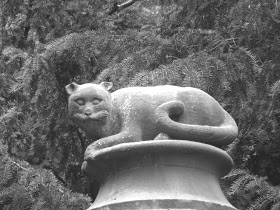

Public monuments to cats – as opposed to literary, artistic and musical celebrations1 – are rare to find, especially dating from the eighteenth century. So this majestic example deserves full appreciation. The lordly cat sits atop a giant Grecian vase, all forming the substantial Cat Monument.2 It was designed in 1749 and built c.1770 in the new weatherproof composite known as Coade Stone.3 Erected at Shugborough Park in Staffordshire, the Monument was commissioned by Thomas Anson (c.1695-1773). He was the felinophile, who owned the estate and had the wealth as well as the space to indulge his taste for architectural patronage in full.

Curiously enough, the identity of this publicly honoured cat remains uncertain. One strong possibility is that it commemorates Thomas Anton’s own favoured pet, named Khouli-Khan. This cat was the last of a line of Persian cats owned by the family. Hence, behind the luxuriant mustachios on the Monument’s lordly feline, the statue may show the round face and short muzzle that is characteristic of that particular breed.

Another possibility, however, is that the honoured cat was the adventurous moggy who circumnavigated the globe in the years 1740-44 with Admiral George Anson (1697-1762). He was the much admired younger brother of Thomas Anson. And the childless George Anson had bequeathed his great fortune, based upon Spanish treasure, to his older sibling. As a result, some of the monuments and memorabilia at Shugborough Park were devised as fraternal tributes to the circumnavigator. In that context, therefore, it is possible that the Cat Monument commemorates the circumnavigating cat.

Throughout this period (as in earlier and later eras), thousands of feline pest controllers travelled the high seas.4 They dined on the mice and rats which infested the wooden ships of the commercial fleet and the Royal Navy. (Keeping pets on board was banned by the British Navy only in 1975). Often these sailing cats were adopted by the crews as informal mascots. The feline companion (name unknown) of George Anson seems to have been a talisman of that ilk. Indeed, it is quite possible that the Cat Monument commemorates not one specific cat but human admiration for the species generically. The design is certainly eclectic. Around the Monument’s plinth are the carved heads of Corinthian goats, which were kept on the Shugborough Park estate c.1768. But the lofty cat is the king.

Accompanying the Monument, meanwhile, Anson commissioned an extraordinary array of follies and fancies.5 The Chinese House (1747) is one of the earliest examples of oriental design in Britain. A Gothic Ruin, complete with a gothic pigeon-house, followed in 1750. The Shepherd’s Monument was built in the later 1750s, taking the form of an ornamental arch around a pastoral bas-relief. (Two outer pillars and a classic pediment were added in 1763). A Doric Temple followed in c.1760. The massive Hadrian’s Arch was then erected in 1762, at a high point on the estate with extensive views. Built in a style borrowed from classical Athens, the design was adapted as a tribute to George Anson, who died in 1762, and George’s wife Elizabeth. A Tower of the Winds, based upon the Athens’ Horologium of Andronikos, was created in 1765, initially with a surrounding pool of water, which was lost in the course of flood damage on the estate in 1795. And in 1771 the Lanthorn of Demosthenes, based upon the design of an Athenian house dating from 4BCE, completed Anson’s career as an alfresco architectural patron. (He also remodelled the ancestral Shugborough Hall and amassed a collection of memorabilia).

Amongst this eclectic miscellany of edifices, the Cat Monument more than holds its own. It has a stately presence, framed by trees. It is not overawed by its Gothic, Oriental, Doric or Corinthian monumental companions, elsewhere in Shugborough Park. Whether it commemorates one adventurous globe-trotting feline, or one exotic Persian cat, or all cats generically, it makes its point finely.
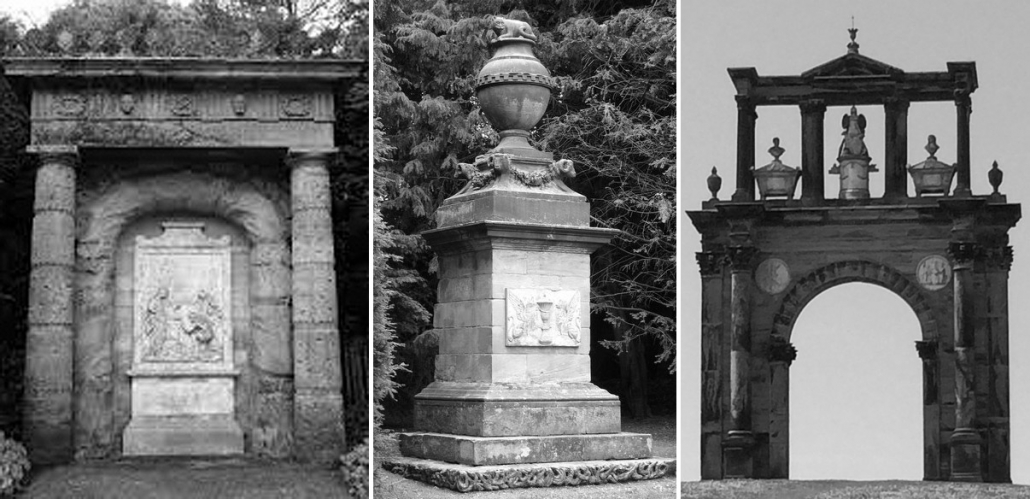
Fig.2.1-3 Three Shugborough Park Monuments, Commissioned by Thomas Anson:
(L) The Shepherd’s Monument (later 1750s; expanded 1763)
(Centre) The Cat Monument (designed 1749; built c.1770)
(R) Hadrian’s Arch (1762), adapted as a tribute to Admiral George Anson and his wife Elizabeth.

Around the globe – and at home in Staffordshire – feline companionship is something to admire. A cat may look at an admiral or at a country landowner (and MP) or at a king. And humans look closely at these classic domestic companions too. At a time of global crisis, compounded of climatic, epidemiological, economic and political challenges, it is as well for humans to recollect their pan-global co-residence with all living beings. And, not least among them, those great triggers to the literary imagination in the form of the amiable, adventurous, wily, and famously enigmatic cats.6

ENDNOTES:

1 H. Loxton, Cats: 99 Lives – Cats in History, Legend and Literature (1999).

2 For the Cat Monument (designed 1749; erected c.1770) NGR: SJ9932022722, see https://www.nationaltrust.org.uk/shugborough-estate/features/parkland-buildings-monuments-and-follies

3 H. Van Lemmen, Coade Stone (Princes Risborough, 2006).

4 See V. Lewis, Ship’s Cats in War and Peace (2001); and listings in https://en.wikipedia.org/wiki/Ship%27s_cat/.

5 All monuments are listed and dated in https://www.nationaltrust.org.uk/shugborough-estate/features/parkland-buildings-monuments-and-follies

6 See P.J. Corfield, ‘“For I will Consider my Cat Jeoffry”: Cats and Literary Creativity in Eighteenth-Century Britain’, work-in-progress for publication 2021.

For further discussion, see Twitter

To read other discussion-points, please click here

To download Monthly Blog 117 please click here

https://www.penelopejcorfield.com/wp-content/uploads/2020/12/2020-09-No1-CAT-MONUMENT-CLOSE-UP-Shugborough.jpg 210 280 Penelope J. Corfield https://www.penelopejcorfield.com/wp-content/uploads/2020/12/P.J.C.png Penelope J. Corfield2020-09-04 16:41:572021-01-12 18:52:52MONTHLY BLOG 117, AN EIGHTEENTH-CENTURY FOLLY-BUILDER & CAT-LOVER
Search Search

Monthly Blogs

  • MONTHLY BLOG 184, THE MOON – FAMILIAR FRIEND OR LONELY STRANGER? 2 April 2026
  • MONTHLY BLOG 183, HICKORY DICKORY DOCK! IN MEMORY OF MY LATE BROTHER JULIAN, OUR HAPPY CHILDHOOD TOGETHER, AND HIS LIFELONG SENSE OF DROLL HUMOUR 1 March 2026
  • MONTHLY BLOG 182, TO LAUGH OR CRY? RESPONDING TO ACADEMIC CRITICISMS 2 February 2026
  • MONTHLY BLOG 181, A YEAR OF POEMS 3 January 2026
  • MONTHLY BLOG 180, TIME & INSPIRATION 1 December 2025
  • MONTHLY BLOG 179, IDENTIFYING DIFFERENT ERAS OF TIME: POTENTIAL & PITFALLS … 1 November 2025
  • MONTHLY BLOG 178, THINKING THROUGH TIME AT ARTHUR’S STONE IN HEREFORDSHIRE 1 October 2025
  • MONTHLY BLOG 177, SONGS ABOUT TIME 3 September 2025

Categories

  • 2026 – Year of Poetry
  • Autobiography
  • Civics
  • Current Affairs
  • Family Memories
  • History
  • Monthly Blog
  • Notices
  • Personal
  • Reviews
  • Skills
  • Time

Archives

Tags

academics agenda ancestry battersea britain christianity continuity degree diagenesis dialectical discussion education eighteenth century ethnicity Georgian government historian historians history humanities humans knowledge labour labour party language London metamorphosis paradigm shift Penelope J Corfield poet policy politicians politics professor research students teachers time traditions transformation universities university vocational voters writing

Penelope J. Corfield

Penelope J. Corfield is a historian, lecturer and education consultant. She recently served as the President of the International Society for Eighteenth-Century Studies (ISECS).

Recent Posts

  • MONTHLY BLOG 184, THE MOON – FAMILIAR FRIEND OR LONELY STRANGER? 2 April 2026
  • MONTHLY BLOG 183, HICKORY DICKORY DOCK! IN MEMORY OF MY LATE BROTHER JULIAN, OUR HAPPY CHILDHOOD TOGETHER, AND HIS LIFELONG SENSE OF DROLL HUMOUR 1 March 2026

CONTACT

Penelope J. Corfield Historian
contact me here

SEARCH THIS SITE

Search Search

SHARE THIS

QUICK LINKS

© Copyright - Penelope J Corfield 2026. All rights reserved. | Dancing Dates Film by Edwina Hannam | Site by Starling Design
  • Link to X
  • Link to Rss this site
  • Link to Mail
Scroll to top Scroll to top Scroll to top

This site uses cookies. By continuing to browse the site, you are agreeing to our use of cookies.

OKLearn more

Cookie and Privacy Settings


How we use cookies

We may request cookies to be set on your device. We use cookies to let us know when you visit our websites, how you interact with us, to enrich your user experience, and to customize your relationship with our website.

Click on the different category headings to find out more. You can also change some of your preferences. Note that blocking some types of cookies may impact your experience on our websites and the services we are able to offer.

Essential Website Cookies

These cookies are strictly necessary to provide you with services available through our website and to use some of its features.

Because these cookies are strictly necessary to deliver the website, refusing them will have impact how our site functions. You always can block or delete cookies by changing your browser settings and force blocking all cookies on this website. But this will always prompt you to accept/refuse cookies when revisiting our site.

We fully respect if you want to refuse cookies but to avoid asking you again and again kindly allow us to store a cookie for that. You are free to opt out any time or opt in for other cookies to get a better experience. If you refuse cookies we will remove all set cookies in our domain.

We provide you with a list of stored cookies on your computer in our domain so you can check what we stored. Due to security reasons we are not able to show or modify cookies from other domains. You can check these in your browser security settings.

Google Analytics Cookies

These cookies collect information that is used either in aggregate form to help us understand how our website is being used or how effective our marketing campaigns are, or to help us customize our website and application for you in order to enhance your experience.

If you do not want that we track your visit to our site you can disable tracking in your browser here:

Other external services

We also use different external services like Google Webfonts, Google Maps, and external Video providers. Since these providers may collect personal data like your IP address we allow you to block them here. Please be aware that this might heavily reduce the functionality and appearance of our site. Changes will take effect once you reload the page.

Google Webfont Settings:

Google Map Settings:

Google reCaptcha Settings:

Vimeo and Youtube video embeds:

Other cookies

The following cookies are also needed - You can choose if you want to allow them:

Accept settingsHide notification only