
MONTHLY BLOG 57, RIDING THE TIDES OF HISTORY
If citing, please kindly acknowledge copyright © Penelope J. Corfield (2015)
Having BLOG-speculated about the Labour Party transforming itself by changing its name,1 I am intrigued to find instead that the Labour Party is transforming itself by broadening its membership, with a massive grass-roots surge since the general election in May 2015. It’s one step towards marshalling a broad coalition of anti-Conservative forces. But this development brings with it some obvious risks, like the dangers of chronic divisions and organisational splits. It will require great skill and team leadership, and goodwill on all sides, to weld together those in the political centre-Left with all those further Left.
Riding the turbulent tides of history is not an easy task. Without the benefits of hindsight (which helps historians but is not available to immediate political commentators), people have to do the best they can and hope that the outcome vindicates them. This BLOG is about the current upheaval within the Labour Party, now that the initially unfancied outsider Jeremy Corbyn has won the leadership.
It must be both a strange and exhilarating experience for a back-bencher aged 66, now to be riding the tides of history. Corbyn has been an assiduous MP for Islington North since 1983 but has never been a minister or previously stood for high office in the Labour Party. Instead, he has focused his efforts upon left-wing lobby groups and public campaigns.2 He is famous for the number of times that he has defied the Labour Party whips in parliament. Now, however, he is articulating a set of attitudes within the Left which have been without a senior voice on mainstream platforms for many years. The result has been a great surge of enthusiasm for his campaign, which no other candidate for the leadership showed any sign of matching.
Here are three thoughts about the Corbyn phenomenon. First, he is articulating something of importance. The fulminations of his opponents within the Labour Party hierarchy make that clear. He is the man of the moment. For Corbyn, his views are not at all new. He is not announcing a conversion. But the novelty for his growing band of supporters comes from hearing such views articulated passionately at a time, after the disastrous 2015 election defeat, when there is widespread disillusionment with Labour’s centrist trimming and when there is a novel opportunity, with a Labour leadership contest not only without a clear centrist front-runner but also conducted under a new populist franchise.
In the olden days, History scholarship candidates used to write essays debating the relative importance of the individual and the deep trends of history. The answer is always a key combination of both. People are the active agents who crystallise the trends; and key individuals, inside or outside formal organisations, are those who are able to seize and to personify the moment.
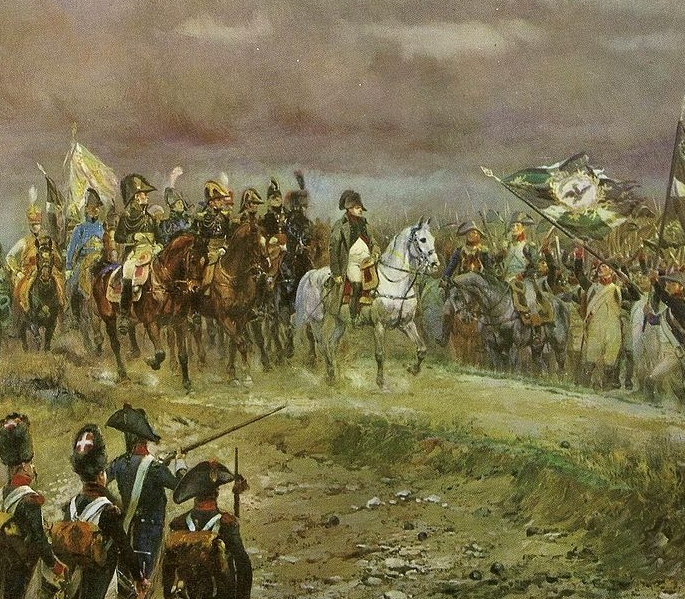
Georg Wilhelm Friedrich Hegel, whose historical philosophy firmly enshrined the importance of grand trends, was stirred by viewing in the flesh one of these significant ‘world-historical’ personages. It was at Jena, in mid-Germany, in October 1806. The French had decisively defeated the fabled might of the Prussian army. Hegel, who then resided in Jena, described in a letter how he witnessed a small hunched man ride by, seated on a grey horse. 3
|
Fig. 1: Captured Prussian flags being presented by French troops to the Emperor Napoleon after the Battle of Jena (1806), as depicted by Édouard Detaille in the late nineteenth century. |
He was the victorious Napoleon, then aged 37. ‘It is indeed a wonderful sensation to see such an individual, who, concentrated here at a single point, astride a horse, reaches out over the world and masters it . . . this extraordinary man, whom it is impossible not to admire’, confessed the usually calm and reticent Hegel, an unknown scholar who was also aged 37. The small figure of Bonaparte was the incarnation of France’s post-revolutionary expansionism in both ideas and military force, which was routing traditional authority across Europe. Later, of course, Napoleon’s star waned decisively. Yet for a while he not only represented but moulded history, aided by his generals, his army, the dynamic energy unleashed by the French Revolution, and the disarray of France’s opponents.
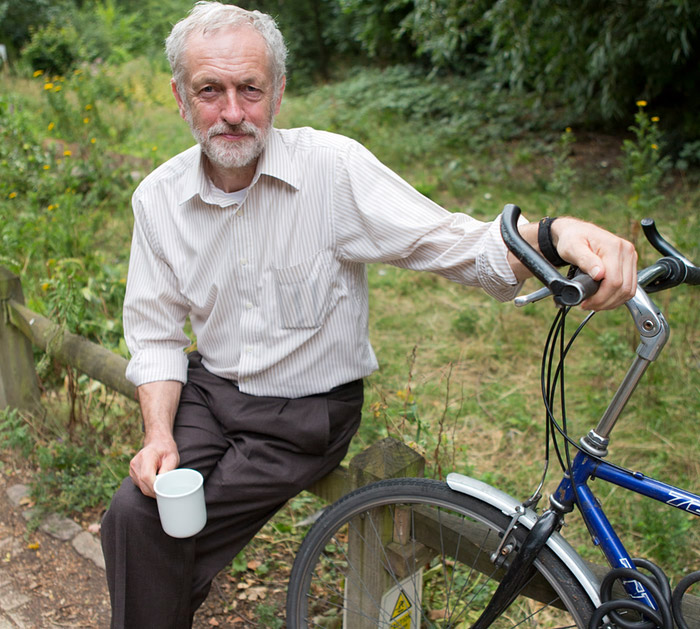
Corbyn is no Napoleon. He seems personally too pleasant and downbeat in style; plus he rides a bicycle. In 2013 he explained to a local journalist his avoidance of seeking high office in the Labour Party on the grounds that ‘I want to be able to look at myself in the mirror’.4 Nonetheless, Corbyn is today the person of the moment on the British Left. He was the comrade who was bold enough to stand for the Labour leadership this time round. His bold, clear ideas have resonance after years of cautious compromise. And his casual unbuttoned persona makes him an attractive antidote to most of today’s overly tailored and straight-jacketed Westminster politicians. So it’s Corbyn’s time to benefit from the historical tides, and thus to have the chance also to mould events.
|
Fig. 2: A casual Jeremy Corbyn, with bike and mug of tea. |
Secondly, it is equally obvious that the tides can ebb as well as flow. The careers of Napoleon in exile, and of many other ‘world-historical’ figures in eclipse after their great days, stand eloquent testimony to that truth. People, who have held the levers of power, frequently find it difficult to realise when their ‘magical’ time has passed. Look at Tony Blair, now aged 62. He commanded the British political stage from the mid-1990s to the mid-2000s, when things began to go wrong for him. As a result, his appeal is now spent, as everyone but he appears to realise, to such an extent that his political interventions are now proving to be counterproductive. The best thing to do, if the tide has ebbed decisively, is to retire from the hotspot with dignity (ideally, finding good deeds to undertake, out of the limelight) and to wait for history to give its ultimate verdict.
But there is a third important reflection: a favourable tide gives a great opportunity if used constructively. It usually benefits best not just from a charismatic leader but also from a good set of long-term organisers on the team; enthusiastic and committed foot soldiers; an energising cause, well articulated; timely ideas; plus a tactical flexibility as well as a good strategic ability to wrong-foot all opponents. Another very helpful component is the support of an able successor, who comes from the next political generation but who is not a rival. As that list reveals, it takes a lot of favourable factors to ride the tides of history successfully, especially over the long term. Nonetheless, it can be done; and the attempt itself is exhilarating.
For any individual, to figure at the heart of history, successfully commanding the ‘Now’ of the present moment, is a great, almost dizzying, experience. It’s a sensation most commonly open to leaders or those vying for leadership positions. But it can happen excitingly for anyone ‘great or small’, in a spiritual or political sense, who believes that they have had a personal ‘call’ to action, as in a spiritual awakening or mission. A thrilling sense of being personally at the heart of history can (for example) get individuals to do amazing and abnormal things, like travelling to far off lands to fight in distant wars.
History’s grand trends often seem impersonal and remote. Yet they are simultaneously the product of countless actions and inactions by countless individuals and groups. So history is also close at hand and personal – not least for leaders who emerge to ride and maybe to redirect the tides. Stirring times.
1 See PJC BLOG/ 55 (July 2015) ‘Post-Election Meditations: Should the Labour Party Change its Name?’ and BLOG/ 56 (Aug. 2015), ‘More Post-Election Meditations: On Changing the Labour Party’s Name’.
2 For details see en.wikipedia.org/wiki/Jeremy_Corbyn.
3 For G.W.F. Hegel (1770-1831) on Napoleon, see T. Pinkard, Hegel: A Biography (Cambridge, 2000), p. 228. See also J. McCarney, Hegel on History (London, 2000); and S. Houlgate, An Introduction to Hegel: Freedom, Truth and History (Oxford, 2005).
4 P. Gruner, ‘As He Reaches 30-Year Milestone, Islington North Labour MP Jeremy Corbyn Reflects on his Career in Politics’, Islington Tribune, 7 June 2013.
For further discussion, see Twitter
To read other discussion-points, please click here
To download Monthly Blog 57 please click here