Tag Archive for: Penelope J Corfield

MONTHLY BLOG 180, TIME & INSPIRATION

If citing, please kindly acknowledge copyright © Penelope J. Corfield (2025)

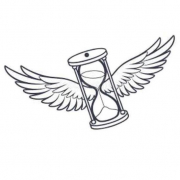
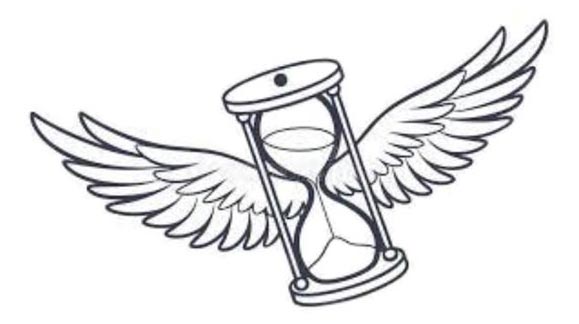
Fig.1. Time Flies, illustrated by Hour-Glass with Wings,
vector design Generative AI:

© Dreamtime 2025

The relentless passage of Time is at once a threat and an inspiration.1 Of course, in one way, it’s menacing: Time flies! Time, once lost, cannot be retrieved! Time travels onwards and does not come back!

Yet that very fact can also provide an inspiration. As Abraham Lincoln once remarked: In the end, it’s not the years in your life that count – it’s the life in your years’. Time is a finite resource; and therefore is best not squandered.

Charles Darwin expressed that very thought rather sternly, as befits an earnest Victorian: ‘A man who dares to waste one hour of Time, has not discovered the value of life’.

Or as the lyrics of Pink Floyd’s song on Time (1973), written by bass-guitarist Roger Waters, wryly noted:

‘Ticking away the moments that make up a dull day,
You fritter and waste the hours in an off-hand way. …
And then, one day, you find ten years have got behind you,
No-one told you when to run – you missed the starting gun.

It’s necessary, therefore, to accept the brute fact that Time moves ever onwards. However much people may wish to ‘call back yesterday, bid Time return’, as one character in Shakespeare’s Richard II eloquently declaims,2 they cannot.

So the ever-moving passage of Time poses a bonny challenge. Optimists like the American essayist, Ralph Waldo Emerson, gave those prone to gloom some uplifting advice: ‘Write it on your heart that every day is the best day in the year’. And Benjamin Franklin was somewhat less exuberant but equally emphatic, as he warned that: ‘You may delay, but Time will not’. In other words, use Time, don’t waste it.

On the positive side, too, there’s a potential learning curve. Thus the eighteenth-century poet and moralist, Alexander Pope, observed sagely that: ‘No one should be ashamed to admit he is wrong, which is but saying, in other words, that he is wiser today than he was yesterday.’

Thus humans can look back at the past, not just with emotions that range from nostalgia to horror, but also to learn. And it’s essential that we do. The past – or rather the human study of the past – has generated a massive stock of information and expertise. Some things, it is true, are learned in the immediate moment. But we cannot learn from the future that has not yet happened.

Evidence, analysis, expertise and inspiration – surviving from the past, and tempered by perceptions and evaluations today – together provide the operating stock of knowledge that is needed for living successfully in Time.3 Without such a resource, humanity would face the same troubles that afflict individuals who have lost all memories and cannot function unaided. So the point is not just: don’t waste Time! But, crucially: learn from it! That wise advice was given by the world’s most renowned expert on temporal challenges, Albert Einstein. He urged: ‘Learn from yesterday, live for today, hope for tomorrow’. Action stations for us all! Learn and live! Proverbially: There’s no Time like the present!

ENDNOTES:

1 This BLOG concludes PJC’s year of Time-BLOGS (2025). For more, see too P.J. Corfield, Time and the Shape of History (2007); and idem, Time-Space: We Are All in it Together (2025).

2 Earl of Salisbury in Shakespeare’s Richard II (written c.1595/6; first pub. 1597), Act 3. sc.2.

3 For the multifarious debates on these complex issues, see C. Callender (ed.), The Oxford Handbook of Philosophy of Time (2011).

For further discussion, see

To read other discussion-points, please click here

To download Monthly Blog 180 please click here

MONTHLY BLOG 179, IDENTIFYING DIFFERENT ERAS OF TIME: POTENTIAL & PITFALLS …

If citing, please kindly acknowledge copyright © Penelope J. Corfield1 (2025)

Dandelion in the wind @ Shutterstock 2025

There is a perennial conflict between, on the one hand, looking at history in terms of specific periods (for example: ‘ancient’, ‘medieval’, ‘modern’) and, on the other, trying to interpret past events without using any of these pre-set concepts. To lump or to split?

The advantage of pre-set periods is partly descriptive. It is much more economical to write ‘in medieval England’ than it is to write ‘in England during the years from the fifth century AD to the later fifteenth century’.

But, once the deed is done, and centuries of history are clumped together, questions instantly multiply: Was there one medieval period? (Scholars disagree). If so, are those the right dates for it? Why is it sometimes divided into the ‘Low Middle Ages’ and the ‘High Middle Ages’? Is the concept basically fractured?

Moreover, if it is one period, then what are its major characteristics? Is the medieval era one of chronic ignorance and backwardness? Or it is a vanished era of romance and chivalry? Or, perhaps, neither of those options? What other alternatives are there??2 And did the wider sequence of stages within which it is allegedly embedded really exist either?3

Yet without any aggregative terms for big periods of time, then historical accounts risk becoming an undifferentiated list of ‘one damned thing after another’ – with the emphasis on the adjective ‘damned’.

Attitudes among historians often shift between doubt and grand certainties. In the nineteenth century, at least for many in the West, history was seen as an unstoppable ‘March of Progress’.4 And some still cling to that vision today.

Meanwhile, for Marxists, history proceeded not by slow evolution but by dramatic leaps. The inevitable class struggle generated many stormy internal tensions that each time led to a revolutionary breakdown, after which a new stage of history emerged, only to be followed by a further revolutionary breakdown, and the advent of a ‘higher’ stage of history. Thus ‘feudalism’ would be followed by ‘capitalism’, to be followed by ‘communism’.5 But neither ‘Progress’ nor the ‘Marxist dialectic’ has worked out precisely as foretold.

In Western intellectual circles in the 1980s and 1990s, doubt rather than certainty became the new mood-music (although of course, there were always dissentient voices). Above all, theorists of ‘postmodernism’ became influential among many disillusioned left-wingers. This viewpoint extended the stages of history from ‘feudal’ to ‘modern’ to ‘postmodern’. And the postmodern stance stressed the problematic nature of all knowledge about the past.

One central tenet of this attitude was an ‘incredulity towards meta-narratives’, as proclaimed by the French social philosopher Jean-François Lyotard.6 Grand sweeping stories about the march of history were at a discount. Time’s arrow did not point in any specific direction, it seemed. It was not sure where it was going.

Taking scepticism yet further, the French philosopher and literary destructionist, Jacques Derrida, asserted that temporality itself has no independent reality. For him, time is a concept which ‘belongs entirely to metaphysics’. (And, clearly, that formulation was not meant as a compliment). Instead, an a-temporal spatiality prevails throughout the cosmos.7

Postmodernist super-scepticism, however, was closely followed by a justified intellectual recoil. Historians, while these days tending to reject schematic grand narratives, have not gone to the other extreme. They do not accept that the past has no meaning, or that studies of history are purely subjective.8

Paradoxically, the postmodernists’ claim – that an old era of so-called confident ‘modernity’ has been superseded by a new age of sceptical ‘postmodernity’ –  does in itself assert that the course of history can be deciphered. In other words, their critique of meta-narratives did not inhibit them from producing an alternative meta-narrative of their own.

Times have moved on. Some writers boldly assert the ‘end of postmodernism’ and define the new era as ‘Post-Postmodern’.9 Others ask sceptically whether such an era was ever really there at all?10

Belief in the heresy of ‘time denial’ was never espoused by more than a tiny minority of philosophers and physicists. History as a subject of study remains immensely popular and important.

Therefore historians around the world continue these research and debates. They seek long-term interpretations that avoid over-simplification and embrace complexity – but that are, simultaneously, not so complex that no meaning can be extracted from the torrent of detail. There are specific periods of history that have a distinctive identity – but there are also long-term evolutionary trends as well as deep continuities, that extend through millennia. The whole mix is as complex as life. It’s also important and endlessly instructive. As a result, it’s fascinating and sometimes infuriating! Come and research the past (choosing any time-period, long or short) and join the non-stop debates! Time-space: it’s what we all live in!

ENDNOTES:

1 Contributing to PJC’s year of Time-BLOGS (2025). For more, see too P.J. Corfield, Time and the Shape of History (2007); and idem, Time-Space: We Are All in it Together (2025).

2 See N. Cantor, Inventing the Middle Ages: The Lives, Works and Ideas of the Great Medievalists of the Twentieth Century (1991); and A. Murray, ‘Should the Middle Ages be Abolished?’ in Essays in Medieval Studies, 21 (2004), pp. 1–22.

3 See esp. P.J. Corfield, ‘POST-Medievalism/Modernity/Postmodernity?’ Rethinking History, Vol. 14 (2010), pp. 379-404. Also available via PJC website, www.penelopejcorfield.co.uk/what_is_history?/Pdf20.

4 See J.B. Bury, The Idea of Progress: An Enquiry into its Origin and Growth (1921); C. Lasch, The True and Only Heaven: Progress and its Critics (1991); G.A. Almond and others, Progress and its Discontents (2022).

5 See variously T.B. Bottomore, Karl Marx (1956); idem (ed.), Modern Interpretations of Marx (1981); D. Conway, A Farewell to Marx: An Outline and Appraisal of his Theories (1987); J.H. Moore (ed.), Legacies of the Collapse of Marxism (1995); G. Therborn, From Marxism to Post-Marxism? (2010).

6 See J-F. Lyotard, The Postmodern Condition: A Report on Knowledge, transl. by G. Bennington and B. Massumi (1979); M. Drolet (ed.), The Postmodernism Reader: Foundational Texts (2004); and popularisation of these arguments in D. Harvey, The Condition of Postmodernity: An Enquiry into the Origins of Cultural Change (1989); F. Jameson, Postmodernism: The Cultural Logic of Late Capitalism (1991); and H. Bertens, The Idea of the Postmodern: A History (1995).

7 See J. Hodge, Derrida on Time (2007); and, as an example of the debates, J.M. Lehmann, Deconstructing Derrida: A Post-Poststructuralist Critique (1993).

8 For a variety of historians’ responses, see R. Evans, In Defence of History (1997); F. Spier, Big History and the Future of Humanity (2010); D. Armitage and J. Guldi, The History Manifesto (2014).

9 For examples, see A. Kirby, ‘The Death of Postmodernism and Beyond’, Philosophy Now, Vol. 58 (2006); J.T. Nealon, Post-Postmodernism: Or, the Cultural Logic of Just-in-Time Capitalism (2012); B. Kuzniarz, Farewell to Postmodernism: Social Theories of the Late Left (2015); A. Gibbons, ‘Postmodernism is Dead. What Comes Next?’ Times Literary Supplement, 14 June 2017.

10 See e.g. S. Redhead, We Have Never Been Postmodern: Theory at the Speed of Light (2011); R. Kramer, Are we Postmodern Yet? And Were We Ever? (2019).

For further discussion, see

To read other discussion-points, please click here

To download Monthly Blog 179 please click here

MONTHLY BLOG 178, THINKING THROUGH TIME AT ARTHUR’S STONE IN HEREFORDSHIRE

If citing, please kindly acknowledge copyright © Penelope J. Corfield (2025)

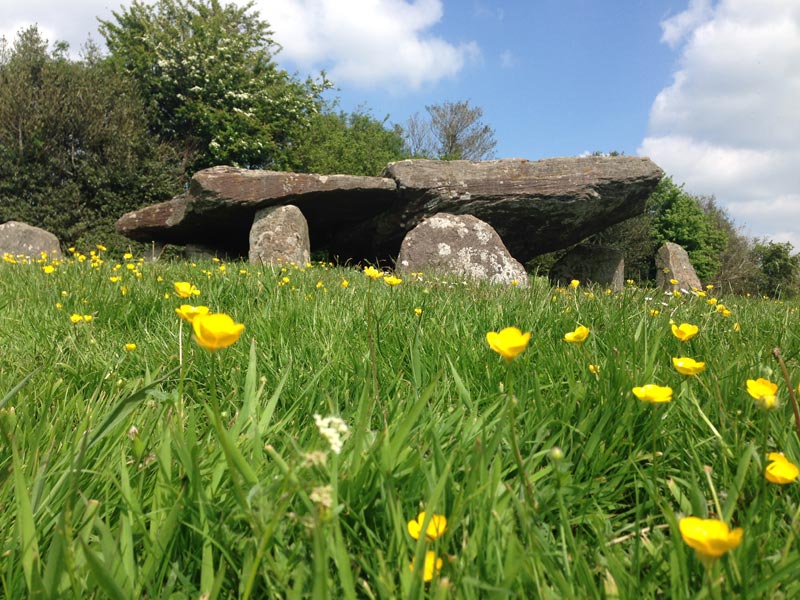
Fig.1 Arthur’s Stone (Herefordshire), constructed c. 3,000 BCE Photo © Tony Belton 2016

Fig.1 Arthur’s Stone (Herefordshire),
constructed c. 3,000 BCE
Photo © Tony Belton 2016

Great rings of giant standing stones, dating from primeval times – such as England’s Stonehenge and Brittany’s Carnac Stones – are wonderful prompts to sweeping thoughts about the length of Time and History.Yet small ancient monuments can be just as striking in their own way. On a very pleasant visit to Herefordshire in summer 2016, my partner and I decided, on the spur of the moment, to follow a signpost to view a historic burial tomb, named Arthur’s Stone. It proved to be wonderfully thought-provoking.

Arthur’s Stone (today guarded by English Heritage)is set high on a ridge between the Wye and Golden Valleys. The site is magnificent. The Stone burial chamber, which was constructed in c. 3,000 BCE, is somewhat dilapidated but that through-Time quality adds to its authenticity. Its impact is dignified without being grandiose. Interested visitors attend in small numbers rather than in great crowds. Yet the simplicity and venerability of the monument, and the tranquillity of its location, together give the Stone great resonance.

In the first place, it is evidence of serious intent on the part of those who placed the Stone high on the ridge. It may have been installed as an astronomical observation point – a function which is claimed (and debated) in the case of many ancient stone monuments. Certainly, none of these sites were constructed out of the blue. They indicate the existence of societies capable of planning, organising and implementing big communal projects. And they were ingenious makers and users of flint tools. Hence it’s not surprising that in the vicinity of Arthur’s Stone, there’s evidence of prior human labour in the form of numerous even older flint flakes and arrow-heads.

Whether this particular monument was built as a tomb, or instead as some form of storage chamber, is unknown. There are other similar monuments in the region, which are known as the ‘Severn-Cotswold’ group of chambered tombs. And there would have been regular communication links between these sites. Thus, while research has yet to reveal the precise functions of all these carefully-positioned great stones, it is clear that they had a significant role for those who manoeuvred them into their special sites. From the start, they had meaning.

A further intriguing train of thought is prompted by the attempts of later generations to ‘domesticate’ these historical markers by associating them with famous personages.So at some stage, long before the thirteenth century CE, this monument, like many other historic stones and relics, became associated in popular legend with the feats of King Arthur. Stories abounded. One reported that he had won a battle there. Another story recounted that he’d met a giant there and triumphantly slain him. Either way, Arthur’s Stone was being given a place in the epic history of the legendary British king. And the name has stuck.

Thereafter, the site has seen some real documented drama as well. In the fifteenth century, a knight was killed there in a fatal duel. And in September 1645 the embattled King Charles I dined at the Stone with his Royalist troops. Perhaps he intended the occasion as a symbolic gesture, although it did not confer upon him sufficient pseudo-Arthurian lustre to defeat Cromwell and the Roundheads. Charles I’s fleeting visit thus did not enter local folklore.

Then at some stage (the precise date is unknown), the site became a focal point for locally popular festivities at midsummer. Villagers in the nearby settlements of Dorstone and Bredwardine gathered in the sloping field in front of Arthur’s Stone, where they engaged in uninhibited drinking, dancing and ‘high jinks’  – away from the inquisitorial eye of the local clergy and magistrates. It was obviously fun, because the popular tradition continued well into Victorian times.

As a sober counter-balance, too, the local Baptists began in the nineteenth century to organise an ecumenical religious service there in high summer. Implicitly, they were saluting the Stone’s sacral reputation, whilst simultaneously purging its more recent pagan associations.

On my own visit there, I met by complete chance a charming senior citizen who lived locally.4   She told me of her personal memories, as a child before World War II, when she joined her school-fellows to sing hymns at the services held there each midsummer. It was a stirring occasion for them all.

The special nature of the place was (and is) undoubted. Throughout its five thousand years of existence, Arthur’s Stone has had multiple meanings and uses for the witnessing generations who both live nearby and visit from afar. Its story is protean. Whether the site is used for astronomy, royal burial, knightly duelling, open-air royal dining, unorthodox popular festivities, community religious services, or (today) for tourist visiting, Arthur’s Stone cannot be locked away into a wrongly named ‘pre-history’.

It does not spring from a long-gone era whose name implies that it pre-dates ‘real’ History.On the contrary. Arthur’s Stone has always been fully within History, which continues to unfold steadily, as long as Time itself does likewise. The great cosmic story is one that welds together both deep continuities and recurrent change. Local monuments do the same. In other words, Arthur’s Stone silently signals Time’s diachronic power to persist and to update simultaneously. And long may it continue to do so!

ENDNOTES:

1 For more on Time & History, see P.J. Corfield, Time-Space: We Are All in it Together (London, 2025).

2 See https://www.english-heritage.org.uk/visit/places/arthurs-stone.

3 For further information, see also A. Watkins, ‘Arthur’s Stone’, Transactions of the Woolhope Naturalists’ Field Club (1928), pp. 149-51; L.V. Grinsell, Folklore of Prehistoric Sites in Britain (1976); and J. Sant, Stone Spotting in Herefordshire (2000);

4 With reiterated thanks and warm appreciation to Ionwen E. Williams (née Davies).

5 For a further critique of the concept of ‘Prehistory’, see PJC, ‘Primevalism: Saluting a Renamed Prehistory’, in A. Baysal, E.L. Baysal and S. Souvatzi (eds), Problematising Time and History in Pre-History (2019), pp. 265-82.

For further discussion, see

To read other discussion-points, please click here

To download Monthly Blog 178 please click here

MONTHLY BLOG 174, HOW DOES INCREASING KNOWLEDGE ABOUT FUTURE TIMES IMPACT UPON THE ART OF PROPHECY?1

If citing, please kindly acknowledge copyright © Penelope J. Corfield (2025)

How does Increasing Knowledge about Future Times impact upon The Art Of Prophecy?

Copyright © Pinterest 2025

Humans learn from the past – and, sometimes, they gain immediate and urgent knowledge in the present too. But they cannot learn directly from the future that has not yet unfolded. That reality has not, however, prevented people from trying hard to look ahead. They can forecast; they can predict; they can prophecy; they can forewarn; and, yes, they can also calculate.2

The future, after all, is far from completely unknowable in broad outline. Thus, as long as the current cosmos survives, it will contain deep continuities (the basic principles of science will continue to hold) as well as gradual changes (animal species will continue their slow evolution), alongside drastic upheavals (volcanoes will erupt; earthquakes shake the ground; tsunamis sweep across seas and land; avalanches crash downhill; violent hurricanes and tornadoes spread devastation).

More specifically, too, various scientific experts can make detailed predictions. For example, astronomers predict the return into view from Planet Earth of some (though not all) interplanetary comets. Thus Halley’s Comet, which humans could last see in 1986, is predicted to become visible again in mid-2061, given that its orbit brings it relatively close to Earth approximately every 75-77 years.3 And, as for forecasting near-at-hand solar and lunar eclipses, well, astronomers can do that without even breaking sweat.

Deep-Space scientists also track the approach of asteroids. With their help, Earthlings will, hopefully, get good notice before the advent of the next big strike and can take preventive action. In that way, they can avoid the fate of the dinosaurs, when an asteroid strike 66 million years ago hit the Yucatan Peninsula – immediately annihilating many dinosaurs and then fatally devastating their habitats.4

Demographers meanwhile can calculate changes in the mean expectation of life among humans – with detailed breakdowns for people living in different regions of the globe. They also confirm that, while in healthy, well-fed societies, very many people today are living into ripe old age, there is a biological limit. A number of people been validated as living past the age of 110 years; but only one to date has survived past the age of 120. (She was Jeanne Calment of France, who died at the age of 122 years and 164 days).5 Certainly impressive. However, at the same time, demographers agree that it is unlikely that human lifespans will rise at all significantly beyond that boundary – even with the latest technological aids. We are mortals, with a distinctly finite lifespan.

Added to those examples, there are other fields where good, reliable data from the past can help people to make informed predictions about the future. In economics, analysts can make predictions about what will be the likely impact of (say) tax cuts; or tariff wars. Similarly, doctors make informed assessments of the progress of a patient’s illness. Meteorologists study past weather patterns in order to issue daily weather forecasts. Some bold scientists predict how developing technology will impact upon people’s future lives one hundred years hence.6 And so forth.

These forecasts are not always right, down to the very last detail. Sometimes, indeed – though not very often – informed predictions can turn out to be completely wrong. Yet together all these assessments and calculations mean that the future is not completely unknown territory. People can make their own judgements on these forecasts, and plan accordingly.

Prophets therefore risk getting crowded out of the field. The men and women, who gaze intently into the future to make predictions, are not projecting their thoughts onto a blank canvas. Future times are studded with scientifically predicted events. A prophet’s audience today will not gape with wonder, as an equivalent audience might have done two thousand years ago – or even more so two million years ago. Prophecy today is at a discount.

Take future sporting events. People like to know or guess who will triumph. But today there’s no need to call upon the services of a prophet or soothsayer. There are racing tipsters galore; as well as countless sporting commentators who give informed advice.

Or take passing examinations. It would be nice to know the result in advance. But it’s not hard to realise that the best way to do well is to revise seriously, rather than to run round the corner to consult a prophet. (And for those examination candidates who don’t grasp that truth, there are plenty of earnest tutors to tell them – repeatedly).

And then there’s success in matters of the heart. It can be exciting to be told by an exotic lady, gazing into a crystal ball, that you are about to be courted by a tall, dark and handsome stranger. Yet it’s also well to recall that there are many permutations to courtship. The handsome stranger might be a passionate lover … or a deceitful love-rat … or a wily financial scammer with eyes for nothing but your money. Love by all means – but keep your wits about you!

So what about the really big deal: prophecies about the end of the world … or at least the end of Planet Earth? These have by no means disappeared.7 Currently one Christian theologian predicts the end of Planet Earth in 2026, as the result of a collision with a giant asteroid. However, another theologian, this time an Islamist, declares that the end will not come before 2129.8 But these days such announcements do not command mass attention.

By contrast, there was in the early 1840s an extensive (though not universal) panic about the imminent End among sundry Christian communities in Britain and the USA. It was triggered by a prophetic warning from the American William Miller, a charismatic Baptist preacher. He used not only sermons but also posters and newsletters to announce that Christ’s Second Coming was due between March 1843 and March 1844. Nothing then happened. So Miller switched the date to 22 October 1844. Such specificity had impact. Numerous families in the USA sold up their homes and businesses, retreating to the mountains and stocking up with food to survive the coming Apocalypse.

What followed, however, was termed ‘the Great Disappointment’. Christ did not re-appear. Most followers were disillusioned. Yet a small number of true believers founded the Seventh Day Adventist Church, which is now a flourishing international community. Its members consider that, even if one specific prediction was wrong, the core prophecy remains true – meaning that it is still vital to be spiritually prepared.9

Since then, no End-of-World prophecy has had anything like that impact. As already noted, such forecasts still continue. Yet today they remain culturally niche, not mainstream. Immediately, there is the climate crisis which threatens the life of humans (and of numerous other species) on Planet Earth, rather than the survival of the entire cosmos. That should be enough to concentrate attention in the here-and-now. As for the very long term, there’s still a lot of Time to unfold. Scientists calculate that locally our sun has at least 5 billion years to continue shining.10 So if End-Time prophets don’t want to disillusion their followers, they should choose a cosmic end-date in the suitably far distant future. Meanwhile, today’s Earthlings already have a big planet-sized problem to resolve together.

ENDNOTES:

1 Another BLOG in my 2025 series, to mark publication of PJC, Time-Space: We Are All in it Together (Austin Macauley: London, 2025).

2 With thanks to Martina Cali and all the lively and thoughtful participants at the Antwerp Conference on Time on 15 November 2024, and especially to the organiser Jeroen Puttevils.

3 P. Lancaster-Brown, Halley and his Comet (1985); D.K. Yeomans, Comets: A Chronological History, of Observation, Science, Myth and Folklore (1991).

4 See variously A. Milne, Fate of the Dinosaurs: New Perspectives in Evolution and Extinction (1991); D. Preston, ‘The Day the Dinosaurs Died’, in The New Yorker (2019): https://www.newyorker.com/magazine/2019/04/08/the-day-the-dinosaurs-died.

5 See https://en.wikipedia.org/wiki/List_of_the_verified_oldest_people (viewed 24 May 2025).

6 M. Kaku. Physics of the Future: How Science Will Shape Human Destiny and Our Daily Lives by the Year 2100 (2011).

7 See e.g. S. Browne, The Other Side and Back: A Psychic’s Guide to Our World and Beyond (1999); idem, Prophecy: What the Future Holds for You (2004); and idem, End of Days: Predictions and Prophecies about the End of the World (2008).

8 https://en.wikipedia.org/wiki/List_of_dates_predicted_for_apocalyptic_events (viewed 25 May 2025).

9 E.R. Sandeen, The Roots of Fundamentalism: British and American Millenarianism, 1800-1930 (1978); R.L. Numbers and J.M. Butler (eds), The Disappointed: Millerism and Millenarianism in the Nineteenth Century (1993); and D.L. Rowe, God’s Strange Work: William Miller and the End of the World (2008).

10 G. Gamow. The Birth and Death of the Sun (1940; revised 1952).

For further discussion, see

To read other discussion-points, please click here

To download Monthly Blog 174 please click here

MONTHLY BLOG 173, IS THERE A MESSAGE TO BE LEARNED FROM THE MANY SAYINGS ABOUT TIME??

If citing, please kindly acknowledge copyright © Penelope J. Corfield (2025)

Copyright © Shutterstock 2025

‘Time and tide wait for no man’. ‘Time flies’. ‘Lost time is never found again’. ‘Time is of the essence’. ‘Every second counts’. ‘Do not put off to tomorrow what you can do today.’ ‘You may delay, but Time will not’ …

Wait a moment! Is there some message here? Sayings about Time abound; and they are mostly designed to make everyone aware that Time is fleeting by, moment by inexorable moment. Shakespeare (who else?) had a good phrase for it. Ever-speeding temporality is characterised as ‘cormorant, devouring Time’.

No use answering with rival dicta, such as ‘Time drags’; ‘Time crawls’; ‘Time lasts for ever’. Such alternative views don’t cut the mustard in Time-conscious urbanised societies, where clocks, watches and digital time-pieces abound and where life is closely timetabled.

Over very many generations, human have worked at measuring the passage of Time – and at communicating the result to the surrounding population. Clocks chime; church-bells ring; alarms go off noisily.

Many are the wise pronouncements that also confirm the immense value of fleeting temporality. ‘Time is the most valuable resource, given to everyone’. It is simultaneously a ‘grand Instructor’; the ‘greatest innovator’; the ‘greatest physician’. No surprise that it is also ‘precious’. Moreover, it can also act as an ‘avenger’ and a ‘reaper’. It has god-like powers.

Therefore there are numerous sayings that advise people to use their time well. ‘Take Time by the forelock’, runs one ancient adage. ‘Better three hours too soon than a minute too late’ (Shakespeare again). ‘Time is the coin of your life. It is the only coin you have – and only you can determine how it will be spent.  Be careful lest you let other people spend it for you!’ Classically, too: ‘Time is money’. Manage it wisely. Indeed, ‘until we can manage Time, we can manage nothing else’. And some quotations are pessimistic. ‘Time is what we want most but use worst!’

So can we get a grip on this elusive, powerful and at times chameleon-like cosmic phenomenon? It’s a great challenge, renewed daily. And the outcome? Well, another saying gives the best answer:‘Only Time will tell’.

ENDNOTES:
1 Another BLOG in my 2025 series, to mark publication of  PJC, Time-Space: We Are All in it Together (Austin Macauley: London, 2025).

For further discussion, see

To read other discussion-points, please click here

To download Monthly Blog 173 please click here

MONTHLY BLOG 172, CAN YOU NAME FIVE STRIKING POEMS ABOUT TIME??

If citing, please kindly acknowledge copyright © Penelope J. Corfield (2025)

172.1 Time’s Wingèd Chariot
© Phrase-finder 2025

In contrast to the dearth of good jokes about Time, there are very many great poems on that theme.1 Here, however, I’ve chosen just five.

Firstly, Andrew Marvell’s appeal to ‘To His Coy Mistress’ (published posthumously in 1681)2 is a magnificent example of the human awareness of life in ever-fleeting Time. The poet is keenly impatient to get his lover into bed with him; but she does not share his haste. So he reproaches her, gently enough but pointedly:

‘Had we but world enough and Time,

This coyness, lady, were no crime ….’

He explains that ideally he would take much longer to woo her – and to dwell in turn on all the beauties of her body and her heart. Yet he is vividly aware of the passing of Time. Or as he puts it, magnificently:

But at my back I always hear

Time’s wingèd chariot hurrying near;

And yonder all before us lie

Deserts of vast eternity. …’

Whether trying to win a race against the clock is the best appeal to get a coy lover into bed remains uncertain. The outcome, however, makes for a great poem, which has been multiply quoted and referenced. So Marvell did win a resonant through-Time fame, even though history does not record whether this poem actually melted the heart of his coy lover.

Another mighty poet of Time is William Shakespeare.3 His sonnets refer to temporality in tones ranging from acceptance to pulsating anger. In Sonnet 16, he urges the dedicatee to ‘Make war upon this bloody tyrant, Time’. Elsewhere, too, he refers to the dark power of ‘Devouring Time’ (Sonnet 19) or the harsh blows inflicted by ‘Time’s injurious hand’ (Sonnet 63) or by Time’s ‘scythe and crooked knife’ (Sonnet 100). Yet at other moments, Shakespeare stresses instead the speedy passage of ‘swift-footed Time’ (also Sonnet 19) and the unpredictability of ‘Time’s fickle glass’ (Sonnet 126). All variants being undeniably evocative.

Yet my favourite is Sonnet 116. It’s rightly famous and much quoted, because it applauds the power of Love to outlast even mighty Time. It starts briskly: ‘Let me not to the marriage of true minds/ Admit impediments’. And continues with a strong affirmation: ‘Love is not love/ Which alters when it Alteration finds’. No! Real human affection will triumph against all odds:

Love’s not Time’s fool, though rosy lips and cheeks

Within his bending sickle’s compass come.

Love alters not within his brief hours and weeks

But bears it out, even to the edge of doom’.

And, musing on tensions between the swift passing of Time and the eternity of Time, here’s my third choice. It’s the Ode to a Nightingale (1819) by John Keats.4 The poet is sadly downcast by ‘the weariness, the fever and the fret’ of daily living. He sits outside on a dark summer night, thinking of death whilst listening to the song of the nightingale:

Now more than ever seems it rich to die,

To cease upon the midnight with no pain, 

While thou art pouring forth thy soul abroad

In such an ecstasy!

Nonetheless, the poet’s thoughts turn also to the eternal powers of nature and of beauty. Some things can last through Time:

Thou wast not born for death, immortal Bird!

No hungry generations tread thee down;

The voice I hear this passing night was heard

 In ancient days by emperor and clown …

Thinking seriously about Time can thus induce thoughts of death – and antidotes to death. The fourth work cited here is not a charming poem – and not intended as such. It’s entitled Howl (1956) and that’s what it does. Alan Ginsberg5 starts bleakly: ‘I saw the best minds of my generation destroyed by madness, starving hysterical naked/’ … and he continues in that vein as he recalls their collective lives in Time. The poem’s long, long sentences, set as blank verse, reek of self-loathing allied to despair about his entre peer group, known as the ‘Beat Generation’.

Only occasionally does a wry humour shine through. Consider Ginsberg’s verdict on his friends’ disdain for the passing of Time. They threw their watches off the roof to cast their ballot for Eternity outside of Time & alarm clocks fell on their heads every day for the next decade’.

But Ginsberg was sure that he and his peer group were seeking something greater than a chaotic lifestyle. Hence they ‘dreamt and made incarnate gaps in Time & Space through images juxtaposed, and trapped the archangel of the soul between two visual images and joined the elemental verbs and set the noun and dash of consciousness together …’. Ginsberg’s personal solution was to embrace Buddhism, though not all did so.

Time’s travails can obviously lead to multiple outcomes. But it’s impossible not to be involved with Time. My fifth and last choice – ‘quick now, here, now always!’ – is The Four Quartets (1943), an amalgamation of four poems by the twentieth-century’s great mystic poet of temporality, T.S. Eliot.6 His message is often enigmatic. He loves a paradox. So one opaque comment declares the outcome to be: ‘Never and always!’ (Verse 3 Little Giddings).

Above all, therefore, Time is not divided into separate segments, Eliot argues. The past and the present are not locked away in separate compartments. They live in humanity’s through-Time consciousness. Hence he muses that:

What might have been and what has been

Point to one end, which is always present.

Consciousness reaches beyond the immediate moment. Yet, simultaneously, consciousness only operates in the here-and-now. So here is another paradox: ‘Only through Time, Time is conquered’. And living within the inexorable power of Time is painful, not restful. After all, ‘… this thing is sure/ That Time is no healer’ ….

Eliot thus expresses a dogged acceptance of the painful limitations of human existence. It’s a tough message. But people must trudge onwards. Not everyone would put the stoic message in these terms. Yet there’s no doubt that Eliot’s philosophy makes for highly evocative poetry:

Time present and Time past

Are both perhaps present in Time future,

And Time future contained in Time past.

If all Time is eternally present All Time is unredeemable.

ENDNOTES:

1 See PJC BLOG/ 171 (March 2025) for the lack of great jokes about Time. And for wider context, see PJC, Time-Space: We Are All in It Together (London, 205).

2 Andrew Marvell (1621-78)’s most famous poem, which was published posthumously in 1681, may well have been written many years earlier. in the early 1650s: see https://en.wikipedia.org/wiki/To_His_Coy_Mistress (viewed 17 March 2025).

3 For William Shakespeare (1564-1616) and temporality, see F. Turner, Shakespeare and the Nature of Time: Moral and Philosophical Themes in Some Plays and Poems (Oxford, 1971).

4 For John Keats (1795-1821), who did indeed die young, see variously R. Gittings, The Keats’ Inheritance (London, 1964);  S. Coote, John Keats: A Life (London, 1995); and J.E. Walsh, Darkling, I Listen: The Last Days and Death of John Keats (New York, 1999).

5 Alan Ginsberg (1926-97), Howl, written c. 1954-5 and first published in Howl and Other Poems (1956), after which the publisher was arrested and charged with obscenity. His subsequent acquittal greatly boosted sales: see https://en.wikipedia.org/wiki/Howl_(poem) (viewed 18 March 2025). For context, see too B. Miles, Ginsberg: A Biography (New York & London, 1989).

6 For T.S. Eliot (1888-1965), see variously P. Ackroyd, T,S. Eliot: A Life (1984); L. Gordon, T.S. Eliot: An Imperfect Life (1998); and K.P. Kramer, Redeeming Time: T.S. Eliot’s Four Quartets (Lanham, Md, 2007).

For further discussion, see

To read other discussion-points, please click here

To download Monthly Blog 172 please click here

MONTHLY BLOG 171, WHY ARE THERE NO GREAT JOKES ABOUT TIME??

If citing, please kindly acknowledge copyright © Penelope J. Corfield (2025)


Well, why are there no great jokes about Time?1 There are quite a few jokes about clocks and watches. They are not particularly funny … but they are certainly worth a gentle smile … like the following:

What kind of bugs live in clocks? Answer: Ticks!

Or how about this one: What do you say when you wear your watch on an aeroplane? Answer: Time flies!

 Or how about this comedic question: What’s the problem with eating a clock? Response: Well, it’s very time-consuming!

All the same, those jokes are really about variants of time-keeping and time-measurement.2 They may produce a smile or groan, in mock tribute to a bad joke. None, however, are designed to make people laugh and simultaneously think about the nature of temporality itself.

Time is far too huge, abstract, all-powerful and unstoppable to be amenable to local and immediate joking.

It’s a bit like trying to laugh about God. (If depicted, both the ‘Holy Father’ and ‘Old Father Time’ are characteristically shown as venerable old men, with long white beards, who are far too august, wise, and all-powerful to be easily teased). Thus there are lots of jokes (some of them offensive) about rival religious groups and practices, as well as about various spiritual leaders. But there are not so many quips about divine power in the abstract. Still, here’s one mini-story which made me smile:

An atheist scientist confronted God, saying; ‘We have figured out how to make a man’. God replied: ‘Okay – let me see you do it’. The scientist bent down and scooped up some earth. ‘Oh no’, objected God: ‘You must first make your own dirt’. 

 Asking about jokes makes one think about the purpose of comedy and making other people laugh. It’s a very human form of interaction. That is, quite a number of other mammalian species make sounds that are indicative of mirth. They do that typically in play and (in some cases) when being tickled. Furthermore, there have also been cases of orangutans in zoos, who have laughed mightily at magic tricks, performed before them by humans. Highly encouraging to magicians!3

No other species, however, use language to communicate humour, in the way that humans do. True, our humour does not always succeed. There are cultural and other variants that affect the reception of jokes and other forms of comedy. Nonetheless, humans use humour to laugh at the unexpected, to highlight the incongruous, to satirise one another, and to generate bonding through shared laughter.4

So humans laugh together. But not much about Time, or – more accurately – not much about the Time-Space continuum which frames the cosmos. It thus frames all human life and all humour too. Yet it’s just too vast and universal to be locally funny. That said, here is a final sally to raise a smile: Why did the crocodile eat the clock? Answer: To kill Time! [And did it succeed? No chance!]

ENDNOTES:

1 Expanding further upon discussions in PJC, Time-Space: We Are All in It Together (London, 2025).

2 For further examples, see J. Nasser, It’s About Time: An (Almost) Complete List of Time Jokes (2013).

3 See https://en.wikipedia.org/wiki/Laughter_in_animals (viewed 27 Feb. 2025)

4 See variously: J. Morreall (ed.), The Philosophy of Laughter and Humour (New York, 1986); T. Garfitt and others (eds), The Anatomy of Laughter (Abingdon, 2005); R.A. Martin, The Psychology of Humour: An Integrative Approach (Cambridge, Mass., 2006); and E. Weitz, The Cambridge Introduction to Comedy (Cambridge, 2009).

For further discussion, see

To read other discussion-points, please click here

To download Monthly Blog 171 please click here

MONTHLY BLOG 170, WHY THINK ABOUT TIME-SPACE, NOT SPACE-TIME??

If citing, please kindly acknowledge copyright © Penelope J. Corfield (2025)

Fig.1 The stunning Century Clock (built 2000) in Tianjin, NW China,
showing the giant clock, with a standard clock face,
encircled by carved signs of the Zodiac,
plus below the working machinery, and, out-stretched,
two giant arms, one holding the Sun,
the other the Moon.

Why think about Time-Space, instead of Space-Time? This BLOG, the second in my 2025 Time series, presents my answer.1

The first significant point to note is that rethinking Space-Time as Time-Space does NOT entail refuting Einstein’s theory of relativity, formulated and elaborated in the years 1905-17.2 Einstein himself did not use the term ‘Space-Time’. But in September 1908 his close intellectual ally (and former tutor), the mathematician Hermann Minkowski, highlighted the implications in justly famous terms:3

Henceforth Space by itself, and Time by itself, are doomed to fade away into mere shadows, and only a kind of union of the two will preserve an independent reality.

This striking declaration did not mean that there are no absolutes anywhere throughout the great cosmos. But the real absolute reality is nothing less than the integral union of Time and Space.

Following Minkowski, this reality then became known as the Space-Time continuum. And it is commonly abbreviated as Space-Time. Furthermore, given that Space is known to have three dimensions, it has encouraged the usage that specifies Time as ‘the fourth dimension’.4

Yet … a minority of philosophers, scientists, geographers and historians are unhappy with that version of the core terminology. They fully accept the union of Time and Space. But they consider that all-encompassing, uni-directional, and unfolding Time is a much mightier phenomenon than simply one dimension of Space, such as height, width or depth. Therefore they use the alternative formulation of ‘Time-Space’ as a more accurate rendering of the partnership.5

It gives priority to Time, which is the dynamic component within the continuum. And it leaves Space fully in the integral partnership – but not as the lead phenomenon. Instead, Space, with its three dimensions, is the splendid physical manifestation of Time.

Moreover, the mighty phenomenon of Time, which embraces the entire cosmos, has its own highly complex characteristics.6 It is not in any way simply a one-dimensional adjunct of Space.

In one way, Time-Space as a concept is hard to visualise. (In another way, it is not hard at all. Just look at the world around you: that’s Time-Space in integrated action).

However, illustrating the conceptual linkages is somewhat trickier. In that context, it’s good to look again at the stunning Century Clock (2000), located in the port city of Tianjin in NW China (see Fig.1, above). It was not built specifically to show the links between Time and Space. But, imaginatively, it does. The centrepiece is the gigantic clock, marking Time. Its mechanical works, including a large swinging pendulum, are visible below. And outstretched are two huge metalwork arms – one holding the Sun, the other the Moon. Thus Time appears as the dynamo, while its power in action holds together the unsleepingly ‘restless universe’.7

And, for those who like to think poetically, here are the evocative words of the seventeenth-century Welsh metaphysical poet Henry Vaughan:8

I saw Eternity the other night,
Like a great ring of pure and endless light,
All calm, as it was bright;
And round beneath it, Time in hours, days, years,
Driv’n by the spheres
Like a vast shadow mov’d; in which the world
And all her train were hurl’d.

Beautiful! With more to follow in next month’s BLOG, on why all this matters …!

ENDNOTES:

1 For further discussion, see PJC, Time-Space: We Are All in It Together (published by Austin Macauley: London, forthcoming 21 Feb. 2025), pp. 98-102.

2 See A. Einstein (1879-1p55), Relativity: The Special and General Theory, transl. R.W. Lawson (New York, 2005). For context, see too R. Stannard, Relativity: A Very Short Introduction (Oxford, 2008).

3 H. Minkowski (1864-1909), Address on ‘Space and Time’, given to 80th Assembly of German Natural Scientists and Physicians (21Sept. 1908), cited in https://en.wikipedia.org/wiki/Hermann_Minkowski (viewed 1 Feb. 2025)

4 There are numerous literary and cultural references to Time as the ‘fourth dimension’, such as N. Calder, Timescale: An Atlas of the Fourth Dimension (New York, 1983); R. Rucker, The Fourth Dimension: Towards a Geometry of Higher Reality (1st pub. 1984; republished with this title, Garden City, NY, 2014); and D. Roy, The Fourth Dimension: Enigma of Time (Irvine, Calif., 2021).

5 See e.g. N. Thrift and J. May (eds), Timespace: Geographies of Temporality (London 2001); T.R.. Schatzki, The Timespace of Human Activity: On Performance, Society and History as Indeterminate Teleology (Lanham, MD, 2010).

6 For more on this theme, see PJC, Time and the Shape of History (London, 2007); and summary in PJC, Time-Space, pp. 93-162.

7 M. Born, The Restless Universe (Glasgow & London, 1936); also N. Henbest and H. Couper, The Restless Universe (Frome & London, 1982).

8 H. Vaughan (1621-95), The World (1650), opening lines: in L.C. Martin (ed.), The Works of Henry Vaughan (Oxford, 1957)l and also available on-line: https://www.poetryfoundation.org/poems/45434/the-world (viewed 2 Feb. 2025).

For further discussion, see

To read other discussion-points, please click here

To download Monthly Blog 170 please click here

MONTHLY BLOG 169, GREAT CLOCKS OF THE WORLD

If citing, please kindly acknowledge copyright © Penelope J. Corfield (2025)

Image of Water Clock from Classical Greece

Fig.1 Image of Water Clock from Classical Greece –
in which the passing of Time is measured by a regulated flow of water.

My theme for 2025 is Time – the universal subject.1 So to kick-start the year, here are seven great clocks of the world – my personal selection out of the myriad of possible candidates.2 These are all on public display (there are countless more in museums) – and drawn from all quarters of the globe.

The first is located in the Republic of Honduras, Central America. It adorns the Cathedral of Comayagua; it is also known as the Arab clock, since it was designed by Moorish clock-smiths in c.1100; and presented, later in the seventeenth century, by the King of Spain to the city of Comayagua in New Spain (present-day Honduras); and in 1711 relocated once more onto the newly completed-Cathedral of the Immaculate Conception, where it remains. It is reportedly the world’s oldest continually functioning gear-clock. Its face [Fig.2] has a beautiful simplicity, whilst its gearing retains a wondrous complexity.

The Arab Clock (built c. 1100AD in Moorish Spain)

Fig.2 The Arab Clock (built c. 1100AD in Moorish Spain),
now adorning Comayagua Cathedral in Honduras – said to be the world’s oldest continually operating gear clock.

The second one comes from North America. It was designed by Thomas Jefferson and built in 1792 for his mansion on his plantation at Monticello, Virginia.3 Known as the Great Clock, it has two faces, the exterior one is visible to the wider world, while the elegant indoor face [see Fig.3] presides over the Great Hall. The clock is powered by the regular movement of two sets of cannonball weights, which descend below the clock into the cellar. These sinking weights drive the clock’s ticking – and the striking of a large time-keeping gong on the roof. Once a week, the weights have to be rewound with a special crank key, fitting into the winding mechanisms on the interior clock face: a task requiring a strong grip – and good balance to scale a special ladder.

The Elegant Interior Face of Thomas Jefferson’s Great Clock on his Virginia estate at Monticello

Fig.3 The Elegant Interior Face of Thomas Jefferson’s Great Clock on his Virginia estate at Monticello:
the central dial shows the hours and minutes, while the small whirling dial marks the passing seconds.
Also visible are the two slots for the weekly rewinding of the cannonball weights,
whose steady and slow descent regulates the clock’s time-keeping.

Circling around the world onto the massive Eurasian continent, the third great clock is to be found in Moscow. It’s a majestic beacon, devised to be seen from afar. Accordingly, the Kremlin Clock (also known as the Kremlin Chimes) is huge, its four faces displayed on the Spasskaya Tower within Moscow’s fortified Kremlin complex [see Fig.4]. Clocks were located there in the sixteenth century; and many updatings have followed. The current Kremlin Clock was designed in 1851; repaired in 1917-18, when a giant gold-plated lead pendulum was installed; restored again in 1932, when the Clock’s hands and numerals were gilded; and majorly restored again in 1974. Historically, the Clock was associated with regular chimes, though there have been periods when the bells were silent. Currently, the bells chime before the quarters and hours are struck – and play a tune, every three hours, on the hour. Compelling!

The majestic Kremlin Clock, also known as the Kremlin Chimes, adorns the imposingly decorated Spasskaya Tower

Fig.4 The majestic Kremlin Clock, also known as the Kremlin Chimes, adorns the imposingly decorated Spasskaya Tower (first built in 1491; restored 2015)on the east wall of the Kremlin complex, overlooking Red Square in central Moscow. Not only can the Clock be seen from afar but the 23 bells in the uppermost belfry serenade the city with specified tunes every three hours.

Swooping southwards and slightly westwards after that, the fourth great timepiece has its home in Cape Town. It’s also a beacon clock, located on the waterfront. The Clock Tower was built in 1882, and used initially as the Port Captain’s Office. The Victorian-Gothic edifice had a tidal gauge on the ground floor; and it also included a reading room, where ships’ captains could gather to catch up with the latest maritime news. The Clock itself was built in Edinburgh and installed high on the Waterfront Tower [see Fig.5], which had begun to lean ominously to one side – but has recently been righted. Scintillating!

Cape Town’s  Waterfront Clock Tower was constructed in 1882

Fig.5: Cape Town’s  Waterfront Clock Tower was constructed in 1882, when its clock, built in Edinburgh,
was first installed. The Victorian- Gothic edifice (adopted as a National Monument in 1978)
was treated to a thorough restoration in the 1990s, when the outer walls were repainted in the original bright red.

The next move, to find my fifth great clock, travels significantly north-eastwards, across the Indian Ocean, to Lucknow in Uttar Pradesh, northern India. There stands the utterly imposing Husainabad Tower, which is India’s tallest clock tower [see Fig.6]. It was constructed in steel and stone in 1881, to a design by the visionary architect Richard Roskell Bayne 4 – his architectural style fusing both Victorian and Mughal features. The great Clock is regulated by a gigantic pendulum; it has a sweet chime; and its clock-face, with the usual numerals and hands pointing to the hours and minutes, also has a floral outer frame, which removes any severity from the timepiece. Enchanting!
The towering splendour of the Husainabad Clock Tower at Lucknow, Uttar Pradesh, India

Fig.6 The towering splendour of the Husainabad Clock Tower
at Lucknow, Uttar Pradesh, India – the superb night-time illuminations
showcasing the Tower’s eclectic architectural styling and its floral-framed Clock.

Journeying ever eastwards (and slightly northwards), the search then brings us to the sixth great clock – this time in the Chinese city of Tianjin, on the coast south-east of Beijing. This is the Century Clock (built 2000). It is situated in the centre of a traffic roundabout near to the central station. This clock also represents fusion – between standard global Time – and traditional astronomical Time. Around the clock face, are the carved representations of twelve signs of the Zodiac. At the top is set Aries, as it brings good luck according to historic Chinese convention. The sculpture is visually stunning, with two massive metal-frame arms flung akimbo – one holding the Sun, the other the Moon – with the giant clock in the middle, and a huge swinging pendulum below [see Fig.7]. Its impact is equally stunning in daylight and when floodlit at night, Wham!

The stunning Century Clock (built 2000) in Tianjin, northwest China.

Fig.7 The stunning Century Clock (built 2000) in Tianjin, northwest China,
showing the giant clock, with a standard clock face, encircled by carved signs of the Zodiac,
plus below the working machinery, and, out-stretched, two giant arms,
one holding the Sun, the other the Moon.

And finally, returning westwards, across the extended continental landmass of Eurasia, the journey ends in Berlin, Germany. My final choice is my personal favourite. It is not strictly out-of-doors. But it is located in a public space – not in a museum. It’s the Clock of Flowing Time (1982),5 standing three floors high, within the open atrium at Berlin’s Europa Center [see Fig.8]. As its name implies, it is a water clock; and its mechanisms are regulated by the circulating flow of brightly-coloured water within its spheres and tubes. There is no standard clock-face. But onlookers can learn to gauge the time according to the number of spheres filled at any given moment. The whole system operates on a twelve-hour cycle, the spheres all emptying together at noon and midnight, before the sequence resumes once more. Non-Stop, Ever-Flowing Time! Poetic!

So many ways to tell the time.

So universal the quest … More next month!

The Clock of Flowing Time in Berlin’s Europa Center

Fig.8 The Clock of Flowing Time in Berlin’s Europa Center –
hard to explain, hard to photograph effectively
but intensely evocative of the non-stop flow of Time.

ENDNOTES:

1 P.J. Corfield, Time-Space: We Are All in It Together (forthcoming February 2025).

2 C. Jagger, The Great Clocks and Watches of the World (London, 1977; and later edns).

3 For Monticello, now a UNESCO-listed World Heritage site, see S.R. Stein, The World of Thomas Jefferson at Monticello (New York, 1993); and, for sober context, L. Stanton, ‘Those Who Labor for my Happiness’: Slavery at Thomas Jefferson’s Monticello (Charlottesville, VA., 2012).

4 R.R. Bayne (1836-1901), who was born in Warwickshire and died in British Columbia, had a prolific building career in India, designing not only workday railway stations but also numerous monumental buildings. A significant collection of his architectural designs and plans is held by the University of Victoria (B.C.) and this material may one day provide the basis for a good biography. See A Welch and others, ‘Building for the Raj: Richard Roskell Bayne’, RACAR, 34/2 (2009). pp. 74-86: https://www.racar-racar.com/uploads/5/7/7/4/57749791/_racar_34_2_06_welchseggerdecaro.pdf.

5 The clock was constructed to a design by the French physicist and artist, Bernard Gitton (b.1935), who has created numerous artistic and ingenious water-clocks. For context, see R. Lamb, ‘How Water-Powered Clocks Work’ (c.2009-10), in 2024 website: https://science.howstuffworks.com/environmental/green-tech/sustainable/water-powered-clock2.htm.

For further discussion, see

To read other discussion-points, please click here

To download Monthly Blog 169 please click here

MONTHLY BLOG 168, ANTWERP DIAMONDS: THREE BEAUTIFUL ASPECTS OF ANTWERP – DIAMOND CAPITAL OF THE WORLD

If citing, please kindly acknowledge copyright © Penelope J. Corfield (2024)

Fig.1 An Antwerp diamond ring –
symbol of the great City of Diamonds

Well, I didn’t get my diamond ring. But, better still, I became acquainted with a great and enchanting city- which I’d never visited before. (Even though it is quite near to my home-town of London – 196 miles (315km) as the crow flies – and readily accessible by the Eurostar train network).

The Conference that I attended in Antwerp on ‘Time and Prophecies’ was productive and stimulating (see BLOG/167 November 2024). And my partner Tony and I extended our stay in order to have some extra time to enjoy the city life. Here are my three personal diamonds.

Firstly, Antwerp has a number of superb art museums – commemorating the Flemish artistic tradition, which dates back to the sixteenth century. If you like any combination of the works of Rubens, Van Dyck, and the Pieter Breugels (Elder & Younger), plus many others, then Antwerp is the art-capital for you.

My personal favourite is the Printing-House Museum (Plantin-Moretus Museum) in the Friday Market.1 It is housed in the former residence-cum-printing establishment of two sixteenth-century printers. The exhibits take visitors through all the stages of printing, from setting the type, to printing the text, to viewing priceless historic books, and admiring handsome libraries with wooden shelves from floor to ceiling – crammed with yet more books. And all these exhibits are accompanied by the heavy creaking of the house’s original wooden floors. One cannot glide around this Museum in silence. Instead, all the visitors make and share the creaks and groans of the wooden flooring, as it has creaked and groaned since the sixteenth century.

Next, my second diamond must be the criss-crossing streets and squares in the centre of old Antwerp.2 These are surrounded by town houses of all eras, which co-exist harmoniously together in a veritable architectural historian’s delight. And, most importantly, city planning policy has ensured that the central residential area is dominated by town houses of five or six storeys – rather than by twentieth-century tower blocks. Churches and the impressive Cathedral thus rise above the dense town housing in an intimate, neighbourly way.

Added to that, many of the central streets are semi-pedestrianised. Consequently, they are chaotically crammed with a hotch-potch of walkers, cyclists, scooters. trams, buses, a few slow-moving cars, and a rare but highly artistic horse-drawn carriage.

Antwerp pedestrians therefore get a really good impression of what it must have been like to walk the streets of a sixteenth-century city centre. Admittedly, the transport technology has changed somewhat over the intervening years. Admittedly, too, there are no ubiquitous piles of horse manure as might have been expected in the days when transport was al horse-drawn. Nonetheless, the hustle and bustle of city life, on an intimate and accessible scale, is excellently well-conveyed by central Antwerp. Top spot in all this urban beauty? Walking round the busy GroenPlaats square, gazing up at the soaring Cathedral nearby, listening to the street buskers and their accordions, dodging the traffic, and patting the nose of a large, handsome and patient black horse, awaiting passengers seeking a ride in his antique carriage.

So what then is my third diamond? Reference might justly be made at this point to Antwerp’s shops and markets; to its huge variety of bars and restaurants; as well as its many monuments; and to its riverside walk (in process of upgrading) by the broad expanse of the River Scheldt.

But my third diamond is awarded to a rare gesture of social recognition. It is a sculpture in the heart of the city – located at the foot of Antwerp’s impressive Gothic Cathedral – close to its main entrance. That great building’s construction began in 1352; and since then, the church has undergone numerous repairs and reconstructions.3 And the unusual sculpture shows four men at work. The gesticulating figure is the architect; and the others represent the unsung builders who raised the immense edifice. Well done to the Belgian sculptor Jef Lambeaux! Very well done, to the Cathedral authorities who presumably commissioned the piece! And excellently well done to the entire building workforce! Respect! Diamonds all round!

Fig.2 Statue Commemorating Achievements of
Antwerp Cathedral Workforce (1935):
located at foot of Cathedral, close to Main Entrance –
photo © Tony Belton October 2024

ENDNOTES:

1 Since 2005, this Museum has been listed by UNESCO as a World-Heritage site. For its own website, see https://museumplantinmoretus.be/en; plus the survey in Wikipedia: https://en.wikipedia.org/wiki/Plantin%E2%80%93Moretus_Museum (viewed 30 Nov. 2024).

2 See e.g. C. Stahl (ed.), The Flaneur: Walking through Antwerp (2019) – multi-lingual edition.

3 See P. Rynck, The Cathedral of Our Lady in Antwerp (Ghent, 2005).

For further discussion, see

To read other discussion-points, please click here

To download Monthly Blog 168 please click here