
MONTHLY BLOG 149, Tracking Down The Fugitive History of the Body Louse
If citing, please kindly acknowledge copyright © Penelope J. Corfield (2023)

|
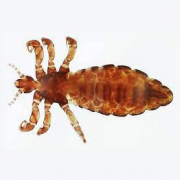
Image1 Human Body Louse |
Eighteenth-century Britons knew all about body lice. But – the subject was rarely mentioned. It was not just polite company that avoided any reference; but people in the wider society too. Body lice – those tiny human parasites – were well known as itchy, infernal nuisances. But they were also seen as shameful, which kept people silent on the subject.
One polite eighteenth-century euphemism for a scurrying louse was a ‘little brown gentleman’. Plainer terms that have evolved over time include ‘bugs’; and ‘crabs’ (for public lice); or catchy alliterations like ‘crotch crickets’ and ‘labia lobsters’.1
In fact, body lice commonly lurk in clothing and bedding, where they lay their eggs; and they crawl on human skin chiefly to feast upon human blood. However, lice not only leave a legacy of intense itching, which can in some people generate allergic reactions of deep lethargy and fatigue, but body lice are also carriers of numerous unpleasant fevers, including typhus.2
Scotland’s great bard, Robert Burns, was highly unusual in writing a poem To a Louse (1786).3 Yet he was entirely conventional in heaping abuse on the offending creature, which he glimpsed on a lady’s bonnet, at church.
Ye ugly, creepin’, blastit wonner [wonder],
Detested, shunn’d, by saunt an’ sinner!
And Burns’ poem concluded wryly that the lady’s fine apparel and glossy self-presentation in church was completely negated by the sight of the small creeping louse. Causing him to exclaim, famously:
O wad some Pow’r the giftie gie us
To see oursels as others see us!
Unfortunately for social historians, however, it’s rare to find documentation about how people actually coped with the nuisance of body lice. It was one of those things that was collectively known, but hardly ever put down in writing.
An oblique account does survive in the autobiography of Elizabeth Ham, a Somerset yeoman’s daughter, who later became a governess and author. She recollected a painful episode from her childhood in the 1780s. After scratching herself repeatedly, she instantly sent home, where she was abruptly isolated for several ‘comfortless’ days. She was treated with sulphur, while all her clothes and bedding were burned. It all amounted to a ‘purgatory for purification’, she wrote wryly.4 And, interestingly, while this domestic upheaval was clearly designed to rout an infestation of body lice, Ham herself did not name the offending creatures. Thus her short account – one of very few – remained cautious, almost superstitious, in its unwillingness to mention lice specifically.
That social shame is interesting in itself, for historians. But it makes it difficult to track variations in the day-to-day prevalence of body lice, as well as to understand variations in human responses (if any).
Genetic studies suggest that the body louse – pediculus humanus corporis – may have originated even before homo sapiens had evolved as a distinct branch of the Great Apes. Yet, once humans had become numerous – and especially once they invented clothing for regular use – there was immediately a happy partnership (from the louse viewpoint).5 Thereafter, the two species have co-evolved together – and co-migrated together all over the globe – the success of the body louse being limited only by regular counter-attacks by humans.
Historians are deeply grateful for such scientific insights, especially in the absence of other records. It is likely that the prevalence of body lice was widespread throughout history, being greater in those societies that did not encourage regular bathing, and much lesser in those that did. Furthermore, with the industrial production of soap – and the mass manufacture of readily washable cotton clothing from the later eighteenth century onwards – the assumption became more commonplace, that people should not normally be afflicted by these parasites. In those circumstances, people became more willing to allow strangers close to them – for example, when shaking hands.6
Yet, as Elizabeth Ham and her family discovered, there were sufficient numbers of lice, lurking in bedding and clothing, that infestation was always a possibility. In which case, the family swung immediately into action to counter-attack. They were shocked at the news – but they knew what to do – although, in Ham’s case, the family seem to have prioritised draconian action rather than reassurance for the disconcerted child.
So today lice infestation remains a known problem, with known remedies. The topic remains one that is shrouded in semi-secrecy. But, equally, some general propositions are clear. Body lice are commonly found in places where humans live in poverty and in crowded, insanitary conditions, without the chance to wash and/or to change their clothing regularly. Furthermore, heightened outbreaks can spread rapidly in times of crisis, such as in hastily assembled refugee camps, or among people surviving precariously in the aftermath of natural disasters, when normal sanitation is disrupted.
Biology has established a long-standing association between body lice and humans. It is a ‘natural’ relationship. However, it is clear that humans don’t love every manifestation of untrammelled nature.7 They don’t reciprocate the body louse’s deep and instinctive attachment. Will humans one day eliminate entirely their clinging but unloved friends? It is a logical possibility. Humans can live happily without body lice, whilst they depend entirely upon their human ‘hosts’. (Adult lice cannot live for more than 2-3 days without ingesting human blood). So the louse is vulnerable. But its final demise is, alas, not yet imminent.
1 Another variant parasite is the head louse which infests human scalps and has eggs known as ‘nits’. For distinctions between the various forms of lice that infest humans, see https://en.wikipedia.org/wiki/Body_louse.
2 As first noted in the classic study by H. Zinsser, Rats, Lice and History (Boston, 1935), pp. 167-70.
3 R. Burns, The Collected Poems, with Introduction by T. Burke (Ware, Herts., 2008), pp. 138-9.
4 E. Gillett (ed.), Elizabeth Ham by Herself, 1783-1820 (London, 1945), p. 33.
5 R. Kittler, M. Kayser and M. Stoneking, ‘Molecular Evolution of Pediculus Humanus and the Origin of Clothing’, Current Biology, 19:13 (2003), pp. 1414-17: doi: 10.1016/s0960-9822(03)00507-4.
6 See current research in progress.
7 A personal disclosure: in my student days, when travelling the world cheaply and staying in doss-houses, I woke one morning to find myself itching unbearably. I then attributed the condition to ‘bed bugs’. Eventually, the itching ceased after much washing and sea-bathing, followed by moving to new accommodation. However, I can record that I have been personally attacked (once!) by body lice – and, gentle readers, it was not fun.
For further discussion, see Twitter
To read other discussion-points, please click here
To download Monthly Blog 149 please click here