
MONTHLY BLOG 180, TIME & INSPIRATION
If citing, please kindly acknowledge copyright © Penelope J. Corfield (2025)
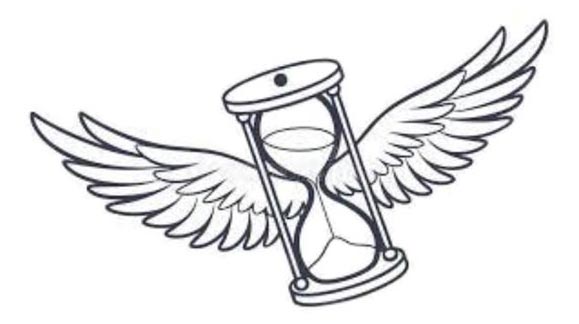
| Fig.1. Time Flies, illustrated by Hour-Glass with Wings, vector design Generative AI: © Dreamtime 2025 |
The relentless passage of Time is at once a threat and an inspiration.1 Of course, in one way, it’s menacing: Time flies! Time, once lost, cannot be retrieved! Time travels onwards and does not come back!
Yet that very fact can also provide an inspiration. As Abraham Lincoln once remarked: ‘In the end, it’s not the years in your life that count – it’s the life in your years’. Time is a finite resource; and therefore is best not squandered.
Charles Darwin expressed that very thought rather sternly, as befits an earnest Victorian: ‘A man who dares to waste one hour of Time, has not discovered the value of life’.
Or as the lyrics of Pink Floyd’s song on Time (1973), written by bass-guitarist Roger Waters, wryly noted:
‘Ticking away the moments that make up a dull day,
You fritter and waste the hours in an off-hand way. …
And then, one day, you find ten years have got behind you,
No-one told you when to run – you missed the starting gun.’
It’s necessary, therefore, to accept the brute fact that Time moves ever onwards. However much people may wish to ‘call back yesterday, bid Time return’, as one character in Shakespeare’s Richard II eloquently declaims,2 they cannot.
So the ever-moving passage of Time poses a bonny challenge. Optimists like the American essayist, Ralph Waldo Emerson, gave those prone to gloom some uplifting advice: ‘Write it on your heart that every day is the best day in the year’. And Benjamin Franklin was somewhat less exuberant but equally emphatic, as he warned that: ‘You may delay, but Time will not’. In other words, use Time, don’t waste it.
On the positive side, too, there’s a potential learning curve. Thus the eighteenth-century poet and moralist, Alexander Pope, observed sagely that: ‘No one should be ashamed to admit he is wrong, which is but saying, in other words, that he is wiser today than he was yesterday.’
Thus humans can look back at the past, not just with emotions that range from nostalgia to horror, but also to learn. And it’s essential that we do. The past – or rather the human study of the past – has generated a massive stock of information and expertise. Some things, it is true, are learned in the immediate moment. But we cannot learn from the future that has not yet happened.
Evidence, analysis, expertise and inspiration – surviving from the past, and tempered by perceptions and evaluations today – together provide the operating stock of knowledge that is needed for living successfully in Time.3 Without such a resource, humanity would face the same troubles that afflict individuals who have lost all memories and cannot function unaided. So the point is not just: don’t waste Time! But, crucially: learn from it! That wise advice was given by the world’s most renowned expert on temporal challenges, Albert Einstein. He urged: ‘Learn from yesterday, live for today, hope for tomorrow’. Action stations for us all! Learn and live! Proverbially: There’s no Time like the present!
ENDNOTES:
1 This BLOG concludes PJC’s year of Time-BLOGS (2025). For more, see too P.J. Corfield, Time and the Shape of History (2007); and idem, Time-Space: We Are All in it Together (2025).
2 Earl of Salisbury in Shakespeare’s Richard II (written c.1595/6; first pub. 1597), Act 3. sc.2.
3 For the multifarious debates on these complex issues, see C. Callender (ed.), The Oxford Handbook of Philosophy of Time (2011).
For further discussion, see Twitter
To read other discussion-points, please click here
To download Monthly Blog 180 please click here