Penelope J Corfield
  • HOME
    • Index to Blogs
    • Monthly Blogs
    • CONTACT
    • Key to Dancing Dates Film
  • CURRENT
    • President International Association C18 Studies
    • Lectures on offer
    • London University’s Long C18 History Seminar
    • Living in Battersea
    • Career at a Glance
    • PJC Publications
  • BRITISH HISTORY
    • Long C18 Overviews
    • Society & Culture
    • Town Life
    • Electoral History
    • Radical Poets
    • The Professions
    • Religion & Irreligion
  • GLOBAL
    • Urban History Through Time
    • C18 European History Overviews
    • Gender History
    • ‘Racial’ Classifications as Pseudo-Science
    • Responding to Climate Change
    • Advance of the International Sphere
  • TIME & HISTORY
    • Time & The Shape of History (2007)
    • Rethinking Historical Periodisation
    • Dimensions of The Long Term
    • Returning to Big History
  • HISTORY-MAKING
    • Why History Matters
    • History of History
    • Fellow Historians
    • Arts of Academic Assessment
    • Pleasures of Intellectual Life
  • REVIEWS
    • History Book Reviews
      • Social History
      • Approaches to History
      • Big History
    • Theatre Reviews
    • Civic/Political Commentaries
    • Personal Portraits
  • Menu Menu

Tag Archive for: cat

MONTHLY BLOG 119, THE FELINE MUSE IN THE LONG EIGHTEENTH-CENTURY

1 November 2020/in History, Monthly Blog/by Penelope J. Corfield

If citing, please kindly acknowledge copyright © Penelope J. Corfield (2020)
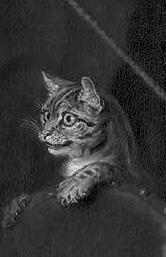
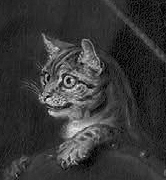
Fig.1: William Hogarth’s alert cat, ears pricked, teeth bared, claws unleashed, and intent gaze fixed upon its notional prey (a caged bird)– revealing the feral cat within the domestic pet. Source: detail from Hogarth’s Portrait of the Graham Children (1742).

Fig.1: William Hogarth’s alert cat, ears pricked, teeth bared, claws unleashed, and intent gaze fixed upon its notional prey (a caged bird)– revealing the feral cat within the domestic pet.
Source: detail from Hogarth’s Portrait of the Graham Children (1742).

Cats in Britain changed their roles decisively in the course of the long eighteenth century.1 They switched from being rat-catchers-in-chief into much treasured domestic pets. Of course, the changeover was not absolute. There were pet cats before this period; and there were rat- and mouse-catching cats long afterwards. Nonetheless, this era was a prime time of change, as Britain launched into its new history as a world leader in terms of urbanisation, commercialisation and (later) industrialisation. Families in town houses increasingly cultivated the companionship of cats not as on-site pest controllers (though that might be an agreeable by-product) but as domestic pets.

Two quick pointers confirm the process of adaptation. One was the growing number of men who worked as professional rat-catchers, undertaking the task more systematically than did domestic cats, which tended to fall asleep after dining well. And the second was the emergence of a regular market in pet food. Vendors known as ‘cat’s-meat men’ (who actually included a few women) walked the town streets with barrows of chopped horsemeat, purchased from the knackers’ yards. Such supplies preceded the tinned catfood which took over the market from the 1920s. Owners wanted their sleek, well-fed pets constantly on hand – not hungrily prowling in garrets and basements in search of food.

In this changed domestic environment, it was not surprising that many felines, snugly ensconced indoors, provided welcome companionship to authors sitting for long hours at their sedentary profession. Much the most famous eighteenth-century cat is the black-coated Hodge, which patiently kept Dr Johnson company while he toiled over his great Dictionary of the English Language (1755). This animal was not in fact the only feline pet in the household. But he was considered to be Johnson’s favourite. (In 1997 a sympathetic statue to Hodge was erected in Gough Square, outside the London townhouse which Dr Johnson rented between 1748 and 1759. Sometimes tourists place coins on the plinth or hang ribbons on the statue, for good luck).2

Other literary figures who were known as cat lovers included the writer and art connoisseur Horace Walpole; the mystic poet Christopher Smart; the legal philosopher Jeremy Bentham, who was one of the first protagonists of animal rights; the Poet Laureate Robert Southey, whose home at Greta Hall in Keswick was full of cats; the ‘Gothic’ author Mary Shelley; and the novelist Sir Walter Scott, whose tabby named Hinse (sometimes spelt Hinx) reportedly tyrannised over his pack of dogs.

Moreover, at least fourteen eighteenth-century poets were inspired by the feline muse. Their ranks included (chronologically) Anne Finch; John Gay, James Thomson; Thomas Gray; Christopher Smart; Percival Stockdale; Anna Seward; William Cowper; William Wordsworth; P.B. Shelley; Joanna Baillie; John Keats; John Clare – and (out of chronological sequence because his feline theme was somewhat exceptional) William Blake. His beautiful and enigmatic ballad saluted the ‘Tyger, tiger, burning bright’ (1794).3 But all the rest, however surprising it may seem (the ‘romantic’ Wordsworth? Keats? Shelley?), wrote poems about domestic cats.

Sometimes they wrote about specific animals. So the poet and anti-slavery campaigner Percival Stockdale wrote verses to commemorate Hodge, the favourite cat of his close friend Dr Johnson. While others wrote about archetypal cats. The poet and hymnodist William Cowper used a feline example to point a moral. His poem to The Retired Cat (written 1791) told the tale of a cat which was shut by mistake into a chest of drawers and left for long hours without food. It taught the imperious puss the invaluable lesson that the world did not revolve around her. But the moral was universal, as Cowper explained: ‘Beware of too sublime a sense/ Of your own worth and consequence!’ 4

Having enjoyed all these poems, my award for the weakest of these effusions goes to one by P.B. Shelley. His epigrammatic Verses on a Cat (c.1800) stress that the causes of suffering among all living creatures are diverse: ‘You would not easily guess/ All the modes of distress/ Which torture the tenants of earth’.5 In one specific case, however, the problem was clear:

But this poor little cat
Only wanted a rat,
To stuff its own little maw

It’s unfair, however, to laugh at Shelley’s plonking verse. It was an example of his very youthful wordplay, at the age of 8 or 9; and not written for posterity. Indeed, for a neophyte poet, the sentiments were impressively mature. Anyway it was saved by Shelley’s sister and published after the poet’s early death aged thirty, when no doubt all mementoes were being treasured.

In fact, all these eighteenth-century feline verse tributes are notable in their different ways. They range from tender to comic; from well-observed to schematic. Collectively, they confirm the ubiquity of cats in the eighteenth-century domestic scene.

Standing out from the pack, two poems record particularly graceful tributes to felinity. Best known is Thomas Gray’s Ode on the Death of a Favourite Cat, Drowned in a Tub of Goldfishes (1748).6 It’s wryly witty. And it ends with the poet’s sage observation that covetousness should not be taken too far.

Not all that tempts your wandering eyes
And heedless hearts, is lawful prize,
Nor all that glisters, gold.

Most wonderfully, however, Christopher Smart’s mid-century ruminations on his cat Jeoffry evoke a real living animal. The 74-line section appears within a much longer mystic-philosophical verse outpouring, entitled Jubilate Agno [Rejoice in the Lamb of God]. The work was not published until long after the poet’s death; and these days the Jeoffry section is often extracted as a separate poem. It is too long to quote in its entirety here. But it is written by a cat-lover, who, whilst struggling with personal anguish,7 wanted to record the special charm of his companion Jeoffry: ‘For he is a mixture of gravity and waggery’.8

As cats came to reign majestically upon the domestic hearth, the feline muse was considerably enhanced. No disrespect to other indoor pets. Or to those magnificent outdoor companions: dogs9 and horses.10 But the feline mixture of caution, companionship, and curiosity makes them potent triggers to innovative thought and cultural creativity. As well as featuring in traditional folkloric tales and magical spells, cats are now commemorated in novels, poems, art, cartoons, films, songs, opera, musicals, philosophical debates and scientific concepts (hello/goodbye to Schrödinger’s cat) and, of course, proverbial sayings. It’s seriously enough to make a cat laugh …

ENDNOTES:

1 For further context, see P.J. Corfield, ‘“For I will Consider my Cat Jeoffry”: Cats and Literary Creativity in Eighteenth-Century Britain’, work-in-progress for publication 2021.

2 But Hodge has rivals in fame. See P.J. Corfield, ‘An Eighteenth-Century Folly Builder, and Cat Lover’, Monthly BLOG 117 (Sept. 2020); and idem, ‘Commemorating Another Feisty Eighteenth-Century Sea-Going Cat’, Monthly BLOG 118 (Oct. 2020).

3 W. Blake (1757-1827), The Tyger (1794), in K. Raine (ed.), A Choice of Blake’s Verse (1970), p. 61.

4 W. Cowper (1731-1800), The Retired Cat (1791) in W. Hayley (ed.), The Life and Posthumous Writings of William Cowper … (Chichester, 1803), Vol. 1, p. 258.

5 P.B. Shelley (1792-1822), Verses on a Cat (1800; publ. 1858), in T. Hutchinson (ed.), The Chief Poetical Works of Percy Bysshe Shelley (1907), p. 829.

6 T. Gray, On the Death of a Favourite Cat, Drowned in a Tub of Goldfishes (1748), in F.T. Palgrave (ed.), The Golden Treasury … (1861; 1959), pp. 138

7 C. Mounsey, Christopher Smart: Clown of God (2001); N. Curry, Christopher Smart (Horndon, 2005).

8 C. Smart (1722-71), Jubilate Agno (c.1759-63; 1st pub. 1939), in idem, A Selection of Poetry, ed. D. Wheeler (2012), pp. 43, 123.

9 F. Jackson (ed.), Faithful Friends: Dogs in Life and Literature (1997); K.W. Chez, Victorian Dogs, Victorian Men: Affect and Animals in Nineteenth-Century Literature and Culture (Columbus, Ohio, 2017).

10 K. Raber and T.J. Tucker, The Culture of the Horse: Status, Discipline and Identity in the Early Modern World (Basingstoke, 2005); S. Forrest, The Age of the Horse: An Equine Journey through Human History (2016).

For further discussion, see Twitter

To read other discussion-points, please click here

To download Monthly Blog 119 please click here
https://www.penelopejcorfield.com/wp-content/uploads/2020/12/2020-11-No1-Hogarth-1742.jpg 257 166 Penelope J. Corfield https://www.penelopejcorfield.com/wp-content/uploads/2020/12/P.J.C.png Penelope J. Corfield2020-11-01 17:31:432021-01-12 18:52:52MONTHLY BLOG 119, THE FELINE MUSE IN THE LONG EIGHTEENTH-CENTURY

MONTHLY BLOG 118, COMMEMORATING ANOTHER FEISTY EIGHTEENTH-CENTURY SEA-GOING CAT

2 October 2020/in History, Monthly Blog/by Penelope J. Corfield

If citing, please kindly acknowledge copyright © Penelope J. Corfield (2020)

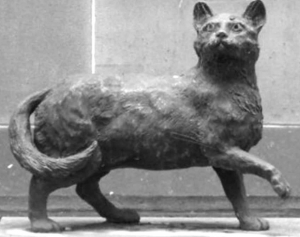
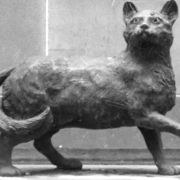
Fig. 1 John Cornwell’s bronze statue of Trim, the feisty black cat who sailed in the circumnavigation of Australia in 1801/3: located outside Mitchell Library, 173 Macquarie St, Sydney, Australia.

Fig. 1 John Cornwell’s bronze statue of Trim, the feisty black cat who sailed in the circumnavigation of Australia in 1801/3: located outside Mitchell Library, 173 Macquarie St, Sydney, Australia.

Another feisty sea-going cat from the eighteenth century has inspired a great set of contemporary statues in both England and Australia.1 This cat was jet black, with white feet and a white star on its breast. He was named Trim, after the devoted servant and companion-at-arms in Laurence Sterne’s whimsical novel Tristram Shandy (1759). And in the years 1801-3 the cat participated in the first recorded circumnavigation of Australia with Captain Matthew Flinders, the explorer and cartographer.2 It was he who later paid Trim the compliment of writing a special account of its life history, preserving its memory for posterity.3

At one point on the trip round Australia, the adventurous feline was washed overboard. But it swam/scrambled to reach a floating rope and clambered determinedly up to safety, winning the captain’s admiration. Indeed, Flinders later saluted Trim as ‘one of the finest animals I ever saw’. The cat had in fact been born on a ship and lived much of its life on board a series of different vessels. So it clearly had the feline equivalent of ‘sea-legs’. It also had a degree of good luck, surviving, with Flinders, the shipwreck of HMS Porpoise in 1803. (The disaster happened on the Wreck Reefs in the Coral Sea, off north-eastern Australia – an area now preserved as a historic shipwreck site).

Trim thus became something of a mascot for Flinders and his crew. Many cats were in fact to be found on board ships.4 They were recruited as mousers, providing on-board pest control. But they often provided affection and companionship as well. Flinders was not short of human company on his circumnavigation. One leading member of his team was a community leader named Bungaree, who came from the indigenous people of eastern Australia. He provided invaluable help as guide and negotiator.5 On more than one occasion on the long journey, he averted conflict between the sailors and various indigenous communities, with whom he managed to communicate, despite the linguistic barriers. Flinders, who wrote warmly of Bungaree’s ‘open and manly conduct’, also appreciated his kindness to Trim.

This adventurous cat was thus an archetype of the many travelling felines who appear in myths and legends.6 In such tales, their natures are resourceful and affectionate, without being dependent or needy. Cats like the companion of Dick Whittington; or Puss-in-Boots (who appears in many European variants); or the cat who proverbially ‘looks at a king’ are cool customers. They star in many folk cultures around the world, featuring in songs and musicals as well as art and cartoons. It is no surprise to find also that travelling cats are imagined as voyagers in space fiction.7 Shared adventures are integral to the long history of human-feline interactions.

What ultimately bonded Trim and Matthew Flinders, however, was their joint experience of imprisonment. On his return from Australia to Britain, the navigator put into the French-held island of Mauritius, hoping that his status as a scientific investigator would secure him safe passage. However, the governor detained him. France and Britain were then at war; and Flinders’ motives were suspected. He was held there from December 1803 to summer 1810, at first in close captivity, and then with greater freedom but without the right to leave. Trim kept Flinders company for most of this period of irksome inactivity; and it was when the cat disappeared suddenly some time in c.1808 (its fate unknown), that Flinders was moved to pen his account of the cat’s life. His warm tribute, stating that Trim was ‘ever the delight and pleasure of his fellow voyagers’, undeniably came from the heart.

Matthew Flinders has been extensively commemorated in Australia. Not only are there many places and institutions which bear his name (including the renowned Flinders University in Adelaide) but he himself named many features around the coast, in the course of circumnavigation. Bungaree has been much less well served, in terms of public commemorations. But Boongaree Island, off the Kimberley coast of Western Australia, was named after him in 1820; and there have been some nautical tributes. (A public statue is surely overdue).

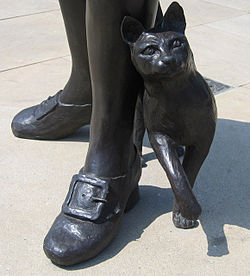
Meanwhile, the cultural star of Trim has risen in recent years. The publication of Flinders’ cat-biography in 1977, allied to the increasing contemporary desire to humanise past heroes, has brought the intrepid feline voyager to public attention. In 1996, John Cornwell’s bronze statue of Trim (Fig.1) was installed outside the Mitchell Library (State Library of New South Wales) in Sydney. The striking representation was an immediate success. The Library began to sell a range of Trim memorabilia and it names its restaurant as Café Trim. In 2006, another engaging statue of Flinders was installed in Donington, his Lincolnshire birthplace. In this case Trim leans confidently against the navigator’s leg, in a style which is obviously cat-like but not subservient. The statue was created by Judith Holmes Drewry, with input from local schoolchildren. Their joint project helped to foster local interest in Flinders, which has recently culminated in a successful campaign to have his remains reburied in Donington’s parish church.

Fig. 2 Trim with Matthew Flinders, standing together on a street corner in Donington, Lincolnshire, Flinders’ birthplace: statue by Judith Holmes Drewry, erected 2006.

Fig. 2 Trim with Matthew Flinders, standing together on a street corner in Donington, Lincolnshire, Flinders’ birthplace: statue by Judith Holmes Drewry, erected 2006.

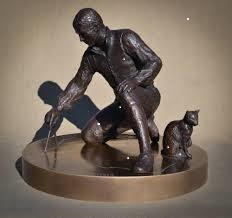
There is also one fine composite statue of Flinders, with Trim on the lookout, both crouching over a chart of the territory of Terra Australis, Flinders being one of the most determined to popularise its name as Australia. This monument, devised by Mark Richards, was erected in 2014. It was timed to commemorate the bicentenary of Flinders’ death in 1814, at the comparatively early age of 40. And the statue was aptly located at Euston Station, which was later constructed over the graveyard where the navigator was buried.8 (His coffin was discovered in 2019 during excavations for the new high-speed rail link, leading to the successful campaign for Flinders to be reinterred at Donington).Fig.3 Flinders, compasses in hand, and Trim on the watch, crouch together over the map of Australia: elegantly apt statue by Mark Richards, installed at Euston Station with copy also at Tasman Terrace, Port Lincoln, Australia.

Fig.3 Flinders, compasses in hand, and Trim on the watch, crouch together over the map of Australia: elegantly apt statue by Mark Richards, installed at Euston Station with copy also at Tasman Terrace, Port Lincoln, Australia.

So these companions on the move are commemorated in multiple locations. The moral, from the viewpoint of a feline wishing to be remembered by posterity, was to be loved by a writer with time to write a cat-biography on its behalf. And for Flinders? He was a great namer of places: among others, Australia’s Port Lincoln, after the county of his birth; Kangaroo Island, named for the abundant wildlife there; Encounter Cove, where he met and exchanged news of his discoveries with the French scientist Nicholas Baudin, who was also exploring the world far from his homeland. Naming has a certain power – not supreme power; but influential. And, yes: Flinders did well to identify the feisty black cat with white feet as Trim – neat, natty, nautical, appealing, affecrtionate – and now memorable as well.

ENDNOTES:

1 Companion-piece to PJC BLOG.117 (Sept. 2020), entitled: ‘An Eighteenth-Century Folly Builder and Cat Lover’. For further context, see also P.J. Corfield, ‘“For I will Consider my Cat Jeoffry”: Cats and Literary Creativity in Eighteenth-Century Britain’, work-in-progress for publication 2021.

2 K. Morgan, Matthew Flinders: Maritime Explorer of Australia (2016).

3 M. Flinders, Trim: Being the True Story of a Brave Seafaring Cat (1977; 1997); https://en.wikipedia.org/wiki/Trim_(cat).

4 See V. Lewis, Ship’s Cats in War and Peace (2001); and listings of known travelling cats in https://en.wikipedia.org/wiki/Ship%27s_cat.

5 K.V. Smith, King Bungaree (Kenthurst, 1992).

6 H. Loxton, Cats: 99 Lives – Cats in History, Legend and Literature (1999)

7 An example is the cat Spot in the sci-fi TV series Star Trek (1966- ).

8 https://en.wikipedia.org/wiki/Matthew_Flinders.

For further discussion, see Twitter

To read other discussion-points, please click here

To download Monthly Blog 118 please click here

https://www.penelopejcorfield.com/wp-content/uploads/2020/12/CATS10-TRIM-AT-SYDNEY002.jpg 674 854 Penelope J. Corfield https://www.penelopejcorfield.com/wp-content/uploads/2020/12/P.J.C.png Penelope J. Corfield2020-10-02 17:18:082021-01-12 18:52:52MONTHLY BLOG 118, COMMEMORATING ANOTHER FEISTY EIGHTEENTH-CENTURY SEA-GOING CAT

MONTHLY BLOG 117, AN EIGHTEENTH-CENTURY FOLLY-BUILDER & CAT-LOVER

4 September 2020/in History, Monthly Blog/by Penelope J. Corfield

If citing, please kindly acknowledge copyright © Penelope J. Corfield (2020)


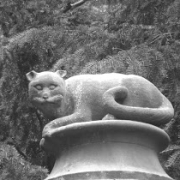
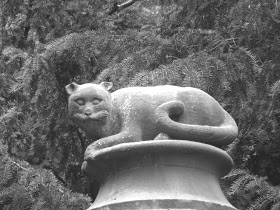
Public monuments to cats – as opposed to literary, artistic and musical celebrations1 – are rare to find, especially dating from the eighteenth century. So this majestic example deserves full appreciation. The lordly cat sits atop a giant Grecian vase, all forming the substantial Cat Monument.2 It was designed in 1749 and built c.1770 in the new weatherproof composite known as Coade Stone.3 Erected at Shugborough Park in Staffordshire, the Monument was commissioned by Thomas Anson (c.1695-1773). He was the felinophile, who owned the estate and had the wealth as well as the space to indulge his taste for architectural patronage in full.

Curiously enough, the identity of this publicly honoured cat remains uncertain. One strong possibility is that it commemorates Thomas Anton’s own favoured pet, named Khouli-Khan. This cat was the last of a line of Persian cats owned by the family. Hence, behind the luxuriant mustachios on the Monument’s lordly feline, the statue may show the round face and short muzzle that is characteristic of that particular breed.

Another possibility, however, is that the honoured cat was the adventurous moggy who circumnavigated the globe in the years 1740-44 with Admiral George Anson (1697-1762). He was the much admired younger brother of Thomas Anson. And the childless George Anson had bequeathed his great fortune, based upon Spanish treasure, to his older sibling. As a result, some of the monuments and memorabilia at Shugborough Park were devised as fraternal tributes to the circumnavigator. In that context, therefore, it is possible that the Cat Monument commemorates the circumnavigating cat.

Throughout this period (as in earlier and later eras), thousands of feline pest controllers travelled the high seas.4 They dined on the mice and rats which infested the wooden ships of the commercial fleet and the Royal Navy. (Keeping pets on board was banned by the British Navy only in 1975). Often these sailing cats were adopted by the crews as informal mascots. The feline companion (name unknown) of George Anson seems to have been a talisman of that ilk. Indeed, it is quite possible that the Cat Monument commemorates not one specific cat but human admiration for the species generically. The design is certainly eclectic. Around the Monument’s plinth are the carved heads of Corinthian goats, which were kept on the Shugborough Park estate c.1768. But the lofty cat is the king.

Accompanying the Monument, meanwhile, Anson commissioned an extraordinary array of follies and fancies.5 The Chinese House (1747) is one of the earliest examples of oriental design in Britain. A Gothic Ruin, complete with a gothic pigeon-house, followed in 1750. The Shepherd’s Monument was built in the later 1750s, taking the form of an ornamental arch around a pastoral bas-relief. (Two outer pillars and a classic pediment were added in 1763). A Doric Temple followed in c.1760. The massive Hadrian’s Arch was then erected in 1762, at a high point on the estate with extensive views. Built in a style borrowed from classical Athens, the design was adapted as a tribute to George Anson, who died in 1762, and George’s wife Elizabeth. A Tower of the Winds, based upon the Athens’ Horologium of Andronikos, was created in 1765, initially with a surrounding pool of water, which was lost in the course of flood damage on the estate in 1795. And in 1771 the Lanthorn of Demosthenes, based upon the design of an Athenian house dating from 4BCE, completed Anson’s career as an alfresco architectural patron. (He also remodelled the ancestral Shugborough Hall and amassed a collection of memorabilia).

Amongst this eclectic miscellany of edifices, the Cat Monument more than holds its own. It has a stately presence, framed by trees. It is not overawed by its Gothic, Oriental, Doric or Corinthian monumental companions, elsewhere in Shugborough Park. Whether it commemorates one adventurous globe-trotting feline, or one exotic Persian cat, or all cats generically, it makes its point finely.

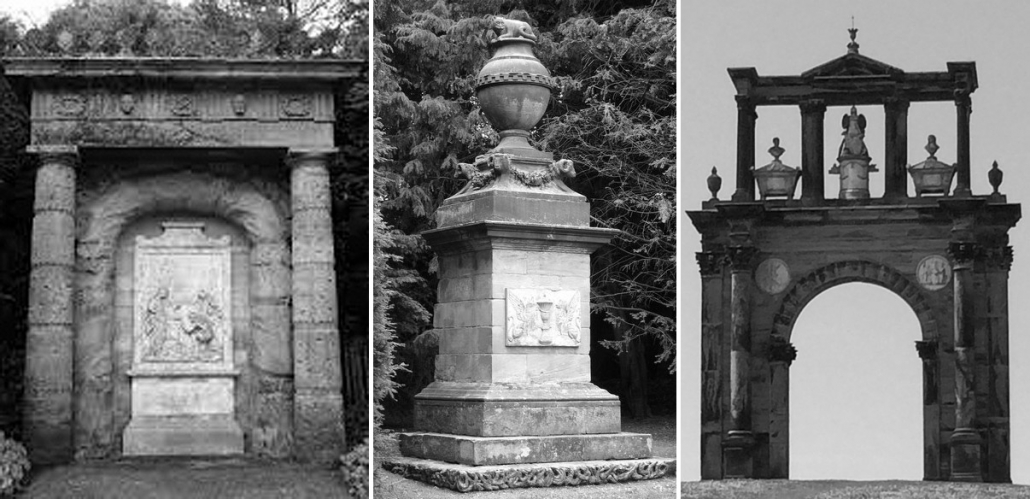
Fig.2.1-3 Three Shugborough Park Monuments, Commissioned by Thomas Anson:
(L) The Shepherd’s Monument (later 1750s; expanded 1763)
(Centre) The Cat Monument (designed 1749; built c.1770)
(R) Hadrian’s Arch (1762), adapted as a tribute to Admiral George Anson and his wife Elizabeth.

Around the globe – and at home in Staffordshire – feline companionship is something to admire. A cat may look at an admiral or at a country landowner (and MP) or at a king. And humans look closely at these classic domestic companions too. At a time of global crisis, compounded of climatic, epidemiological, economic and political challenges, it is as well for humans to recollect their pan-global co-residence with all living beings. And, not least among them, those great triggers to the literary imagination in the form of the amiable, adventurous, wily, and famously enigmatic cats.6

ENDNOTES:

1 H. Loxton, Cats: 99 Lives – Cats in History, Legend and Literature (1999).

2 For the Cat Monument (designed 1749; erected c.1770) NGR: SJ9932022722, see https://www.nationaltrust.org.uk/shugborough-estate/features/parkland-buildings-monuments-and-follies

3 H. Van Lemmen, Coade Stone (Princes Risborough, 2006).

4 See V. Lewis, Ship’s Cats in War and Peace (2001); and listings in https://en.wikipedia.org/wiki/Ship%27s_cat/.

5 All monuments are listed and dated in https://www.nationaltrust.org.uk/shugborough-estate/features/parkland-buildings-monuments-and-follies

6 See P.J. Corfield, ‘“For I will Consider my Cat Jeoffry”: Cats and Literary Creativity in Eighteenth-Century Britain’, work-in-progress for publication 2021.

For further discussion, see Twitter

To read other discussion-points, please click here

To download Monthly Blog 117 please click here

https://www.penelopejcorfield.com/wp-content/uploads/2020/12/2020-09-No1-CAT-MONUMENT-CLOSE-UP-Shugborough.jpg 210 280 Penelope J. Corfield https://www.penelopejcorfield.com/wp-content/uploads/2020/12/P.J.C.png Penelope J. Corfield2020-09-04 16:41:572021-01-12 18:52:52MONTHLY BLOG 117, AN EIGHTEENTH-CENTURY FOLLY-BUILDER & CAT-LOVER
Search Search

Monthly Blogs

  • MONTHLY BLOG 184, THE MOON – FAMILIAR FRIEND OR LONELY STRANGER? 2 April 2026
  • MONTHLY BLOG 183, HICKORY DICKORY DOCK! IN MEMORY OF MY LATE BROTHER JULIAN, OUR HAPPY CHILDHOOD TOGETHER, AND HIS LIFELONG SENSE OF DROLL HUMOUR 1 March 2026
  • MONTHLY BLOG 182, TO LAUGH OR CRY? RESPONDING TO ACADEMIC CRITICISMS 2 February 2026
  • MONTHLY BLOG 181, A YEAR OF POEMS 3 January 2026
  • MONTHLY BLOG 180, TIME & INSPIRATION 1 December 2025
  • MONTHLY BLOG 179, IDENTIFYING DIFFERENT ERAS OF TIME: POTENTIAL & PITFALLS … 1 November 2025
  • MONTHLY BLOG 178, THINKING THROUGH TIME AT ARTHUR’S STONE IN HEREFORDSHIRE 1 October 2025
  • MONTHLY BLOG 177, SONGS ABOUT TIME 3 September 2025

Categories

  • 2026 – Year of Poetry
  • Autobiography
  • Civics
  • Current Affairs
  • Family Memories
  • History
  • Monthly Blog
  • Notices
  • Personal
  • Reviews
  • Skills
  • Time

Archives

Tags

academics agenda ancestry battersea britain christianity continuity degree diagenesis dialectical discussion education eighteenth century ethnicity Georgian government historian historians history humanities humans knowledge labour labour party language London metamorphosis paradigm shift Penelope J Corfield poet policy politicians politics professor research students teachers time traditions transformation universities university vocational voters writing

Penelope J. Corfield

Penelope J. Corfield is a historian, lecturer and education consultant. She recently served as the President of the International Society for Eighteenth-Century Studies (ISECS).

Recent Posts

  • MONTHLY BLOG 184, THE MOON – FAMILIAR FRIEND OR LONELY STRANGER? 2 April 2026
  • MONTHLY BLOG 183, HICKORY DICKORY DOCK! IN MEMORY OF MY LATE BROTHER JULIAN, OUR HAPPY CHILDHOOD TOGETHER, AND HIS LIFELONG SENSE OF DROLL HUMOUR 1 March 2026

CONTACT

Penelope J. Corfield Historian
contact me here

SEARCH THIS SITE

Search Search

SHARE THIS

QUICK LINKS

© Copyright - Penelope J Corfield 2026. All rights reserved. | Dancing Dates Film by Edwina Hannam | Site by Starling Design
  • Link to X
  • Link to Rss this site
  • Link to Mail
Scroll to top Scroll to top Scroll to top

This site uses cookies. By continuing to browse the site, you are agreeing to our use of cookies.

OKLearn more

Cookie and Privacy Settings


How we use cookies

We may request cookies to be set on your device. We use cookies to let us know when you visit our websites, how you interact with us, to enrich your user experience, and to customize your relationship with our website.

Click on the different category headings to find out more. You can also change some of your preferences. Note that blocking some types of cookies may impact your experience on our websites and the services we are able to offer.

Essential Website Cookies

These cookies are strictly necessary to provide you with services available through our website and to use some of its features.

Because these cookies are strictly necessary to deliver the website, refusing them will have impact how our site functions. You always can block or delete cookies by changing your browser settings and force blocking all cookies on this website. But this will always prompt you to accept/refuse cookies when revisiting our site.

We fully respect if you want to refuse cookies but to avoid asking you again and again kindly allow us to store a cookie for that. You are free to opt out any time or opt in for other cookies to get a better experience. If you refuse cookies we will remove all set cookies in our domain.

We provide you with a list of stored cookies on your computer in our domain so you can check what we stored. Due to security reasons we are not able to show or modify cookies from other domains. You can check these in your browser security settings.

Google Analytics Cookies

These cookies collect information that is used either in aggregate form to help us understand how our website is being used or how effective our marketing campaigns are, or to help us customize our website and application for you in order to enhance your experience.

If you do not want that we track your visit to our site you can disable tracking in your browser here:

Other external services

We also use different external services like Google Webfonts, Google Maps, and external Video providers. Since these providers may collect personal data like your IP address we allow you to block them here. Please be aware that this might heavily reduce the functionality and appearance of our site. Changes will take effect once you reload the page.

Google Webfont Settings:

Google Map Settings:

Google reCaptcha Settings:

Vimeo and Youtube video embeds:

Other cookies

The following cookies are also needed - You can choose if you want to allow them:

Accept settingsHide notification only