
Penelope J Corfield
  • HOME
    • Index to Blogs
    • Monthly Blogs
    • CONTACT
    • Key to Dancing Dates Film
  • CURRENT
    • President International Association C18 Studies
    • Lectures on offer
    • London University’s Long C18 History Seminar
    • Living in Battersea
    • Career at a Glance
    • PJC Publications
  • BRITISH HISTORY
    • Long C18 Overviews
    • Society & Culture
    • Town Life
    • Electoral History
    • Radical Poets
    • The Professions
    • Religion & Irreligion
  • GLOBAL
    • Urban History Through Time
    • C18 European History Overviews
    • Gender History
    • ‘Racial’ Classifications as Pseudo-Science
    • Responding to Climate Change
    • Advance of the International Sphere
  • TIME & HISTORY
    • Time & The Shape of History (2007)
    • Rethinking Historical Periodisation
    • Dimensions of The Long Term
    • Returning to Big History
  • HISTORY-MAKING
    • Why History Matters
    • History of History
    • Fellow Historians
    • Arts of Academic Assessment
    • Pleasures of Intellectual Life
  • REVIEWS
    • History Book Reviews
      • Social History
      • Approaches to History
      • Big History
    • Theatre Reviews
    • Civic/Political Commentaries
    • Personal Portraits
  • Menu Menu

Tag Archive for: chairman mao

MONTHLY BLOG 62, IS THE PAST DEAD OR ALIVE? AND THE SNARES OF SUCH BINARY QUESTIONS.

1 February 2016/in History, Monthly Blog/by Penelope J. Corfield

If citing, please kindly acknowledge copyright © Penelope J. Corfield (2016)

Is the past dead or alive? Posing such a binary question insists upon choice; but the options constitute a false dichotomy. Nonetheless, the death of the past is often proclaimed. This BLOG examines the arguments for and against; and highlights the snares of binary thinking.

Firstly, the past, dead or alive? The ‘death of the past’ is a common, possibly reassuring notion. If you have forgotten the History dates learned at school, then don’t worry, you are in good company. Most people have. In the USA there is a sad debate entitled: ‘Is History history?’ There is at least one book entitled The Death of the Past.1 In fact, that particular study laments that people forget far too much. Nonetheless, emphatic phrases circulate in popular culture. ‘Never look back. The past is dead and buried’. ‘The bad (or good) Old Days have gone’. Something or other is irrevocably past – rendering it ‘as dead as the proverbial dodo’, which was last reliably sighted in Mauritius in 1662.2016-02 No1 Frohawk_Dodo-1905
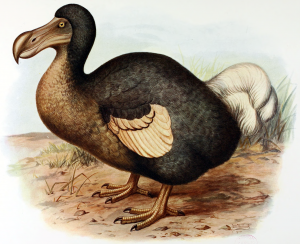
Illus. 1: The Dodo by F.W. Frohawk,
from L.W. Rothschild’s Extinct Birds (1907).

At the same time, however, there’s a rival strand of thought, which asserts that the past is very much alive. The most famous and often quoted claim to that effect comes from William Faulkner, writing in the American Deep South in 1951, where memories and resentments from Civil War times have far from disappeared. ‘The past is never dead’, he wrote. ‘It’s not even past’. 2

Another strong statement to that effect came from Karl Marx in 1851/2. He thundered at the unpastness of the past. Revolutionary activism was constantly hampered by old thinking and old ideas: ‘The tradition of all the dead generations weighs like a nightmare upon the brain of the living’.3

Opposition to old thinking was accordingly expressed by many later Communist leaders. The ‘new’ was good and revolutionary. Antiquity was the dangerous foe. Chairman Mao’s campaign against the ‘Four Olds’ – Old Customs, Old Culture, Old Habits, Old Ideas – was a striking example, at the time of his intended Cultural Revolution in 1966.4 Yet the fact that various traditional aspects of Chinese life still persist today indicates the difficulty of uprooting very deeply embedded social attitudes, even when using the resources of a totalitarian state.

For historians, meanwhile, it’s best to reject over-simplified choices. Many things in the past (both material and intangible) have died or come to an end. Yet far from everything has shared the same fate. Ideas, languages, cultures, religions persist through Time, incorporating changes alongside continuities; biological traits evolve over immensely long periods; the structure of the cosmos unfolds over many billennia (an emergent neologism) within a measurable framework.

Hence there’s nothing like a rigid divide between past and present. They are separated by no more than a nano-second between NOW and the immediate nano-second before NOW, so that legacies/contributions from the past infuse every moment as it is lived.

Secondly, thinking in terms of binary alternatives: Having to choose between bad/old/dead versus good/new/alive is a classic example of binary thought. It is an approach commonly cultivated by activists, for example in revolutionary or apocalyptic religious movements. Are you with the great cause or against it? Such attitudes can be psychologically powerful in binding groups together.

Binaries can also be useful when assessing the strength and weakness of an argument or a proposed course of action. As bimanual creatures, we can consider the pros and cons, using the formula ‘on the one hand’ … ‘on the other hand’. Indeed, when making a case, it’s always helpful to understand the arguments against your own. That way, when facing a fundamental critic, you are prepared. (Binary options also provide a good way to bully a witness on oath: Come on, answer, Yes or No! When the truthful reply might be ‘Somewhat’ or ‘Maybe’.)

It’s even been argued that some human societies are intrinsically binary in their deepest thought patterns. Russian culture is one that has been historically so identified.5 Hence binary switching may have helped to familiarise the population with the country’s dramatic twentieth-century lurches from Tsarism to Communism and, later, back to a different form of oligarchic Democracy. (Do today’s Russians agree; or perhaps, agree somewhat?)

Either way, there is no doubt that binary thought, like binary notation, has its uses. But studying History requires the capacity to grapple with complexity alongside simplicity. Is the past dead or alive? The answer is both and neither. It falls within the embrace of ever-stable ever-fluid Time, which lives and dies simultaneously.

1  J.H. Plumb, The Death of the Past (1969; reissued Harmondsworth, 1973; Basingstoke, 2003).

2  W. Faulkner, Requiem for a Nun (1951), Act 1, sc. 3.

3  K. Marx, The Eighteenth Brumaire of Louis Napoleon (1851/2), in D. McClellan (ed.), Karl Marx: Selected Writings (Oxford, 1977), p. 300.

4  P. Clark, The Chinese Cultural Revolution: A History (Cambridge, 2008); M. Gao, The Battle for China’s Past: Mao and the Cultural Revolution (2008).

5  Y.M. Lotman and B.A. Uspensky, ‘Binary Models in the Dynamics of Russian Culture’, in A.D. and A.S. Nakhimovsky (eds), The Semiotics of Russian Cultural History (Ithaca, NY., 1985), pp. 30-66.

For further discussion, see Twitter

To read other discussion-points, please click here

To download Monthly Blog 62 please click here

https://www.penelopejcorfield.com/wp-content/uploads/2016/02/2016-02-No1-Frohawk_Dodo-1905.png 244 300 Penelope J. Corfield https://www.penelopejcorfield.com/wp-content/uploads/2020/12/P.J.C.png Penelope J. Corfield2016-02-01 12:00:492021-01-12 18:53:09MONTHLY BLOG 62, IS THE PAST DEAD OR ALIVE? AND THE SNARES OF SUCH BINARY QUESTIONS.
Search Search

Monthly Blogs

  • MONTHLY BLOG 184, THE MOON – FAMILIAR FRIEND OR LONELY STRANGER? 2 April 2026
  • MONTHLY BLOG 183, HICKORY DICKORY DOCK! IN MEMORY OF MY LATE BROTHER JULIAN, OUR HAPPY CHILDHOOD TOGETHER, AND HIS LIFELONG SENSE OF DROLL HUMOUR 1 March 2026
  • MONTHLY BLOG 182, TO LAUGH OR CRY? RESPONDING TO ACADEMIC CRITICISMS 2 February 2026
  • MONTHLY BLOG 181, A YEAR OF POEMS 3 January 2026
  • MONTHLY BLOG 180, TIME & INSPIRATION 1 December 2025
  • MONTHLY BLOG 179, IDENTIFYING DIFFERENT ERAS OF TIME: POTENTIAL & PITFALLS … 1 November 2025
  • MONTHLY BLOG 178, THINKING THROUGH TIME AT ARTHUR’S STONE IN HEREFORDSHIRE 1 October 2025
  • MONTHLY BLOG 177, SONGS ABOUT TIME 3 September 2025

Categories

  • 2026 – Year of Poetry
  • Autobiography
  • Civics
  • Current Affairs
  • Family Memories
  • History
  • Monthly Blog
  • Notices
  • Personal
  • Reviews
  • Skills
  • Time

Archives

Tags

academics agenda ancestry battersea britain christianity continuity degree diagenesis dialectical discussion education eighteenth century ethnicity Georgian government historian historians history humanities humans knowledge labour labour party language London metamorphosis paradigm shift Penelope J Corfield poet policy politicians politics professor research students teachers time traditions transformation universities university vocational voters writing

Penelope J. Corfield

Penelope J. Corfield is a historian, lecturer and education consultant. She recently served as the President of the International Society for Eighteenth-Century Studies (ISECS).

Recent Posts

  • MONTHLY BLOG 184, THE MOON – FAMILIAR FRIEND OR LONELY STRANGER? 2 April 2026
  • MONTHLY BLOG 183, HICKORY DICKORY DOCK! IN MEMORY OF MY LATE BROTHER JULIAN, OUR HAPPY CHILDHOOD TOGETHER, AND HIS LIFELONG SENSE OF DROLL HUMOUR 1 March 2026

CONTACT

Penelope J. Corfield Historian
contact me here

SEARCH THIS SITE

Search Search

SHARE THIS

QUICK LINKS

© Copyright - Penelope J Corfield 2026. All rights reserved. | Dancing Dates Film by Edwina Hannam | Site by Starling Design
  • Link to X
  • Link to Rss this site
  • Link to Mail
Scroll to top Scroll to top Scroll to top

This site uses cookies. By continuing to browse the site, you are agreeing to our use of cookies.

OKLearn more

Cookie and Privacy Settings


How we use cookies

We may request cookies to be set on your device. We use cookies to let us know when you visit our websites, how you interact with us, to enrich your user experience, and to customize your relationship with our website.

Click on the different category headings to find out more. You can also change some of your preferences. Note that blocking some types of cookies may impact your experience on our websites and the services we are able to offer.

Essential Website Cookies

These cookies are strictly necessary to provide you with services available through our website and to use some of its features.

Because these cookies are strictly necessary to deliver the website, refusing them will have impact how our site functions. You always can block or delete cookies by changing your browser settings and force blocking all cookies on this website. But this will always prompt you to accept/refuse cookies when revisiting our site.

We fully respect if you want to refuse cookies but to avoid asking you again and again kindly allow us to store a cookie for that. You are free to opt out any time or opt in for other cookies to get a better experience. If you refuse cookies we will remove all set cookies in our domain.

We provide you with a list of stored cookies on your computer in our domain so you can check what we stored. Due to security reasons we are not able to show or modify cookies from other domains. You can check these in your browser security settings.

Google Analytics Cookies

These cookies collect information that is used either in aggregate form to help us understand how our website is being used or how effective our marketing campaigns are, or to help us customize our website and application for you in order to enhance your experience.

If you do not want that we track your visit to our site you can disable tracking in your browser here:

Other external services

We also use different external services like Google Webfonts, Google Maps, and external Video providers. Since these providers may collect personal data like your IP address we allow you to block them here. Please be aware that this might heavily reduce the functionality and appearance of our site. Changes will take effect once you reload the page.

Google Webfont Settings:

Google Map Settings:

Google reCaptcha Settings:

Vimeo and Youtube video embeds:

Other cookies

The following cookies are also needed - You can choose if you want to allow them:

Accept settingsHide notification only