
MONTHLY BLOG 179, IDENTIFYING DIFFERENT ERAS OF TIME: POTENTIAL & PITFALLS …
If citing, please kindly acknowledge copyright © Penelope J. Corfield1 (2025)
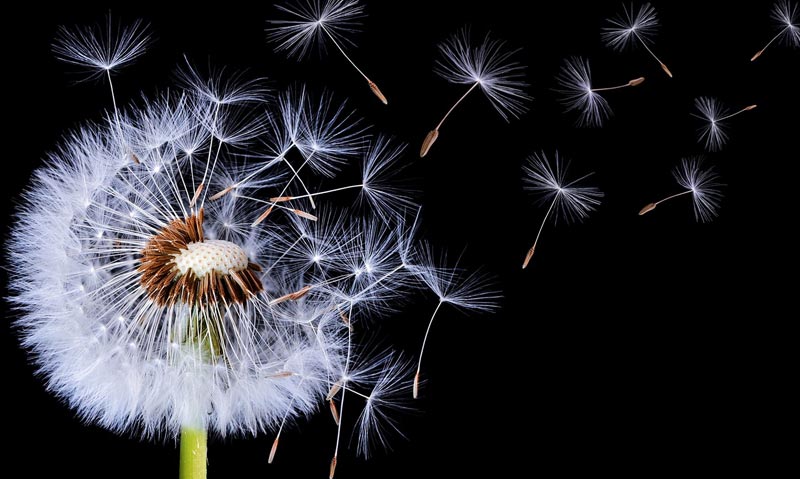
| Dandelion in the wind @ Shutterstock 2025 |
There is a perennial conflict between, on the one hand, looking at history in terms of specific periods (for example: ‘ancient’, ‘medieval’, ‘modern’) and, on the other, trying to interpret past events without using any of these pre-set concepts. To lump or to split?
The advantage of pre-set periods is partly descriptive. It is much more economical to write ‘in medieval England’ than it is to write ‘in England during the years from the fifth century AD to the later fifteenth century’.
But, once the deed is done, and centuries of history are clumped together, questions instantly multiply: Was there one medieval period? (Scholars disagree). If so, are those the right dates for it? Why is it sometimes divided into the ‘Low Middle Ages’ and the ‘High Middle Ages’? Is the concept basically fractured?
Moreover, if it is one period, then what are its major characteristics? Is the medieval era one of chronic ignorance and backwardness? Or it is a vanished era of romance and chivalry? Or, perhaps, neither of those options? What other alternatives are there??2 And did the wider sequence of stages within which it is allegedly embedded really exist either?3
Yet without any aggregative terms for big periods of time, then historical accounts risk becoming an undifferentiated list of ‘one damned thing after another’ – with the emphasis on the adjective ‘damned’.
Attitudes among historians often shift between doubt and grand certainties. In the nineteenth century, at least for many in the West, history was seen as an unstoppable ‘March of Progress’.4 And some still cling to that vision today.
Meanwhile, for Marxists, history proceeded not by slow evolution but by dramatic leaps. The inevitable class struggle generated many stormy internal tensions that each time led to a revolutionary breakdown, after which a new stage of history emerged, only to be followed by a further revolutionary breakdown, and the advent of a ‘higher’ stage of history. Thus ‘feudalism’ would be followed by ‘capitalism’, to be followed by ‘communism’.5 But neither ‘Progress’ nor the ‘Marxist dialectic’ has worked out precisely as foretold.
In Western intellectual circles in the 1980s and 1990s, doubt rather than certainty became the new mood-music (although of course, there were always dissentient voices). Above all, theorists of ‘postmodernism’ became influential among many disillusioned left-wingers. This viewpoint extended the stages of history from ‘feudal’ to ‘modern’ to ‘postmodern’. And the postmodern stance stressed the problematic nature of all knowledge about the past.
One central tenet of this attitude was an ‘incredulity towards meta-narratives’, as proclaimed by the French social philosopher Jean-François Lyotard.6 Grand sweeping stories about the march of history were at a discount. Time’s arrow did not point in any specific direction, it seemed. It was not sure where it was going.
Taking scepticism yet further, the French philosopher and literary destructionist, Jacques Derrida, asserted that temporality itself has no independent reality. For him, time is a concept which ‘belongs entirely to metaphysics’. (And, clearly, that formulation was not meant as a compliment). Instead, an a-temporal spatiality prevails throughout the cosmos.7
Postmodernist super-scepticism, however, was closely followed by a justified intellectual recoil. Historians, while these days tending to reject schematic grand narratives, have not gone to the other extreme. They do not accept that the past has no meaning, or that studies of history are purely subjective.8
Paradoxically, the postmodernists’ claim – that an old era of so-called confident ‘modernity’ has been superseded by a new age of sceptical ‘postmodernity’ – does in itself assert that the course of history can be deciphered. In other words, their critique of meta-narratives did not inhibit them from producing an alternative meta-narrative of their own.
Times have moved on. Some writers boldly assert the ‘end of postmodernism’ and define the new era as ‘Post-Postmodern’.9 Others ask sceptically whether such an era was ever really there at all?10
Belief in the heresy of ‘time denial’ was never espoused by more than a tiny minority of philosophers and physicists. History as a subject of study remains immensely popular and important.
Therefore historians around the world continue these research and debates. They seek long-term interpretations that avoid over-simplification and embrace complexity – but that are, simultaneously, not so complex that no meaning can be extracted from the torrent of detail. There are specific periods of history that have a distinctive identity – but there are also long-term evolutionary trends as well as deep continuities, that extend through millennia. The whole mix is as complex as life. It’s also important and endlessly instructive. As a result, it’s fascinating and sometimes infuriating! Come and research the past (choosing any time-period, long or short) and join the non-stop debates! Time-space: it’s what we all live in!
ENDNOTES:
1 Contributing to PJC’s year of Time-BLOGS (2025). For more, see too P.J. Corfield, Time and the Shape of History (2007); and idem, Time-Space: We Are All in it Together (2025).
2 See N. Cantor, Inventing the Middle Ages: The Lives, Works and Ideas of the Great Medievalists of the Twentieth Century (1991); and A. Murray, ‘Should the Middle Ages be Abolished?’ in Essays in Medieval Studies, 21 (2004), pp. 1–22.
3 See esp. P.J. Corfield, ‘POST-Medievalism/Modernity/Postmodernity?’ Rethinking History, Vol. 14 (2010), pp. 379-404. Also available via PJC website, www.penelopejcorfield.co.uk/what_is_history?/Pdf20.
4 See J.B. Bury, The Idea of Progress: An Enquiry into its Origin and Growth (1921); C. Lasch, The True and Only Heaven: Progress and its Critics (1991); G.A. Almond and others, Progress and its Discontents (2022).
5 See variously T.B. Bottomore, Karl Marx (1956); idem (ed.), Modern Interpretations of Marx (1981); D. Conway, A Farewell to Marx: An Outline and Appraisal of his Theories (1987); J.H. Moore (ed.), Legacies of the Collapse of Marxism (1995); G. Therborn, From Marxism to Post-Marxism? (2010).
6 See J-F. Lyotard, The Postmodern Condition: A Report on Knowledge, transl. by G. Bennington and B. Massumi (1979); M. Drolet (ed.), The Postmodernism Reader: Foundational Texts (2004); and popularisation of these arguments in D. Harvey, The Condition of Postmodernity: An Enquiry into the Origins of Cultural Change (1989); F. Jameson, Postmodernism: The Cultural Logic of Late Capitalism (1991); and H. Bertens, The Idea of the Postmodern: A History (1995).
7 See J. Hodge, Derrida on Time (2007); and, as an example of the debates, J.M. Lehmann, Deconstructing Derrida: A Post-Poststructuralist Critique (1993).
8 For a variety of historians’ responses, see R. Evans, In Defence of History (1997); F. Spier, Big History and the Future of Humanity (2010); D. Armitage and J. Guldi, The History Manifesto (2014).
9 For examples, see A. Kirby, ‘The Death of Postmodernism and Beyond’, Philosophy Now, Vol. 58 (2006); J.T. Nealon, Post-Postmodernism: Or, the Cultural Logic of Just-in-Time Capitalism (2012); B. Kuzniarz, Farewell to Postmodernism: Social Theories of the Late Left (2015); A. Gibbons, ‘Postmodernism is Dead. What Comes Next?’ Times Literary Supplement, 14 June 2017.
10 See e.g. S. Redhead, We Have Never Been Postmodern: Theory at the Speed of Light (2011); R. Kramer, Are we Postmodern Yet? And Were We Ever? (2019).
For further discussion, see Twitter
To read other discussion-points, please click here
To download Monthly Blog 179 please click here