
Penelope J Corfield
  • HOME
    • Index to Blogs
    • Monthly Blogs
    • CONTACT
    • Key to Dancing Dates Film
  • CURRENT
    • President International Association C18 Studies
    • Lectures on offer
    • London University’s Long C18 History Seminar
    • Living in Battersea
    • Career at a Glance
    • PJC Publications
  • BRITISH HISTORY
    • Long C18 Overviews
    • Society & Culture
    • Town Life
    • Electoral History
    • Radical Poets
    • The Professions
    • Religion & Irreligion
  • GLOBAL
    • Urban History Through Time
    • C18 European History Overviews
    • Gender History
    • ‘Racial’ Classifications as Pseudo-Science
    • Responding to Climate Change
    • Advance of the International Sphere
  • TIME & HISTORY
    • Time & The Shape of History (2007)
    • Rethinking Historical Periodisation
    • Dimensions of The Long Term
    • Returning to Big History
  • HISTORY-MAKING
    • Why History Matters
    • History of History
    • Fellow Historians
    • Arts of Academic Assessment
    • Pleasures of Intellectual Life
  • REVIEWS
    • History Book Reviews
      • Social History
      • Approaches to History
      • Big History
    • Theatre Reviews
    • Civic/Political Commentaries
    • Personal Portraits
  • Menu Menu

Tag Archive for: social history

MONTHLY BLOG 46, THE HISTORY OF THE HAND-SHAKE

1 October 2014/in History, Monthly Blog/by Penelope J. Corfield

If citing, please kindly acknowledge copyright © Penelope J. Corfield (2014)

Not everyone shakes hands. But those who do are expressing an egalitarian relationship. As a form of greeting, the handshake differs completely in meaning from the bow or curtsey, which display deference from the ‘lowly’ to those on ‘high’.1  In one Jane Austen novel, a fearlessly ‘modern’ young woman extends her hand to a young man at a crowded party. Of course, it is Marianne Dashwood, the embodiment of ‘sensibility’. She has just re-encountered the errant Willoughly, long after he has ended their unofficial courtship. Marianne immediately holds out her hand, claiming him as an intimate friend. But he avoids her gesture. Marianne then exclaims ‘in a voice of the greatest emotion: “Good God! Willoughby, what is the meaning of this? … Will you not shake hands with me?”’. He cannot avoid doing so, but drops her hand quickly. After a few short exchanges, Willoughby then leaves ‘with a slight bow’.2  He has dropped her. Their body language says it all.

There is a particular poignancy in this scene. In this era, men and women who were not related to one another would not ordinarily touch hands as a form of greeting. But, of course, lovers might do so. No wonder that a mere touch was so powerful when it was so rare. (And it retains its appeal today in romantic mythology and countless pop songs: I Wanna hold your Hand!)3  Shakespeare, as ever, had known the scene. Romeo understands the intimacy implied when he takes Juliet’s hand in a dance, as does she: ‘And palm to palm is like holy palmer’s kiss’.4

Even more definitively, a couple would touch hands in a marriage ceremony (even allowing for the many varieties of ritual associated with weddings).5 The wording was clear. ‘Taking someone’s hand in marriage’ is an ultimate symbol of good faith, along with the exchange of rings which remain visible on the hand. These are public signs of personal commitment. An earlier poetic expression also offered an endgame variant, in the form of a final handshake. Michael Dayton’s Sonnet LXI (1594) which starts ‘Since there’s no help, come let us kiss and part’ invites the parting lovers to: ‘shake hands for ever, cancel all our vows’.

At the same time, a close handshake also has a set of commercial connotations. When two traders agree upon a contract, they may indicate the same by a handshake. However unequal they may be in wealth and commercial status, for the purposes of the deal they are equals, both pledging to fulfil the bargain. It constitutes a ‘gentleman’s agreement’ – upheld by personal honour. The same etiquette applies in making a bet.

Hence reneging upon a wager or deal sealed with a personal handshake is viewed as particularly heinous. The loser may even litigate for redress. Today the American Sports World News reports rumours that Charles Wang, the majority owner of the New York Islanders ice-hockey team, is being sued for $10 million by hedge-fund manager Andrew Barroway. Wang’s crime? He had allegedly reneged on a handshake pact to sell his Islanders franchise to Barroway.6
Typically, a handshake is a brief and routine affair, usually but not invariably with the right hand. True, there are variants. The prolonged handshake plus a clasp of the recipient’s upper arm by the shaker’s other hand is a gesture of special warmth – stereotypically undertaken by gregarious American politicians.7

Or there is the Masonic handshake. It gives a secret signal, allowing members of a separate society to identify one another. Apparently, there are many variants of the Masonic handshake, denoting differences in rank within the organisation. That information is rather depressing, since the handshake is, in principle, egalitarian. Nonetheless, it shows the potential for stylistic variation, from the firm muscular grip to the fleeting touch-and-drop.
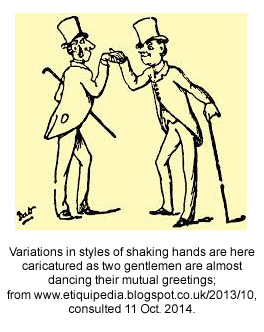
Variations in styles of shaking hands are here caricatured as two gentlemen are almost dancing their mutual greetings; from www.etiquipedia.blogspot.co.uk/2013/10, consulted 11 Oct. 2014. Gradually, routine British styles of greeting began to incorporate the handshake. It was most common among civilian men of similar middle-class standing. By contrast, the toffs stuck with their traditional bowing and curtseying. Meanwhile, hand-shaking was rare among workers in ‘dirty’ trades and industries, because people in unavoidably grimy jobs usually tried to contain rather than to spread the dirt. The emblem of two clasped hands nonetheless appeared proudly on various trade union banners, as a pledge of solidarity.

The advent of the social handshake was thus not uniform across all periods and classes. But it could be found, between close male friends, in Britain from at least Shakespeare’s time. Yet its subsequent spread has taken a long time a-coming. For example, in 1828 the anonymous author of A Critique of the Follies and Vices of the Age was still expressing displeasure at the new popularity of the handshake, including between men and women.8

One reason for some snobbish hostility, among polite society in Britain, was the association of this custom with the republican USA, where its usage became increasingly common after American independence. There were also connotations of support for the hand-shaking citizens of republican France from 1793 onwards. English visitors to the USA like the novelist and social commentator Frances Trollope thus waxed somewhat critical of the local mores. In 1832, she deplored the habit of hand-shaking between both sexes and all classes (albeit excluding the non-free).For her, this form of greeting was too bodily intimate, especially as ‘the near approach of the gentleman [ironically] was always redolent of whiskey and tobacco’.9

Ultimately, however, the snobs were routed. Old-style bowing and curtseying has generally disappeared, although hat wearers may still doff their hats to ladies. However, the twentieth century also produced another twist in the tale. Just as the hand-shake was becoming quite widely adopted in Britain by the 1970s, it was suddenly challenged by a new custom, imported from overseas. It is the continental kiss, in the form of a light clasp of the upper arms and a peck on the cheek (or, for the physically fastidious, an air-kiss). Such a manoeuvre would give good scope to a later Marianne Dashwood, who might grip an errant Willoughby in order to kiss him warmly. Nonetheless, be warned: whatever the greeting style, body language always provides ways of signalling the rejection as well as the offering of friendship.

1  See P.J. Corfield, previous monthly BLOG 45 ‘Doffing One’s Hat’. And for fuller discussion, see PJC, ‘Dress for Deference & Dissent: Hats and the Decline of Hat Honour’, Costume: Journal of the Costume Society, 23 (1989), pp. 64-79; also transl. in K.Gerteis (ed.), Zum Wandel von Zeremoniell und Gesellschaftsritualen: Aufklärung, 6 (1991), pp. 5-18; and posted on PJC personal website as Pdf/8.

2  J. Austen, Sense and Sensibility (1st pub. London, 1811): chapter 28.

3 The Beatles (1963).

4  W. Shakespeare, Romeo and Juliet (written mid 1590s; 1597), Act 1, sc. 5. A palmer was a successful pilgrim, returning from the Holy Land bearing palms as a sign that the journey had been achieved.

5  A traditional ritual of ‘hand-fasting’, announcing a solemn public engagement, has also been updated for use today in pagan marriage ceremonies.

6 Sports World News on-line 12.Aug. 2014, at www.sportsworldnews.com/articles, consulted 11 Oct. 2014.

7  See e.g. John Travolta’s film portrayal of a notably touchy-feely American presidential candidate, based upon Bill Clinton, in Primary Colors (dir. Mike Nichols, 1998).

8  Anon., Something New on Men and Manners: A Critique of the Follies and Vices of the Age … (Hailsham, Sussex, 1828), p. 174.

9  F. Trollope, Domestic Manners of the Americans (1832), ed. R. Mullen (Oxford, 1984), p. 83.

For further discussion, see Twitter

To read other discussion-points, please click here

To download Monthly Blog 46 please click here
https://www.penelopejcorfield.com/wp-content/uploads/2020/12/P.J.C.png 0 0 Penelope J. Corfield https://www.penelopejcorfield.com/wp-content/uploads/2020/12/P.J.C.png Penelope J. Corfield2014-10-01 12:00:462021-01-12 18:53:15MONTHLY BLOG 46, THE HISTORY OF THE HAND-SHAKE

MONTHLY BLOG 45, DOFFING ONE’S HAT

1 September 2014/in History, Monthly Blog/by Penelope J. Corfield

If citing, please kindly acknowledge copyright © Penelope J. Corfield (2014)

TV’s Pride and Prejudice (1995) provided many memorable images, not least Colin Firth as Mr Darcy diving into a pool to emerge reborn as a feeling, empathetic human being. This transformation gains extra impact when contrasted with the intense formality of his general deportment. When, after some months of absence, Darcy and Bingley re-enter the Bennet family home at Longbourn, they bow deeply in unison, whilst Mrs Bennet and all her daughters rise as one and bend their heads in synchronised response. Audiences may well sigh, admiringly or critically according to taste. What a contrast with our own casual manners. It satisfies a sense that the past must have been different – like a ‘foreign country’, in a much-cited phrase from L.P. Hartley.1

But did people in Georgian polite society actually greet each other like that on a day-to-day basis? There is good evidence for the required formality (and dullness) of Hanoverian court life on ceremonial occasions. A fashionable ball or high society dinner might also require exceptional courtesies. But ordinary life, even among the elite of Britain’s landed aristocrats and commercial plutocrats, was not lived strictly according to the etiquette books.

Instead, the eighteenth century saw an attenuation of the lavish old-style formalities, which were known as ‘hat honour’. In theory, men when meeting their social superiors made a deep bow, removing their headgear, with a visible flourish. Gentlemen greeting a ‘lady’ would also remove their hats with a courteous nod. For women, the comparable requirement was the low curtsey from the ‘inferior’ to the ‘superior’. Those who held their heads highest (and hatted in the case of men) the more socially elevated, since lowering the head always signalled deference. This understanding underpins the custom of addressing monarchs as ‘Your Highness’.

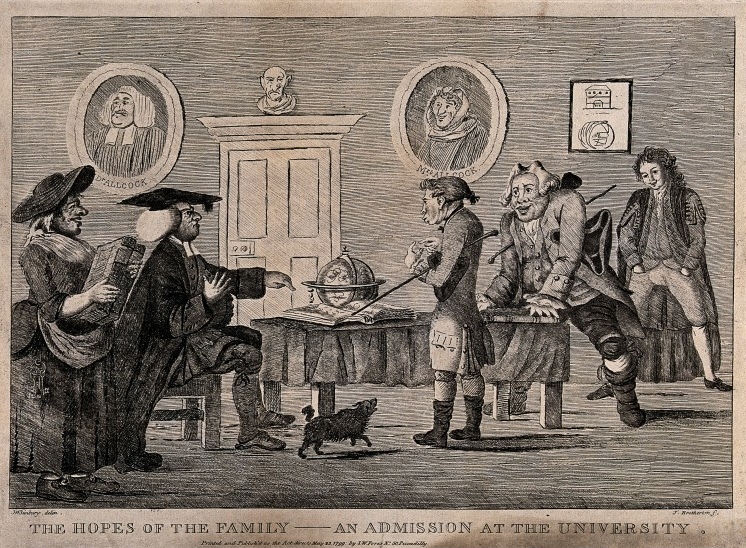
Illustration 1 ‘The Hopes of the Family’ (1799) shows a young man being interviewed for University admission. A don presides, wearing his mortar board, whilst the nervous applicant and his eager father, an old-fashioned country gentleman, have both doffed their hats, which they carry under their arms. An undergraduate in his gown looks on nonchalantly, his hands in pockets. Yet he too remains bare-headed in the presence of a senior member of his College. Only the applicant’s mother, who is subject to the different rules of etiquette for women, covers her head with a rustic bonnet.

V0040710 A school master is sitting at a table pointing at some books

Illus 1: A gentle satire by Henry William Bunbury, entitled

The Hopes of the Family (1799) – © The Welcome Library.

In accordance with this etiquette, King Charles I on trial before Parliament in 1648 wore a high black hat throughout the proceedings. It was a signal that, as the head of state, he would not uncover for any lower authority. The answer of his republican opponents was radical. Charles I was found guilty of warfare against his own people, as a ‘tyrant, traitor and murderer’. He was decapitated, beheading the old power structure very literally and publicly.

After the Restoration of the monarchy in 1660, there was some return to the old formalities. (Or at least hopes of the same). For example, in October 1661 the naval official and MP Samuel Pepys recorded his displeasure at what he considered to be the undue pride of his manservant, who kept his hat on in the house.2 Pepys expected deference from his ‘inferiors’, whilst being ready to accord it to his own ‘superiors’. But it was not always easy to judge. In July 1663, Pepys worried that he may have offended the Duke of York, by not uncovering when the two men were walking in sight of each other in St James’s Park.3 It was a tricky decision. Failure, to doff one’s hat, when close at hand, would be rude, yet uncovering from too far away would seem merely servile.

Over the very long term, however, all these formalities began to attenuate. With the advent of brick buildings and roaring coal-fires, the habitual wearing of hats indoors generally disappeared – mob-caps and night-caps excepted. And in public, the old gestures continued but in an attenuated form. With commercial growth came the advent of many people of middling status. It was hard for them to calculate the precise gradations of status between one individual and another. The old-style mannerisms were also too slow for a fast-moving and urbanising world.

As a result, between men the deep bow began to change into a nod of the head. The elaborate flourish of the hat gradually turned into a quick lifting or pulling. And the respectful long tug of the forelock, on the part of those too poor to have any headgear, turned into a briefer touch to the head.4

A notable example of the abbreviation of hat honour was the codification of the military salute. It was impractical for rank-and-file soldiers to remove their headgear whenever encountering their officers. On the other hand, military discipline required the respecting of ranks. The answer was a symbolic gesture. ‘Inferiors’ greeted their ‘superiors’ by touching the hand to the head. Different regiments evolved their own traditions. Only in 1917 (well into World War I) did the British army decide that all salutes should be given right-handedly.

Meanwhile, the female greeting in the form of a low curtsey, holding out the dress, also evolved into a briefer bob or half-curtsey. It was expected from all lower-status women when meeting ‘superiors’. But hat honour was confined to men. On public occasions, women retained their hats, bonnets and feathers. Even in church, they did not copy men in baring their heads but respected St Paul’s Biblical dictum that it was not ‘comely’ for women to pray to God uncovered.5

These etiquette rules delight TV- and film-makers. In reality, however, the conventions were always in evolution. Rules were broken and/or fudged, as well as followed. Moreover, by the later eighteenth-century in Britain a new form of interpersonal greeting had arrived. It was the egalitarian hand-shake. Jane Austen’s characters not only bowed and curtsied to each other. They also, in certain circumstances, shook hands. In one Austen novel, a fearlessly ‘modern’ young woman extends her hand to shake that of a young man at a public assembly. Anyone know the reference? Answer follows in next month’s BLOG on Handshaking.

1 L.P. Hartley, The Go-Between (1943, p. 1: ‘the past is a foreign country – they do things differently there’.

2 R. Latham and W. Matthews (eds), The Diary of Samuel Pepys, Vol. II: 1661 (1970), p 199.

3 Ibid., Vol. IV: 1663 (1971), p. 252.

4 P.J. Corfield, ‘Dress for Deference & Dissent: Hats and the Decline of Hat Honour’, Costume: Journal of the Costume Society, 23 (1989), pp. 64-79; also transl. in K.Gerteis (ed.), Zum Wandel von Zeremoniell und Gesellschaftsritualen: Aufklärung, 6 (1991), pp. 5-18. Also posted on PJC personal website as Pdf/8.

5 Holy Bible, 1 Corinthians, 11:13.

For further discussion, see Twitter

To read other discussion-points, please click here

To download Monthly Blog 45 please click here

https://www.penelopejcorfield.com/wp-content/uploads/2020/12/P.J.C.png 0 0 Penelope J. Corfield https://www.penelopejcorfield.com/wp-content/uploads/2020/12/P.J.C.png Penelope J. Corfield2014-09-01 12:00:262021-01-12 18:53:15MONTHLY BLOG 45, DOFFING ONE’S HAT

MONTHLY BLOG 44, QUOTATIONS AND IRONY

1 August 2014/in Monthly Blog, Skills/by Penelope J. Corfield

If citing, please kindly acknowledge copyright © Penelope J. Corfield (2014)

Quotations should never be mangled and should always be cited honestly, with due attention to context. Yes – absolutely yes.  It’s axiomatic for all scholarship – but also for proper communications. It does happen that words are taken out of context and twisted into another meaning. But it’s never right.

To take an example: if a theatre critic sees a controversial play and writes: ‘The very last thing that I’d say is that this production is brilliant’, then the theatre’s publicity team could put the critic’s name in lights alongside the quotation: ‘This production is brilliant’. Factually, those attributed words are correct. The critic did write them. Yet the truncated quotation gives the reverse meaning to that intended. Both the critic and any members of the audience, who were deceived into attending on the strength of the critic’s recommendation, have grounds for complaint.

Another potential for misunderstanding comes when heavy irony is taken at face value. In one of Shakespeare’s famous oratorical set-pieces, Mark Antony mourns the assassination of Caesar by Brutus and his allies with the repeated phrase: ‘And Brutus is an honourable man’ … [They are all] ‘honourable men’. The stress upon the repeated phrase, like a refrain, urges the Roman crowd to understand that the words mean the reverse of what they apparently say.

By the end, the citizens turn against the assassins: ‘They were traitors: honourable men!’1  On the face of it, Mark Antony has given Brutus a favourable character reference. In context, however, he stands condemned, not just as an assassin but as one who has basely betrayed his closest friend and colleague. ‘This was the unkindest cut of all’.

Nonetheless, there is a problem for anyone who uses irony. If the listeners or readers fail to get the implied message, then they will come to an erroneous conclusion. A Roman citizen who left the forum after the opening phrases of Antony’s speech (or who wasn’t listening carefully) could depart thinking: ‘I was sorry to hear of  Caesar’s death but it must be acceptable as Brutus, a man of honour, explained why he had to do it, and Antony confirms that Brutus is an honourable man’.

Irony, then, is powerful but risky. It depends upon an attentive community between speaker/writer and audience/readers which allows the words to be decoded successfully.

For historians, quoting from sources whose authors have long gone, there is always a challenge to understand meanings in their full context. When does a word or phrase in use mean its opposite? And did people in the past always get the hidden message?

When Jonathan Swift published his Modest Proposal for Preventing the Children of Poor People from being a Burthen to their Parents or Country, and for Making them Beneficial to the Publick (1729), he provided an exercise in sustained irony that revealed itself through the moral enormity of the proposed solution. ‘A young healthy child well nursed, is, at a year old, a most delicious nourishing and wholesome food.’ Poor parents would solve their financial problems by selling their children, who would provide good food for the rich. Infanticide? Cannibalism? Class callousness? Swift does not advocate these. Instead, his irony conveys outrage at the poverty of the poor and the indifference of the rich.

Jonathan Swift’s famous use of sustained irony in his Modest Proposal (1729)Why am I writing about this now? Because I am currently thinking about the use of evidence and the dangers of inadvertent misinterpretation. The question really arises when using a lot of sources in a historical collage.

I have just done that in an essay, published in Social History, on eighteenth-century Britain as an ‘Age of Infidelity’.2  It cites at least 75 contemporary verdicts on the state of religion and irreligion. Many are book titles, some are declarations within books, some are printed texts reporting upon speeches and sermons.

A proportion of these works were clearly using overblown rhetoric, uttered in times of crisis. When John Bowlder agonised in 1798 that the British nation’s lack of faith seemed to portend nothing less than ‘the eradicating [of] Christianity in this Quarter of the World’,3  it is hard not to smile. Religion had more staying power than he was ready to admit. On the other hand, Bowdler’s deep anxiety was typical of many committed Christians in the later 1790s, when Britain was struggling in the prolonged war against France. Why such extreme danger? It could only be that God was angry with the nation for its irreligious ways.

Bowdler not only wrote to chastise the people but took practical steps to offer a remedy. He co-founded the Church Building Society,4  which provided new places of worship in the newly expanding towns. In my Social History essay, I am able to give further information about Bowdler, as he was a particularly notable contributor to the debates. His name on its own attracts interest. Two of his children, Thomas and Henrietta Bowdler, removed all the saucy bits from Shakespeare, in order to make the bard acceptable for respectable family reading.5  Their reward was much public ridicule – and the invention of a new verb ‘to bowdlerise’. Such contextual information illuminates the era’s culture wars, in which the Bowdlers were eager partisans.

But, in an essay of approximately 7,000 words, it’s not possible to devote equal attention to the other 74 eighteenth-century contemporaries – laypeople as well as clergymen – who expressed views on the state of religion. It would overrun the restricted length of a scholarly essay – and confuse the unfolding analysis. Naturally, I checked all the sources that I used, for both content and context. And I especially searched for rival tracts, arguing that the eighteenth century was an ‘Age of Faith’ or equivalent.

Is it possible that I missed some exercises in irony? Logically, yes, although I hope not. (Please check my sources, all duly footnoted!) Sustained Swiftian-style irony is comparatively rare. Moreover, people writing on the state of irreligion tended to be heated and passionate rather than coolly playing with double meanings.

What I do claim to have found is not a debate without the potential for irony but instead one which circulated a new eighteenth-century cliché. It stated that the era was ‘an Age of Infidelity’. By this phrase, the commentators did not refer to people’s unfaithfulness to their marriage vows. That constituted ‘conjugal infidelity’, plentiful enough but far from unique to the eighteenth century. Nor did the commentators refer to apostacy: Christians in this period were not turning into Islamic or Jewish or any other religious variety of ‘infidels’.

No, it was the spread of secularisation that was being noted, chiefly in alarm: the advent of a society, officially Christian, where people had the option of not going to church, not following Christian lifestyles, and (even) not sharing Christian beliefs. It is possible that some eighteenth-century references to the ‘Age of Infidelity’ were meant ironically. But, if all that the commentators left were the unvarnished words, then they are liable to be read literally.

Ironists beware. Unless your double meaning is suitably signalled, it will become lost in time.

1  W. Shakespeare, Julius Caesar (written 1599/1600), Act 3, scene 2.

2  P.J. Corfield, ‘“An Age of Infidelity”: Secularisation in Eighteenth-Century England’, Social History, 39 (2014), pp. 229-47; available via Taylor & Francis publishers online = www.tandfonline.com.

3  J. Bowdler, Reform or Ruin: Take Your Choice! (Dublin, 1798), p. 21.

4  For the CBS, now part of the National Churches Trust, see www.churchplansonline.org.

5  See Wikipedia, sub Thomas Bowdler (1754-1825): en.wikipedia.org.

For further discussion, see Twitter

To read other discussion-points, please click here

To download Monthly Blog 44 please click here

https://www.penelopejcorfield.com/wp-content/uploads/2020/12/P.J.C.png 0 0 Penelope J. Corfield https://www.penelopejcorfield.com/wp-content/uploads/2020/12/P.J.C.png Penelope J. Corfield2014-08-01 12:00:092021-01-12 18:53:15MONTHLY BLOG 44, QUOTATIONS AND IRONY
Search Search

Monthly Blogs

  • MONTHLY BLOG 184, THE MOON – FAMILIAR FRIEND OR LONELY STRANGER? 2 April 2026
  • MONTHLY BLOG 183, HICKORY DICKORY DOCK! IN MEMORY OF MY LATE BROTHER JULIAN, OUR HAPPY CHILDHOOD TOGETHER, AND HIS LIFELONG SENSE OF DROLL HUMOUR 1 March 2026
  • MONTHLY BLOG 182, TO LAUGH OR CRY? RESPONDING TO ACADEMIC CRITICISMS 2 February 2026
  • MONTHLY BLOG 181, A YEAR OF POEMS 3 January 2026
  • MONTHLY BLOG 180, TIME & INSPIRATION 1 December 2025
  • MONTHLY BLOG 179, IDENTIFYING DIFFERENT ERAS OF TIME: POTENTIAL & PITFALLS … 1 November 2025
  • MONTHLY BLOG 178, THINKING THROUGH TIME AT ARTHUR’S STONE IN HEREFORDSHIRE 1 October 2025
  • MONTHLY BLOG 177, SONGS ABOUT TIME 3 September 2025

Categories

  • 2026 – Year of Poetry
  • Autobiography
  • Civics
  • Current Affairs
  • Family Memories
  • History
  • Monthly Blog
  • Notices
  • Personal
  • Reviews
  • Skills
  • Time

Archives

Tags

academics agenda ancestry battersea britain christianity continuity degree diagenesis dialectical discussion education eighteenth century ethnicity Georgian government historian historians history humanities humans knowledge labour labour party language London metamorphosis paradigm shift Penelope J Corfield poet policy politicians politics professor research students teachers time traditions transformation universities university vocational voters writing

Penelope J. Corfield

Penelope J. Corfield is a historian, lecturer and education consultant. She recently served as the President of the International Society for Eighteenth-Century Studies (ISECS).

Recent Posts

  • MONTHLY BLOG 184, THE MOON – FAMILIAR FRIEND OR LONELY STRANGER? 2 April 2026
  • MONTHLY BLOG 183, HICKORY DICKORY DOCK! IN MEMORY OF MY LATE BROTHER JULIAN, OUR HAPPY CHILDHOOD TOGETHER, AND HIS LIFELONG SENSE OF DROLL HUMOUR 1 March 2026

CONTACT

Penelope J. Corfield Historian
contact me here

SEARCH THIS SITE

Search Search

SHARE THIS

QUICK LINKS

© Copyright - Penelope J Corfield 2026. All rights reserved. | Dancing Dates Film by Edwina Hannam | Site by Starling Design
  • Link to X
  • Link to Rss this site
  • Link to Mail
Scroll to top Scroll to top Scroll to top

This site uses cookies. By continuing to browse the site, you are agreeing to our use of cookies.

OKLearn more

Cookie and Privacy Settings


How we use cookies

We may request cookies to be set on your device. We use cookies to let us know when you visit our websites, how you interact with us, to enrich your user experience, and to customize your relationship with our website.

Click on the different category headings to find out more. You can also change some of your preferences. Note that blocking some types of cookies may impact your experience on our websites and the services we are able to offer.

Essential Website Cookies

These cookies are strictly necessary to provide you with services available through our website and to use some of its features.

Because these cookies are strictly necessary to deliver the website, refusing them will have impact how our site functions. You always can block or delete cookies by changing your browser settings and force blocking all cookies on this website. But this will always prompt you to accept/refuse cookies when revisiting our site.

We fully respect if you want to refuse cookies but to avoid asking you again and again kindly allow us to store a cookie for that. You are free to opt out any time or opt in for other cookies to get a better experience. If you refuse cookies we will remove all set cookies in our domain.

We provide you with a list of stored cookies on your computer in our domain so you can check what we stored. Due to security reasons we are not able to show or modify cookies from other domains. You can check these in your browser security settings.

Google Analytics Cookies

These cookies collect information that is used either in aggregate form to help us understand how our website is being used or how effective our marketing campaigns are, or to help us customize our website and application for you in order to enhance your experience.

If you do not want that we track your visit to our site you can disable tracking in your browser here:

Other external services

We also use different external services like Google Webfonts, Google Maps, and external Video providers. Since these providers may collect personal data like your IP address we allow you to block them here. Please be aware that this might heavily reduce the functionality and appearance of our site. Changes will take effect once you reload the page.

Google Webfont Settings:

Google Map Settings:

Google reCaptcha Settings:

Vimeo and Youtube video embeds:

Other cookies

The following cookies are also needed - You can choose if you want to allow them:

Accept settingsHide notification only