Penelope J Corfield
  • HOME
    • Index to Blogs
    • Monthly Blogs
    • CONTACT
    • Key to Dancing Dates Film
  • CURRENT
    • President International Association C18 Studies
    • Lectures on offer
    • London University’s Long C18 History Seminar
    • Living in Battersea
    • Career at a Glance
    • PJC Publications
  • BRITISH HISTORY
    • Long C18 Overviews
    • Society & Culture
    • Town Life
    • Electoral History
    • Radical Poets
    • The Professions
    • Religion & Irreligion
  • GLOBAL
    • Urban History Through Time
    • C18 European History Overviews
    • Gender History
    • ‘Racial’ Classifications as Pseudo-Science
    • Responding to Climate Change
    • Advance of the International Sphere
  • TIME & HISTORY
    • Time & The Shape of History (2007)
    • Rethinking Historical Periodisation
    • Dimensions of The Long Term
    • Returning to Big History
  • HISTORY-MAKING
    • Why History Matters
    • History of History
    • Fellow Historians
    • Arts of Academic Assessment
    • Pleasures of Intellectual Life
  • REVIEWS
    • History Book Reviews
      • Social History
      • Approaches to History
      • Big History
    • Theatre Reviews
    • Civic/Political Commentaries
    • Personal Portraits
  • Menu Menu

Tag Archive for: david

MONTHLY BLOG 17, EVENTS LIVED THROUGH – PART TWO: 1971

1 February 2012/in Autobiography, Monthly Blog/by Penelope J. Corfield

If citing, please kindly acknowledge copyright © Penelope J. Corfield (2012)

Can you take decisions? Including tough ones that don’t please everyone? I discovered that I can, by doing it intensively as an elected councillor. At the same time, I learned that, having made a decision, it’s important to defend it when the going gets tough. Unless it’s proven to have been a serious mistake (should be only rarely or, ideally, never) – in which case a dignified retreat is required. And it’s also vital to follow through, to ensure that policies are implemented. It turns out that lots of decisions are triumphantly made and then quietly shelved. Sometimes such a negative outcome stems from subterranean obstruction by the officers; but sometimes also from a surfeit of political decisions, made without time for consolidation.

These were some of the valuable lessons I learned as an elected Labour Councillor on the London Borough of Wandsworth in the years 1971-4.
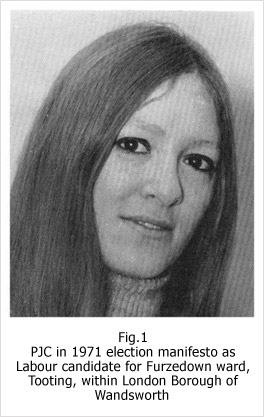
february001It was a fascinating time. We had a large majority and a small dispirited Tory opposition. We were also predominantly new brooms, as many former Labour councillors did not stand again after our big local defeat in 1968. Many of my close political friends held leading posts in the Labour Group; and I became the Planning Applications supremo. Incidentally, I was never offered a bribe, despite chairing a committee that made various financially significant decisions. Labour’s new planning leaders early resolved that, when meeting with developers, those present should always include Council officers alongside councillors. It was the right decision. In particular, we were well aware that underhand kickbacks had been paid by building contractors to the previous Labour leader in Wandsworth.1 So we wanted to be not just clean but visibly so.

Overall, the years 1971-4 became key ‘events lived through’ which influenced my outlook on life. Nothing like a bit of experience to leaven one’s theoretical stance. I learned that I can take decisions. And that, while I enjoyed the political hurly-burly in the short term, I was not cut out for a lifetime of the same.

Lots of things went well. I won’t list them all, because they are now history. But I was proud of running a sharp, questing, and efficient Planning Applications committee. We made good decisions briskly. We were not afraid to challenge the officers. But we stuck to good planning practice, engendering a great team morale which was left as a legacy.

Labour’s strategic stance also bore long-term fruits. We collectively opposed the proposed inner London motorway. It was initially supported by transport experts and by the political bigwigs of London Labour. But concerted opposition from grass-roots like us, and from Battersea’s MP Douglas Jay, ‘stopped the box’. It would have divided Battersea by a locally inaccessible motorway leading to a massive motorway ‘spaghetti’ interchange at Clapham Junction. Halting this planning monstrosity was a decisive victory that shifted inner-urban transport policy towards controlling motor traffic rather than giving it priority over homes, jobs and a pleasant local environment.

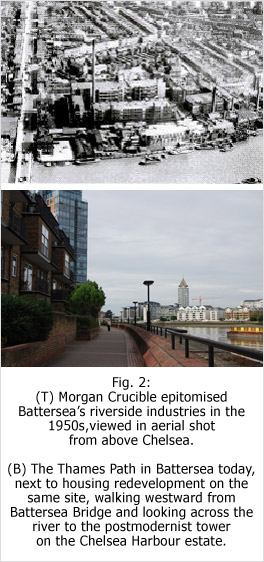
Moreover, we had many positive plans for the low-rise urban renewal of Battersea’s housing and for environmental improvements. Notably, the Wandsworth Labour councillors were among the first to promote plans for the Thames riverside walk and the Wandle walkway from Croydon to the Thames, now the Wandle Trail, supported by the Wandle Trail group. I can still remember the derision and disbelief (even on our own side) when the Planning Committee asserted that these things could and would be achieved over time. Yet the need for access to London riverfront has now become orthodoxy. The Thames River Path is not always landscaped to the best effect. But it does exist and the remaining gaps in the ‘magical 40 miles (64 km)’ from Hampton Court to the Themes Barrier are now being plugged, wherever possible.2 I still feel pride, when walking this route (see Fig.2), that I contributed to the collective effort that went into its patient creation.
february002Things also went wrong. The worst for the collective morale and cohesion of the Labour Group was the controversy over the Conservative government’s Housing Finance Act (1972). This legislation disempowered municipal councils of all political hues, by imposed a central decision upon local rent levels. And the Act turned out to be but the first in a long succession of moves to take power away from locally elected bodies. So we were right on democratic grounds to oppose it, in the hopes that a majority of councils would refuse to implement the act. But wrong to continue the arguments, once it was apparent that no such majority was forthcoming.1 Our Labour Group became bitterly divided. And even when we eventually agreed to implement the rent rise, we remained at odds, even while steaming ahead as a progressive Labour council. It took the gloss off what was an otherwise inspiriting experience.

After three years of intense politics, I decided – reluctantly – not to stand again. I realised that, in my core being, I was an academic, not a politician. I never regretted the decision. At the same time, my brief but intense political foray gave me respect for politicians and sympathy with the pressures of their lifestyle. Probably that’s one contributory reason for the survival of my nearly 50-year relationship with my partner Tony Belton, who has remained a Wandsworth Labour councillor since 1971.

Living with a politician, however, for me has proved enough. I’m glad that I can take decisions; and glad that one of them was to limit my experience as an elected councillor. Would I recommend this role to others? Yes, for those with time and commitment. But while for me ‘1968’ meant no instant revolution, then ‘1971’ meant no instant political solutions. I decided to remain a grass-root; and to teach/research History – not as the ‘dead past’ but as a living process.

1 In 1971, Cllr Sid Sporle was gaoled for six years on charges of corruption, having been part of a ‘building’ network including Labour’s Newcastle city boss T. Dan Smith, architect John Paulson, and Tory front-bencher Reginald Maudling. See M. Gillard, Nothing to Declare: The Political Corruptions of John Poulson (1980); Stephen Knight, The Brotherhood: The Secret World of the Freemasons (1984), pp. 203-6; and P.J. Corfield with Mike Marchant, DVD – Red Battersea: One Hundred Years of Labour, 1908-2008 (2008).

2 See David Sharp, Thames Path (National Trail Guide, 2010); and website www.walklondon.org.uk.

3 Others are writing more on this dispute. For the Derbyshire councillors who did hold out for non-implementation, to their personal cost, see J. Langdon and D. Skinner, The Story of Clay Cross (1974).

For further discussion, see Twitter

To read other discussion-points, please click here

To download Monthly Blog 17 please click here
https://www.penelopejcorfield.com/wp-content/uploads/2020/12/P.J.C.png 0 0 Penelope J. Corfield https://www.penelopejcorfield.com/wp-content/uploads/2020/12/P.J.C.png Penelope J. Corfield2012-02-01 12:00:012021-01-12 18:54:27MONTHLY BLOG 17, EVENTS LIVED THROUGH – PART TWO: 1971

MONTHLY BLOG 16, EVENTS LIVED THROUGH – PART ONE: 1968

1 January 2012/in Autobiography, Monthly Blog/by Penelope J. Corfield

If citing, please kindly acknowledge copyright © Penelope J. Corfield (2012)

Another way of thinking of influences (whether positive or negative) is to think of events lived through. There’s nothing like direct experience for augmenting or revising or contradicting the impact of books and people.

By contrast with my parents, I haven’t lived through a World War, so I have nothing to compare with the intense, anxious, sometimes exhilarating times that they knew as young adults. But impactful events can come in all sorts of shapes and sizes. The question is what is/was significant for the individual.

For myself, I would have to nominate the combination of events in and around two different years: 1968 and 1971. This set of meditations refers to the first of those: the year of world-wide student ‘revolutions’. I was then a postgraduate at the LSE and, technically at least, at the eye of the storm. For me personally, this was a great time. I was young, happily in love, beginning to become engaged in politics, and deeply absorbed in London life, in my historical research, and in endless discussions about the meaning of life with my friends and family.

Optimism, which is my personal default condition, seemed pervasive in the youth culture of the times. It was energising. (Not that I wrote my thesis very rapidly. I was almost too busy with my research to put pen to paper … a serious mistake, as I later came to realise). But the positive atmosphere was contagious. There were plentiful jobs; there was lot of talk about sex; there was great music; there were experimental films; and there was a cultural irreverence that opened eyes and minds. Later, in the 1980s and 1990s, I taught so many sad-eyed and depressed students that I felt almost guilty at continuing to be cheerful. I always tried to jolly them along, on the grounds that an atmosphere of educational gloom is not good for learning, let alone for personal development. But cheeriness seemed more difficult under Thatcher, whereas in 1968 optimism – at least at first – was so easy.

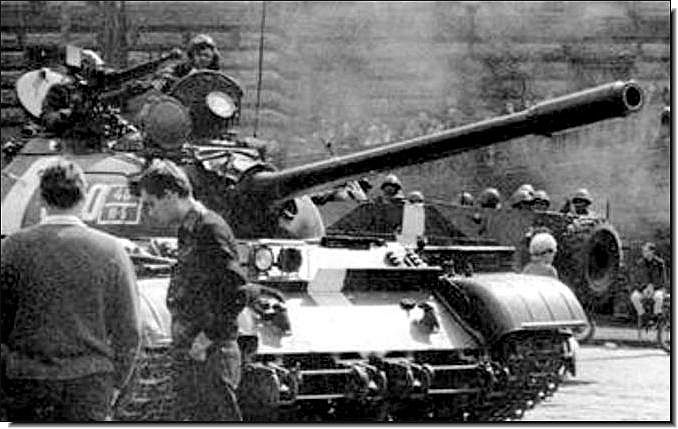
This famous year, however, was much more complex in practice. As often happens, radical euphoria is hard to sustain. There are always plenty of serpents in Eden. One repellent shock was the Soviet invasion of Czechoslovakia on 21-22 August 1968, dousing liberal hopes invested in the Prague Spring. I remember halting in a street near Norwich, where I’d gone for research purposes, to watch with consternation as the invasion was blurrily shown on a black-and-white television in a shop-window. I was depressed – and angered that the Dubcek experiment had not had time to unfold. But I was not particularly shocked, as Hungary in 1956 had provided a prior warning. That crisis had triggered many left-wingers in Britain, like my uncle Christopher Hill, to leave the Communist Party – after the failure of their attempts at democratic reform within the British CP.
soviet-invasion-czechoslovakia-1968-illustrated-history-pictures-images-photos-008In the aftermath of Czechoslovakia, the response in Britain was not so drastic. I personally wasn’t so blind about the faults of the Soviet system. And I was not a member of the British CP, so couldn’t resign in protest. Nonetheless, the general effect was dispiriting. The political and cultural left,1 which at that time were still in synchronisation, were angered but also depressed.
Brute force had again triumphed. Totalitarian repression was bad enough in itself. But totalitarianism in the name of the left was worse, since it perverted the ideal of international brotherhood. That betrayal made it even more galling, in following years, to be denounced, by right-wing opponents in local politics, as an agent of Moscow. I certainly wasn’t. But the behaviour of communist Russia made it possible for hostile rhetoric to tar – however unjustly – all those on the broad spectrum of the left as advocates of totalitarian state power. It was particularly unfair when that accusation was made against the historian E.P. Thompson, who was actively encouraging East European dissidents.

At the same time, 1968 was full of much more immediate student politics at home. I enjoyed the alternative debates and attended, casually rather than systematically, a number of mass meetings. I also participated in a number of protest demonstrations, including the so-called ‘riot’ outside the US Embassy in Grosvenor Square on 17 March 1968.

But I didn’t join any of the sit-ins, primarily because I disbelieved the euphoric rhetoric that accompanied them. I remember one activist (now a Labour peer in the House of Lords) proclaiming, to cheers, that occupying the Principal’s room and opening the College files would promote the imminent overthrow of western capitalism. Even the enthusiasm of the moment, which surely permits a bit of exaggeration, could not excuse such an infantile level of analysis. I was offended not so much at the students’ actions but at their weak rationale for their behaviour and their lack of strategic sense. This vagueness signalled in advance that the protests in Britain were bound to fail, since the students’ ultimate aims were so utopian and their actions were so far from seizing or even challenging any real levers of political or economic power. (The situation was different in France, where the student and worker protests contributed to the resignation of De Gaulle in 1969. Yet even there, the eventual limitations to the student activism were very visible).

Capitalism is anyway a very protean force, liable to change and adapt. And, whatever form it took in 1968, it was highly unlikely to be overthrown by disrupting the universities. It was laughable, really. The outcome almost everywhere was a mouse, in the form of student representation on university boards and the creation of departmental staff/student committees. Good – but not revolutionary, even within the most hide-bound of academic institutions.

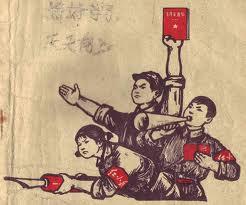
The energies and enthusiasms of 1968 were dissipated. And elsewhere, we learned in detail later, student radicalism in the form of the Red Guards was used cruelly by Mao as a party mechanism of social terror.
China Red Guards 1968So 1968 was an educative moment for me. Vague utopianism had to be rejected as much as totalitarianism. Indeed, utopianism had to be treated with even more suspicion, since it seemed the more seductive. The answer – between brute force and empty rhetoric – had to be more humdrum and more realistic. In company with my partner Tony Belton, I became more active within the Labour Party. In 1971, we were both elected as councillors in the London Borough of Wandsworth. The outcome of that experience also proved to be stimulating but far from simple – see my next month’s discussion-piece.

1 This definition takes attitudes towards the redistribution of wealth as the dividing line between the political left (in favour) and the right (opposed, unless undertaken by non-state charities). An alternative, supported by some neo-liberals, sees attitudes towards state power as forming the dividing line with neo-liberals (opposed) and statists (supportive). But the latter division, although psychologically important for some libertarians, is not very helpful practically as de facto all parties are inescapably embroiled in the modern state, thus lumping everyone de facto into just one category.

For further discussion, see Twitter

To read other discussion-points, please click here

To download Monthly Blog 16 please click here

https://www.penelopejcorfield.com/wp-content/uploads/2012/01/soviet-invasion-czechoslovakia-1968-illustrated-history-pictures-images-photos-008.jpg 429 678 Penelope J. Corfield https://www.penelopejcorfield.com/wp-content/uploads/2020/12/P.J.C.png Penelope J. Corfield2012-01-01 12:00:152021-01-12 18:54:27MONTHLY BLOG 16, EVENTS LIVED THROUGH – PART ONE: 1968
Search Search

Monthly Blogs

  • MONTHLY BLOG 184, THE MOON – FAMILIAR FRIEND OR LONELY STRANGER? 2 April 2026
  • MONTHLY BLOG 183, HICKORY DICKORY DOCK! IN MEMORY OF MY LATE BROTHER JULIAN, OUR HAPPY CHILDHOOD TOGETHER, AND HIS LIFELONG SENSE OF DROLL HUMOUR 1 March 2026
  • MONTHLY BLOG 182, TO LAUGH OR CRY? RESPONDING TO ACADEMIC CRITICISMS 2 February 2026
  • MONTHLY BLOG 181, A YEAR OF POEMS 3 January 2026
  • MONTHLY BLOG 180, TIME & INSPIRATION 1 December 2025
  • MONTHLY BLOG 179, IDENTIFYING DIFFERENT ERAS OF TIME: POTENTIAL & PITFALLS … 1 November 2025
  • MONTHLY BLOG 178, THINKING THROUGH TIME AT ARTHUR’S STONE IN HEREFORDSHIRE 1 October 2025
  • MONTHLY BLOG 177, SONGS ABOUT TIME 3 September 2025

Categories

  • 2026 – Year of Poetry
  • Autobiography
  • Civics
  • Current Affairs
  • Family Memories
  • History
  • Monthly Blog
  • Notices
  • Personal
  • Reviews
  • Skills
  • Time

Archives

Tags

academics agenda ancestry battersea britain christianity continuity degree diagenesis dialectical discussion education eighteenth century ethnicity Georgian government historian historians history humanities humans knowledge labour labour party language London metamorphosis paradigm shift Penelope J Corfield poet policy politicians politics professor research students teachers time traditions transformation universities university vocational voters writing

Penelope J. Corfield

Penelope J. Corfield is a historian, lecturer and education consultant. She recently served as the President of the International Society for Eighteenth-Century Studies (ISECS).

Recent Posts

  • MONTHLY BLOG 184, THE MOON – FAMILIAR FRIEND OR LONELY STRANGER? 2 April 2026
  • MONTHLY BLOG 183, HICKORY DICKORY DOCK! IN MEMORY OF MY LATE BROTHER JULIAN, OUR HAPPY CHILDHOOD TOGETHER, AND HIS LIFELONG SENSE OF DROLL HUMOUR 1 March 2026

CONTACT

Penelope J. Corfield Historian
contact me here

SEARCH THIS SITE

Search Search

SHARE THIS

QUICK LINKS

© Copyright - Penelope J Corfield 2026. All rights reserved. | Dancing Dates Film by Edwina Hannam | Site by Starling Design
  • Link to X
  • Link to Rss this site
  • Link to Mail
Scroll to top Scroll to top Scroll to top

This site uses cookies. By continuing to browse the site, you are agreeing to our use of cookies.

OKLearn more

Cookie and Privacy Settings


How we use cookies

We may request cookies to be set on your device. We use cookies to let us know when you visit our websites, how you interact with us, to enrich your user experience, and to customize your relationship with our website.

Click on the different category headings to find out more. You can also change some of your preferences. Note that blocking some types of cookies may impact your experience on our websites and the services we are able to offer.

Essential Website Cookies

These cookies are strictly necessary to provide you with services available through our website and to use some of its features.

Because these cookies are strictly necessary to deliver the website, refusing them will have impact how our site functions. You always can block or delete cookies by changing your browser settings and force blocking all cookies on this website. But this will always prompt you to accept/refuse cookies when revisiting our site.

We fully respect if you want to refuse cookies but to avoid asking you again and again kindly allow us to store a cookie for that. You are free to opt out any time or opt in for other cookies to get a better experience. If you refuse cookies we will remove all set cookies in our domain.

We provide you with a list of stored cookies on your computer in our domain so you can check what we stored. Due to security reasons we are not able to show or modify cookies from other domains. You can check these in your browser security settings.

Google Analytics Cookies

These cookies collect information that is used either in aggregate form to help us understand how our website is being used or how effective our marketing campaigns are, or to help us customize our website and application for you in order to enhance your experience.

If you do not want that we track your visit to our site you can disable tracking in your browser here:

Other external services

We also use different external services like Google Webfonts, Google Maps, and external Video providers. Since these providers may collect personal data like your IP address we allow you to block them here. Please be aware that this might heavily reduce the functionality and appearance of our site. Changes will take effect once you reload the page.

Google Webfont Settings:

Google Map Settings:

Google reCaptcha Settings:

Vimeo and Youtube video embeds:

Other cookies

The following cookies are also needed - You can choose if you want to allow them:

Accept settingsHide notification only