Penelope J Corfield
  • HOME
    • Index to Blogs
    • Monthly Blogs
    • CONTACT
    • Key to Dancing Dates Film
  • CURRENT
    • President International Association C18 Studies
    • Lectures on offer
    • London University’s Long C18 History Seminar
    • Living in Battersea
    • Career at a Glance
    • PJC Publications
  • BRITISH HISTORY
    • Long C18 Overviews
    • Society & Culture
    • Town Life
    • Electoral History
    • Radical Poets
    • The Professions
    • Religion & Irreligion
  • GLOBAL
    • Urban History Through Time
    • C18 European History Overviews
    • Gender History
    • ‘Racial’ Classifications as Pseudo-Science
    • Responding to Climate Change
    • Advance of the International Sphere
  • TIME & HISTORY
    • Time & The Shape of History (2007)
    • Rethinking Historical Periodisation
    • Dimensions of The Long Term
    • Returning to Big History
  • HISTORY-MAKING
    • Why History Matters
    • History of History
    • Fellow Historians
    • Arts of Academic Assessment
    • Pleasures of Intellectual Life
  • REVIEWS
    • History Book Reviews
      • Social History
      • Approaches to History
      • Big History
    • Theatre Reviews
    • Civic/Political Commentaries
    • Personal Portraits
  • Menu Menu

Tag Archive for: words

MONTHLY BLOG 85, WORKING WITH WORDS

29 December 2017/in Monthly Blog, Skills/by Penelope J. Corfield

If citing, please kindly acknowledge copyright © Penelope J. Corfield (2018)

A lot of the fun of being a writer comes from the sheer pleasure of working with words. Not only inventing new ones (see BLOG/84, November 2017). But additionally the multifarious challenges of finding the mot juste; of avoiding repetition of favoured words; and of avoiding clichéd combinations of nouns and adjectives Why should debates always turn out to be ‘heated’? or every array be denoted as ‘dazzling’? By the way, for those who enjoy nothing as much as a time-honoured cliché, there are splendid compilations to be consulted.1
2018-01 No1 Hogarth's distressed_poet

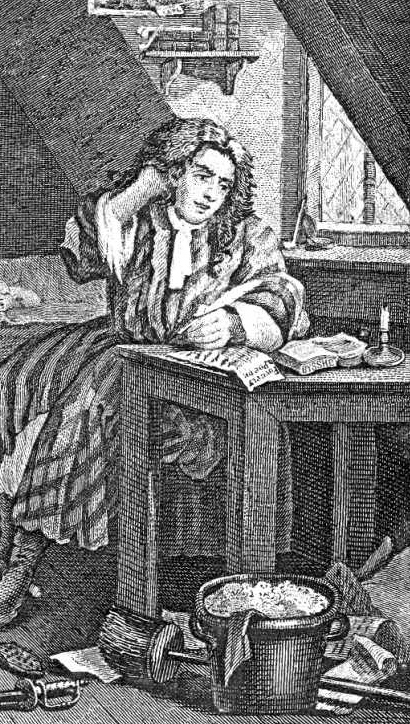
Fig.1 Detail from William Hogarth’s Distrest Poet,
from oil painting c.1736, engraved 1741.

My personal favourite is Gustave Flaubert’s Dictionary of Accepted Ideas, which contains the following admirable dictum on ‘FEUDALISM: No need to have one single precise notion about it: thunder against!’2

To keep myself alert when writing, I set myself three internal technical challenges – as well as thinking about my main message. One test is that no two paragraphs within an essay or book chapter should start with the same first word. That avoids visually boring readers with a page of prose that contains a repetitious string of ‘The …/ The… / The …/’.

The second test is to refrain from echoing key terms between one sentence and the next. It’s very easy to get one’s vocabulary stuck. But, fortunately, English is a rich and hybrid language, with many synonyms. So it is always possible to refer (say) to ‘Parliament’ in one sentence, and to ‘the ‘legislative’ in the next. And so on. That way, readers are not numbed by a monotonous repetition of the same word, again and again, within one paragraph. Adding variety can be tricky in the case of technical terms, for which there are few synonyms. Nonetheless, variation can be achieved by inserting short explanatory points in simpler language. Repetition (whether in terms of vocabulary or sentence structure) is a powerful stylistic device. Yet it entirely loses its punch if it is used all the time.

So my third challenge also requires diversification. Sentences should not all be alike in length. If every point is expressed with the utmost brevity, one after another, the result can be a mind-overwhelming rat-tat-tat of ideas, without time for thought and assimilation. Let alone qualifications and nuances.

Equally, however, too many very long sentences, end to end, can be so rich and intricate that they become soporific. I’ve expressed that viewpoint before (December 2015) and can’t resist quoting myself.3 ‘Alternatively, the full and unmitigated case for long, intricate, sinuous, thoughtful yet controlled sentences, winding their way gracefully and inexorably across vast tracts of crisp, white paper can be made not only in terms of academic pretentiousness – always the last resort of the petty-minded – but also in terms of intellectual expansiveness and mental ‘stretch’, with a capacity to reflect and inflect even the most subtle nuances of thought, although it should certainly be remembered that, without some authorial control or indeed domination in the form of a final full-stop, the impatient reader – eager to follow the by-ways yet equally anxious to seize the cardinal point – can find a numbing, not to say crushing, sense of boredom beginning to overtake the responsive mind, as it struggles to remember the opening gambit, let alone the many intermediate staging posts, as the overall argument staggers and reels towards what I can only describe, with some difficulty, as the ultimate conclusion or final verdict: The End!’ [162 words in one sentence, which were fun to write but rather exhausting to read].4

Ideally, every sequence of lengthy sentences, which are often unavoidable in academic writing, should be counter-balanced by a pithy dictum. (Something a bit weightier than a Tweet; but incorporating the same brevity). To my students, I define a pithy dictum as a meaningful statement that’s expressed in ten words or less. How to enjoy working with words? ‘Write with variety’.

1 J. Cresswell, The Penguin Book of Clichés (2000); N. Fountain, Clichés: Avoid Them Like the Plague (2012; 2015).

2 G. Flaubert, Dictionary of Accepted Ideas, transl. and ed. J. Barzun (1954), p. 38.

3 P.J.C., ‘Writing Through a Big Research Project, Not Writing Up’, Monthly Blog/60 (Dec. 2015).

4 This puny effort barely registers in the smallest foothills of long sentences in the English language, the best known example being Molly Bloom’s soliloquy at the end of James Joyce’s Ulysses (1922), which is reportedly a sequence of almost 4,000 words (but including many shorter sentences put together without punctuation).

For further discussion, see Twitter

To read other discussion-points, please click here

To download Monthly Blog 85 please click here

https://www.penelopejcorfield.com/wp-content/uploads/2017/12/2018-01-No1-Hogarths-distressed_poet.jpg 724 410 Penelope J. Corfield https://www.penelopejcorfield.com/wp-content/uploads/2020/12/P.J.C.png Penelope J. Corfield2017-12-29 12:30:052021-01-12 18:52:59MONTHLY BLOG 85, WORKING WITH WORDS

MONTHLY BLOG 84, INVENTING WORDS

1 December 2017/in History, Monthly Blog/by Penelope J. Corfield

If citing, please kindly acknowledge copyright © Penelope J. Corfield (2017)

Speakers and writers constantly adopt and play with new words and usages, even while the deep grammatical structures of language evolve, if at all, only very slowly. I remember an English class at school when I was aged about twelve or thirteen when we were challenged to invent new words. The winning neologism was ‘puridence’. It meant: by pure coincidence. Hence, one could say ‘I walked along the pavement, puridence I slipped and fell on a banana skin’. The winner was my class-mate Audrey Turner, who has probably forgotten. (I wonder whether anyone else remembers this moment?)

2017-12 No1 slip-man-black-banana-md

Fig.1 Slip Man Black Banana:
‘Puridence I slipped and fell on a banana skin’

Another new word, invented by my partner Tony Belton on 26 October 2013, is ‘wrongaplomb’. It refers to someone who is habitually in error but always with total aplomb. It’s a great word, which immediately summons to my mind the person for whom the term was invented. But again, I expect that Tony has also forgotten. (He has). New words arrive and are shed with great ease. This is one which came and went, except for the fact that I noted it down.

No wonder that dictionary compilers find it a struggle to keep abreast. The English language, as a Germanic tongue hybridised by its conjunction with Norman French, already has a huge vocabulary, to which additions are constantly made. One optimistic proposal in the Gentleman’s Magazine in 1788 hoped to keep a check upon the process in Britain, by establishing a person or committee to devise new words for every possible contingency.1 But real-life inventions and borrowings in all living languages were (and remain) far too frequent, spontaneous and diffuse for such a system to work. The Académie française (founded 1635), which is France’s official authority on the French language, knows very well the perennial tensions between established norms and innovations.2 The ‘Immortels’, as the 40 academicians are termed, have a tricky task as they try to decide for eternity. Consequently, a prudent convention ensures that the Académie’s rulings are advisory but not binding.

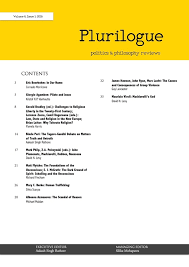
For my part, I love encountering new words and guessing whether they will survive or fail. In that spirit, I have invented three of my own. The first is ‘plurilogue’. I coined this term at an academic seminar in January 2016 and then put it into a BLOG.3 It refers to multi-lateral communications across space (not so difficult in these days of easy international messaging) and through time. In particular, it evokes the way that later generations of historians constantly debate with their precursors. ‘Dialogue’ doesn’t work to explain such communications. Dead historians can’t answer back. But ‘plurilogue’ covers the multiplicity of exchanges, between living historians, and with the legacy of ideas from earlier generations.

Will the term last? I think so. Having invented it, I then decided to google (a recently-arrived verb). To my surprise, I discovered that there already is an on-line international journal of that name. It has been running since 2011. It features reviews in philosophy and political science. My initial response was to find the prior use annoying. On the other hand, that’s a selfish view. No one owns a language. Better to think that ‘plurilogue’ is a word whose time has come. Its multiple coinages are a sign of its relevance. Humans do communicate across time and space; and not just in dialogue. So ‘plurilogue’ has a tolerable chance of lasting, especially as it’s institutionalised in a journal title.

2017-12 No2 plurilogue Vol 1
A second term that I coined and published in 2007 is ‘diachromesh’.4 It defines the way that humans (and everything in the cosmos for good measure) are integrally situated in an unfolding through-Time, also known as the very long term or ‘diachronic’. That latter word is itself relatively unusual. But it has some currency among historians and archaeologists.

The ‘diachronic’ is the alternate pair to the ‘synchronic’ (the immediate fleeting moment). Hence my comment that: ‘the synchronic is always in the diachronic – in that every short-term moment contributes to a much longer term’. Equally, the conjunction operates the other way round. ‘The diachronic is always in the synchronic – in that long-term frameworks always inform the passing moment as well’.5 Therefore it follows that, just as we can refer to synchromesh gear changes, operating together in a single moment of time, so it’s relevant to think of diachromesh, effortlessly meshing each single moment into the very long-term.6

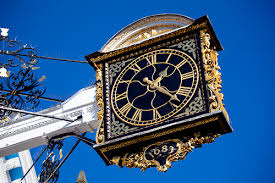
So far so good. Is diachromesh liable to last? I can’t find a journal with that name. However, the word in is circulation. Google it and see. The references are few and far between. But! For example, in an essay on the evolution of the urban high street, architectural analyst Sam Griffiths writes: ‘The spatial configuration of the grid is reticulated in space and time, a materialisation of Corfield’s (2007) “diachromesh”.’7

2017-12 No3 clock in Guildford high street

Fig.3 Guildhall Clock on Guildford High Street, marking each synchronic moment since 1683 in an urban high street, diachromeshed within its own space and time.

Lastly, I also offered the word ‘trialectics’ in 2007. Instead of cosmic history as composed of binary forces, I envisage a dynamic threefold process of continuity (persistence), gradual change (momentum) and macro-change (turbulence).8 For me, these interlocking dimensions are as integral to Time as are the standard three dimensions of Space.

Be that as it may, I was then staggered to find that the term had a pre-history, of which I was hitherto oblivious. Try web searches for trialectics in logic; ecology; and spatial theories, such as Edward Soja’s planning concept of Thirdspace.9 Again, however, it would seem that this is a word whose time has come. The fact that ‘trialectics’ is subject to a range of nuanced meanings is not a particular problem, since that happens to so many words. The core of the idea is to discard the binary of dialectics. Enough of either/or. Of point/counter-point; or thesis/antithesis. Instead, there are triple dimensions in play.

Coining new words is part of the trialectical processes that keep languages going through time. They rely upon deep continuities, whilst experiencing gradual changes – and, at the same time, facing/absorbing/rejecting the shock of the new. Luckily there is already a name for the grand outcome of this temporal mix of continuity/micro-change/macro-change. It’s called History.

1 S.I. Tucker, Protean Shape: A Study in Eighteenth-Century Vocabulary and Usage (1967), p. 104.

2 http://www.academie-francaise.fr/.

3 P.J. Corfield, ‘Does the Study of History “Progress” – and How does Plurilogue Help? BLOG/61 (Jan. 2016), www.penelopejcorfield.com/monthly-blogs/.

4 P.J. Corfield, Time and the Shape of History (2007), p. xv.

5 Ibid.

6 This assumption differs from that of a small minority of physicists and philosophers who view Time as broken, each moment sundered from the next. See e.g. J. Barbour, The End of Time: The Next Revolution in our Understanding of the Universe (1999). I might call this interpretation a case of ‘wrongaplomb’.

7 S. Griffiths, ‘The High Street as a Morphological Event’, in L. Vaughan (ed.), Suburban Urbanities: Suburbs and the Life of the High Street (2015), p. 45.

8 Corfield, Time and Shape of History, pp. 122-3, 211-16, 231, 248, 249. See also idem, ‘Time and the Historians in the Age of Relativity’, in A.C.T. Geppert and T. Kössler (eds), Obsession der Gegenwart: Zeit im 20. Jahrhundert/ Concepts of Time in the Twentieth Century (Geschichte und Gesellschaft: Sonderheft, 25, Göttingen, 2015), pp. 71-91; also available on www.penelopejcorfield.co.uk.

9 www.wikipedia.org/Edward_Soja

For further discussion, see Twitter

To read other discussion-points, please click here

To download Monthly Blog 84 please click here

https://www.penelopejcorfield.com/wp-content/uploads/2017/12/2017-12-No1-slip-man-black-banana-md.png 297 276 Penelope J. Corfield https://www.penelopejcorfield.com/wp-content/uploads/2020/12/P.J.C.png Penelope J. Corfield2017-12-01 12:00:382021-01-12 18:52:59MONTHLY BLOG 84, INVENTING WORDS
Search Search

Monthly Blogs

  • MONTHLY BLOG 184, THE MOON – FAMILIAR FRIEND OR LONELY STRANGER? 2 April 2026
  • MONTHLY BLOG 183, HICKORY DICKORY DOCK! IN MEMORY OF MY LATE BROTHER JULIAN, OUR HAPPY CHILDHOOD TOGETHER, AND HIS LIFELONG SENSE OF DROLL HUMOUR 1 March 2026
  • MONTHLY BLOG 182, TO LAUGH OR CRY? RESPONDING TO ACADEMIC CRITICISMS 2 February 2026
  • MONTHLY BLOG 181, A YEAR OF POEMS 3 January 2026
  • MONTHLY BLOG 180, TIME & INSPIRATION 1 December 2025
  • MONTHLY BLOG 179, IDENTIFYING DIFFERENT ERAS OF TIME: POTENTIAL & PITFALLS … 1 November 2025
  • MONTHLY BLOG 178, THINKING THROUGH TIME AT ARTHUR’S STONE IN HEREFORDSHIRE 1 October 2025
  • MONTHLY BLOG 177, SONGS ABOUT TIME 3 September 2025

Categories

  • 2026 – Year of Poetry
  • Autobiography
  • Civics
  • Current Affairs
  • Family Memories
  • History
  • Monthly Blog
  • Notices
  • Personal
  • Reviews
  • Skills
  • Time

Archives

Tags

academics agenda ancestry battersea britain christianity continuity degree diagenesis dialectical discussion education eighteenth century ethnicity Georgian government historian historians history humanities humans knowledge labour labour party language London metamorphosis paradigm shift Penelope J Corfield poet policy politicians politics professor research students teachers time traditions transformation universities university vocational voters writing

Penelope J. Corfield

Penelope J. Corfield is a historian, lecturer and education consultant. She recently served as the President of the International Society for Eighteenth-Century Studies (ISECS).

Recent Posts

  • MONTHLY BLOG 184, THE MOON – FAMILIAR FRIEND OR LONELY STRANGER? 2 April 2026
  • MONTHLY BLOG 183, HICKORY DICKORY DOCK! IN MEMORY OF MY LATE BROTHER JULIAN, OUR HAPPY CHILDHOOD TOGETHER, AND HIS LIFELONG SENSE OF DROLL HUMOUR 1 March 2026

CONTACT

Penelope J. Corfield Historian
contact me here

SEARCH THIS SITE

Search Search

SHARE THIS

QUICK LINKS

© Copyright - Penelope J Corfield 2026. All rights reserved. | Dancing Dates Film by Edwina Hannam | Site by Starling Design
  • Link to X
  • Link to Rss this site
  • Link to Mail
Scroll to top Scroll to top Scroll to top

This site uses cookies. By continuing to browse the site, you are agreeing to our use of cookies.

OKLearn more

Cookie and Privacy Settings


How we use cookies

We may request cookies to be set on your device. We use cookies to let us know when you visit our websites, how you interact with us, to enrich your user experience, and to customize your relationship with our website.

Click on the different category headings to find out more. You can also change some of your preferences. Note that blocking some types of cookies may impact your experience on our websites and the services we are able to offer.

Essential Website Cookies

These cookies are strictly necessary to provide you with services available through our website and to use some of its features.

Because these cookies are strictly necessary to deliver the website, refusing them will have impact how our site functions. You always can block or delete cookies by changing your browser settings and force blocking all cookies on this website. But this will always prompt you to accept/refuse cookies when revisiting our site.

We fully respect if you want to refuse cookies but to avoid asking you again and again kindly allow us to store a cookie for that. You are free to opt out any time or opt in for other cookies to get a better experience. If you refuse cookies we will remove all set cookies in our domain.

We provide you with a list of stored cookies on your computer in our domain so you can check what we stored. Due to security reasons we are not able to show or modify cookies from other domains. You can check these in your browser security settings.

Google Analytics Cookies

These cookies collect information that is used either in aggregate form to help us understand how our website is being used or how effective our marketing campaigns are, or to help us customize our website and application for you in order to enhance your experience.

If you do not want that we track your visit to our site you can disable tracking in your browser here:

Other external services

We also use different external services like Google Webfonts, Google Maps, and external Video providers. Since these providers may collect personal data like your IP address we allow you to block them here. Please be aware that this might heavily reduce the functionality and appearance of our site. Changes will take effect once you reload the page.

Google Webfont Settings:

Google Map Settings:

Google reCaptcha Settings:

Vimeo and Youtube video embeds:

Other cookies

The following cookies are also needed - You can choose if you want to allow them:

Accept settingsHide notification only