Penelope J Corfield
  • HOME
    • Index to Blogs
    • Monthly Blogs
    • CONTACT
    • Key to Dancing Dates Film
  • CURRENT
    • President International Association C18 Studies
    • Lectures on offer
    • London University’s Long C18 History Seminar
    • Living in Battersea
    • Career at a Glance
    • PJC Publications
  • BRITISH HISTORY
    • Long C18 Overviews
    • Society & Culture
    • Town Life
    • Electoral History
    • Radical Poets
    • The Professions
    • Religion & Irreligion
  • GLOBAL
    • Urban History Through Time
    • C18 European History Overviews
    • Gender History
    • ‘Racial’ Classifications as Pseudo-Science
    • Responding to Climate Change
    • Advance of the International Sphere
  • TIME & HISTORY
    • Time & The Shape of History (2007)
    • Rethinking Historical Periodisation
    • Dimensions of The Long Term
    • Returning to Big History
  • HISTORY-MAKING
    • Why History Matters
    • History of History
    • Fellow Historians
    • Arts of Academic Assessment
    • Pleasures of Intellectual Life
  • REVIEWS
    • History Book Reviews
      • Social History
      • Approaches to History
      • Big History
    • Theatre Reviews
    • Civic/Political Commentaries
    • Personal Portraits
  • Menu Menu

MONTHLY BLOG 60, WRITING THROUGH A BIG RESEARCH PROJECT, NOT WRITING UP

1 December 2015/in Monthly Blog, Skills/by Penelope J. Corfield

If citing, please kindly acknowledge copyright © Penelope J. Corfield (2015)

My heart sinks when I hear someone declare gaily: ‘I’ve done all the research; now all I have to do is write it up’.1 So what’s so wrong with that? It sounds so straightforward. First research, then sit down and write. Then, bingo, big party with lots of happy friends and relieved research supervisor.

But undertaking a big project in the Humanities or Social Sciences doesn’t and shouldn’t work like that.2 So my heart sinks on behalf of any researcher who declares ‘All I have to do is write it up’, because he or she has been wasting a lot of time, under the impression that they have been working hard. Far from being close to the end of a big project, they have hardly begun.

Why so? There are both practical and intellectual reasons for ‘writing through’ a big research project, rather than ‘writing up’ at the end. For a start, stringing words and paragraphs together to construct a book-length study takes a lot of time. The exercise entails ordering a miscellany of thoughts into a satisfactory sequence, marshalling a huge amount of documented detail to expound the sustained argument, and then punching home a set of original conclusions. It’s an arduous art, not an automatic procedure.
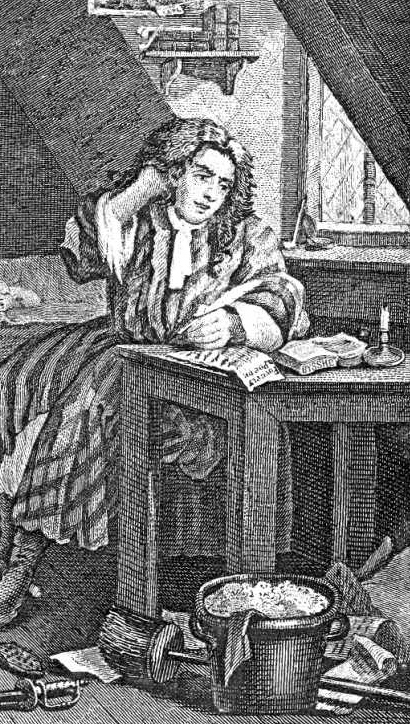
2015-12 No1 Hogarth's distressed_poet

Hogarth’s Distrest Poet (1741) expresses the agonies of composition, as he sits in a poky garret, poor and dishevelled, with abandoned drafts at his feet.

Writing and research in the Humanities and Social Sciences should thus proceed in tandem. These tasks between them provide the necessary legs which enable a project to advance. No supervised researcher should be without a target deadline for a forthcoming report or interim paper, which collectively function as prototype chapters. That rule applies from the onset, starting with a written review of the research questions, or bibliographical overview, or primary source search – or however the project is launched. Without ‘writing through’, researchers do not really appreciate what they have found or what they are arguing. Certainly there will be much redrafting and revision, as the research progresses. That’s all part of the process.

But grappling with ideas to turn them into a sustained account in written words is not just a medium for communication. It’s a mechanism for cogitation itself. Just as spoken language crystallises instinctive feelings into expressed thoughts, so the process of turning thoughts into written form advances, clarifies and extends their meaning to form a considered analysis. A book can say much more than a speech, because it’s longer and more complexly structured than even the longest speech. Writing through continually means thinking through properly.

Incidentally, what about prose style? The answer is: suit yourself. Match your personality. Obviously, suit the subject-matter too. Snappy dictums are good value. I enjoy them myself. They punch an argument home. But non-stop bullet-points are wearing. Ideas are unduly compressed. Readers can be stunned. The big argument goes missing. Writing short sentences is fun. Brevity challenges the mind. I could go on. And on. One gets a second wind. But content is also required. Otherwise, vacuity is revealed. And exhaustion threatens. So arguments need building. One point after another. There may be an exception. Sometimes they prove the rule. Sometimes, however, not. It depends upon the evidence. Everything needs evaluation. Points are sometimes obvious. Yet there’s room for subtlety. Don’t succumb to the obvious. Meanings multiply. Take your time. Think things through. Test arguments against data. There’s always a rival case. But what’s the final conclusion? Surely, it’s clear enough. Think kindly of your readers. Employ authorial diversity. Meaning what exactly? [162 words in 39 sentences, none longer than five words]

Alternatively, the full and unmitigated case for long, intricate, sinuous, thoughtful yet controlled sentences, winding their way gracefully and inexorably across vast tracts of crisp, white paper can be made not only in terms of academic pretentiousness – always the last resort of the petty-minded – but also in terms of intellectual expansiveness and mental ‘stretch’, with a capacity to reflect and inflect even the most subtle nuances of thought, although it should certainly be remembered that, without some authorial control or indeed domination in the form of a final full-stop, the impatient reader – eager to follow the by-ways yet equally anxious to seize the cardinal point – can find a numbing, not to say crushing, sense of boredom beginning to overtake the responsive mind, as it struggles to remember the opening gambit, let alone the many intermediate staging posts, as the overall argument staggers and reels towards what I can only describe, with some difficulty, as the ultimate conclusion or final verdict: The End! [162 words in one sentence, also fun to write].3

In other words, my stylistic advice is to vary the mix of sentence lengths. A combination of an Ernest-Hemingway-style brevity4  with an Edward Gibbonian luxuriance allows points to be fully developed, but also summarised pithily.

Thus, in order to develop a sustained case within a major research project, my organisational advice is to ‘write through’ throughout. That’s the only real way to germinate, sustain, develop, understand innerly and simultaneously communicate a big overarching picture, complete with supporting arguments and data. Oh, and my final point? Let’s banish the dreadful phrase ‘writing up’. It means bodging.

2015-12 No2 Writing

A snappy dictum from the American journalist and writer William Zinsser (1922-2015).

1 This BLOG is a companion-piece to PJC BLOG/59, ‘Supervising a Big Research Project to Finish Well and on Time: Three Framework Rules’ (Nov. 2015). Also relevant is PJC BLOG/34 ‘Coping with Writer’s Block’ (Oct. 2013).

2 In the Sciences, the model is somewhat different, according to the differential weight given to experimental research processes/outcomes and to written output.

3 My puny effort barely registers in the smallest foothills of lengthy sentences in the English language, one celebrated example being Molly Bloom’s soliloquy as finale to James Joyce’s Ulysses (1922), reportedly in a sentence of over 4,000 words.

4 Hemingway is commonly cited as the maestro of pithiness. Yet the playwright Samuel Beckett also shares the honours in the brevity stakes, writing in sharp contradistinction to his friend and fellow-Irishman James Joyce.

For further discussion, see Twitter

To read other discussion-points, please click here

To download Monthly Blog 60 please click here

Tags: academic, arguments, evaluation, Hogarth, humanities, James Joyce, Molly Bloom, research, Samuel Beckett, Social Sciences, Ulysses, William Zinsser, writing up
Share this entry
  • Share on Facebook
  • Share on X
  • Share on WhatsApp
  • Share on Pinterest
  • Share on LinkedIn
  • Share by Mail
https://www.penelopejcorfield.com/wp-content/uploads/2015/12/2015-12-No1-Hogarths-distressed_poet1.jpg 289 288 Penelope J. Corfield https://www.penelopejcorfield.com/wp-content/uploads/2020/12/P.J.C.png Penelope J. Corfield2015-12-01 12:00:352021-01-12 18:53:10MONTHLY BLOG 60, WRITING THROUGH A BIG RESEARCH PROJECT, NOT WRITING UP
You might also like
MONTHLY BLOG 19, IN PRAISE OF PUBLIC INFORMATION, AND DISPRAISE OF SUGARED PUBLIC RELATIONS
MONTHLY BLOG 16, EVENTS LIVED THROUGH – PART ONE: 1968
MONTHLY BLOG 82, WRITING PERSONAL REFERENCES
MONTHLY BLOG 17, EVENTS LIVED THROUGH – PART TWO: 1971
MONTHLY BLOG 179, IDENTIFYING DIFFERENT ERAS OF TIME: POTENTIAL & PITFALLS …
PJC WEBSITE REVIEW/4 – THE LIFE OF STUFF (1993) BY SIMON DONALD
MONTHLY BLOG 67, WHAT NEXT? INTERROGATING HISTORICAL EVIDENCE
MONTHLY BLOG 81, RESPONDING TO ANONYMOUS ACADEMIC ASSESSMENTS
Search Search

Monthly Blogs

  • MONTHLY BLOG 184, THE MOON – FAMILIAR FRIEND OR LONELY STRANGER? 2 April 2026
  • MONTHLY BLOG 183, HICKORY DICKORY DOCK! IN MEMORY OF MY LATE BROTHER JULIAN, OUR HAPPY CHILDHOOD TOGETHER, AND HIS LIFELONG SENSE OF DROLL HUMOUR 1 March 2026
  • MONTHLY BLOG 182, TO LAUGH OR CRY? RESPONDING TO ACADEMIC CRITICISMS 2 February 2026
  • MONTHLY BLOG 181, A YEAR OF POEMS 3 January 2026
  • MONTHLY BLOG 180, TIME & INSPIRATION 1 December 2025
  • MONTHLY BLOG 179, IDENTIFYING DIFFERENT ERAS OF TIME: POTENTIAL & PITFALLS … 1 November 2025
  • MONTHLY BLOG 178, THINKING THROUGH TIME AT ARTHUR’S STONE IN HEREFORDSHIRE 1 October 2025
  • MONTHLY BLOG 177, SONGS ABOUT TIME 3 September 2025

Categories

  • 2026 – Year of Poetry
  • Autobiography
  • Civics
  • Current Affairs
  • Family Memories
  • History
  • Monthly Blog
  • Notices
  • Personal
  • Reviews
  • Skills
  • Time

Archives

Tags

academics agenda ancestry battersea britain christianity continuity degree diagenesis dialectical discussion education eighteenth century ethnicity Georgian government historian historians history humanities humans knowledge labour labour party language London metamorphosis paradigm shift Penelope J Corfield poet policy politicians politics professor research students teachers time traditions transformation universities university vocational voters writing

Penelope J. Corfield

Penelope J. Corfield is a historian, lecturer and education consultant. She recently served as the President of the International Society for Eighteenth-Century Studies (ISECS).

Recent Posts

  • MONTHLY BLOG 184, THE MOON – FAMILIAR FRIEND OR LONELY STRANGER? 2 April 2026
  • MONTHLY BLOG 183, HICKORY DICKORY DOCK! IN MEMORY OF MY LATE BROTHER JULIAN, OUR HAPPY CHILDHOOD TOGETHER, AND HIS LIFELONG SENSE OF DROLL HUMOUR 1 March 2026

CONTACT

Penelope J. Corfield Historian
contact me here

SEARCH THIS SITE

Search Search

SHARE THIS

QUICK LINKS

© Copyright - Penelope J Corfield 2026. All rights reserved. | Dancing Dates Film by Edwina Hannam | Site by Starling Design
  • Link to X
  • Link to Rss this site
  • Link to Mail
Link to: MONTHLY BLOG 59, SUPERVISING A BIG RESEARCH PROJECT TO FINISH WELL AND ON TIME: THREE FRAMEWORK RULES Link to: MONTHLY BLOG 59, SUPERVISING A BIG RESEARCH PROJECT TO FINISH WELL AND ON TIME: THREE FRAMEWORK RULES MONTHLY BLOG 59, SUPERVISING A BIG RESEARCH PROJECT TO FINISH WELL AND ON TIME:... Link to: PJC WEBSITE REVIEW/7 – LOVE FOR LOVE (1695) BY WILLIAM CONGREVE Link to: PJC WEBSITE REVIEW/7 – LOVE FOR LOVE (1695) BY WILLIAM CONGREVE PJC WEBSITE REVIEW/7 – LOVE FOR LOVE (1695) BY WILLIAM CONGREVE
Scroll to top Scroll to top Scroll to top

This site uses cookies. By continuing to browse the site, you are agreeing to our use of cookies.

OKLearn more

Cookie and Privacy Settings


How we use cookies

We may request cookies to be set on your device. We use cookies to let us know when you visit our websites, how you interact with us, to enrich your user experience, and to customize your relationship with our website.

Click on the different category headings to find out more. You can also change some of your preferences. Note that blocking some types of cookies may impact your experience on our websites and the services we are able to offer.

Essential Website Cookies

These cookies are strictly necessary to provide you with services available through our website and to use some of its features.

Because these cookies are strictly necessary to deliver the website, refusing them will have impact how our site functions. You always can block or delete cookies by changing your browser settings and force blocking all cookies on this website. But this will always prompt you to accept/refuse cookies when revisiting our site.

We fully respect if you want to refuse cookies but to avoid asking you again and again kindly allow us to store a cookie for that. You are free to opt out any time or opt in for other cookies to get a better experience. If you refuse cookies we will remove all set cookies in our domain.

We provide you with a list of stored cookies on your computer in our domain so you can check what we stored. Due to security reasons we are not able to show or modify cookies from other domains. You can check these in your browser security settings.

Google Analytics Cookies

These cookies collect information that is used either in aggregate form to help us understand how our website is being used or how effective our marketing campaigns are, or to help us customize our website and application for you in order to enhance your experience.

If you do not want that we track your visit to our site you can disable tracking in your browser here:

Other external services

We also use different external services like Google Webfonts, Google Maps, and external Video providers. Since these providers may collect personal data like your IP address we allow you to block them here. Please be aware that this might heavily reduce the functionality and appearance of our site. Changes will take effect once you reload the page.

Google Webfont Settings:

Google Map Settings:

Google reCaptcha Settings:

Vimeo and Youtube video embeds:

Other cookies

The following cookies are also needed - You can choose if you want to allow them:

Accept settingsHide notification only