Penelope J Corfield
  • HOME
    • Index to Blogs
    • Monthly Blogs
    • CONTACT
    • Key to Dancing Dates Film
  • CURRENT
    • President International Association C18 Studies
    • Lectures on offer
    • London University’s Long C18 History Seminar
    • Living in Battersea
    • Career at a Glance
    • PJC Publications
  • BRITISH HISTORY
    • Long C18 Overviews
    • Society & Culture
    • Town Life
    • Electoral History
    • Radical Poets
    • The Professions
    • Religion & Irreligion
  • GLOBAL
    • Urban History Through Time
    • C18 European History Overviews
    • Gender History
    • ‘Racial’ Classifications as Pseudo-Science
    • Responding to Climate Change
    • Advance of the International Sphere
  • TIME & HISTORY
    • Time & The Shape of History (2007)
    • Rethinking Historical Periodisation
    • Dimensions of The Long Term
    • Returning to Big History
  • HISTORY-MAKING
    • Why History Matters
    • History of History
    • Fellow Historians
    • Arts of Academic Assessment
    • Pleasures of Intellectual Life
  • REVIEWS
    • History Book Reviews
      • Social History
      • Approaches to History
      • Big History
    • Theatre Reviews
    • Civic/Political Commentaries
    • Personal Portraits
  • Menu Menu

MONTHLY BLOG 24, HISTORY AS THE STAPLE OF A CIVIC EDUCATION

1 November 2012/in Civics, Monthly Blog/by Penelope J. Corfield

If citing, please kindly acknowledge copyright © Penelope J. Corfield (2012)

Politicians have a duty to attend to civics as well as to economics. Indeed, we all do. So talking about whether the study of History is ‘useful’ for the economy is a very partial way of approaching an essential component of human’s collective living. We all need to be rooted in space and time. Politicians should therefore be advocating the study of History as the essential contribution to individual and social connectedness. In a word, civics in the full meaning of the term. Not just learning how to fill in a ballot paper – but learning how communities develop over time, how they cope with conflict and with conflict-resolution, and, incidentally, how they struggle to create truly fair and democratic societies.

Praise of the study of History as a means of learning essential skills is all very well. Lots of useful things are indeed achieved by this means. People learn to evaluate complex sources, to make and debate critical judgments based upon careful assessments of often contradictory evidence, and to understand continuity and change over the long term. So far, so good.

Yet it is seriously inadequate to recommend a subject only in terms of the skills it teaches and not in terms of its core content. It’s like (say) recommending learning to sing in order to strengthen the vocal chords and to improve lung capacity. Or (as the ad agency Saatchi & Saatchi notoriously did in 1988) recommending a visit to the Victoria & Albert Museum in order to enjoy a nice egg salad in its ‘ace caff’ – with some very valuable art objects attached.

november004By the way, so notorious has that advertisement become that it is strangely difficult to find the originals image on the web. It seems to have been self-censored by both the Museum and the ad agency – probably in shame.

When recommending History, there is a crucial Knowledge agenda at stake as well as a supporting Skills agenda. Of course, the two are inextricably linked. Historical skills without historical Knowledge are poorly learned and quickly forgotten. But learning History has a greater and essential value purely in its own right. It is not ‘just’ a route to Skills but a subject of all-encompassing and thrilling importance.

All of human life is there; and all humans need access to this shared reservoir of knowledge about our shared past. People always glean some outline information by one means or another. They pick up myths and assumptions and bits and pieces from their families and communities.

But people learn more and better when they learn systematically: about the history of the country that they live in; and about the comparative history of other countries, both nearby and far away; and about how a myriad of different developments around the world fit into a long-term human history, which includes continuities as well as change.

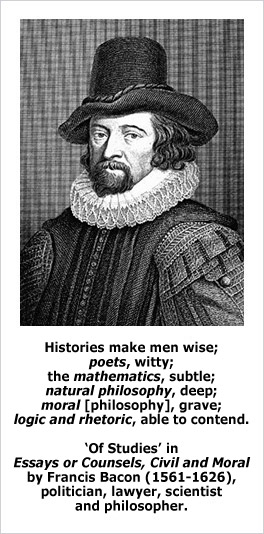
Needless to say, these perceptions are hardly new. ‘Histories make men wise’, as Francis Bacon long ago observed. Thinkers and doers from classical Greece to Winston Churchill have agreed and recommended its study.
november003Why then has the subject matter of History been comparatively undervalued in recent years? It can’t just be the power of the Skills agenda and the influence of ministers fussing about every subject’s contribution to the economy.

Nor can it be that History teachers are ‘boring’ and that they teach students nothing but the dates of kings, queens and battles. Ofsted report after Ofsted report has stated otherwise. The subject is considered to be generally well and imaginatively conveyed. Moreover, the sizeable number of students choosing to take the subject, even once it has ceased to be compulsory, shows that there is a continuing human urge to understand the human past.

Nonetheless, the public reputation of History as a subject of study is currently poor. It is often dismissed as the ‘dead past’. Why should students need to know about things that have long gone? The pace of technological change in particular seems to point people ‘onwards’, not backwards. What can the experience of the older generation, who notoriously have trouble coping with shiny new gadgets, teach the adept and adaptable young?

Well, there are many answers to such rhetoric.

In the first place, things that are ‘dead’ are not necessarily lacking in interest. It is valuable to stretch the mind to learn about vanished cultures, as some indeed have. Impressively, archaeologists, historians, palaeontologists, biologists and language experts have together discovered much about the long evolution of our own species – often from the skimpiest bits of evidence. It’s a highly relevant story about adaptation and survival, often in hostile climes.

Meanwhile, there is a second answer too. It’s completely fallacious to assume that everything in the past is ‘dead’. Much – very much – survives and develops through time, to create a living history, which embraces everyone alive today. The human genome, for example, is an evolving inheritance from the past. So are the dynamic histories, languages and cultures that we have so variously created.

We need more long-term accounts of how such things continue, evolve and change over the very long term. The recent stress by historians upon close focus studies, looking at one period or great event in depth, has been fruitful. Yet it should not exclude long-term narratives. They help to frame the details and to fit the immediate complexities into bigger pictures. (My own suggestion for a secondary-schools course on ‘The Peopling of Britain’, in which everyone living in Britain has a stake, is published in the November issue of History Today).1  In sum, we all need to learn systematically – and to continue learning – about our own and other people’s histories. It’s a lifetime project, for individuals and for citizens.

• My December Blog will consider further how historians can advance the public case for studying History.

1 P.J. Corfield, ‘Our Island Stories – The Peopling of Britain’, History Today, vol. 62, issue 11 (Nov. 2012), pp. 52-3.

For further discussion, see Twitter

To read other discussion-points, please click here

To download Monthly Blog 24 please click here
Tags: britain, chartists, education, history, ofsted, politician, school
Share this entry
  • Share on Facebook
  • Share on X
  • Share on WhatsApp
  • Share on Pinterest
  • Share on LinkedIn
  • Share by Mail
https://www.penelopejcorfield.com/wp-content/uploads/2020/12/P.J.C.png 0 0 Penelope J. Corfield https://www.penelopejcorfield.com/wp-content/uploads/2020/12/P.J.C.png Penelope J. Corfield2012-11-01 12:00:182021-01-12 18:54:25MONTHLY BLOG 24, HISTORY AS THE STAPLE OF A CIVIC EDUCATION
You might also like
MONTHLY BLOG 25, CHAMPIONING THE STUDY OF HISTORY
MONTHLY BLOG 32, REACTIONS TO MAKING A HISTORY DVD
MONTHLY BLOG 92, HISTORIANS AT WORK THROUGH TIME
MONTHLY BLOG 144, A YEAR OF GEORGIAN CELEBRATIONS – 12: Celebrating the annual late-November Jonathan Swift Festival in the City of Dublin, where the Anglo-Irish wit, satirist and cleric was born and where he served as Dean of St Patrick’s Cathedral from 1713 to 1745.
MONTHLY BLOG 26, WORST AND BEST ACADEMIC LECTURES THAT I’VE HEARD
MONTHLY BLOG 62, IS THE PAST DEAD OR ALIVE? AND THE SNARES OF SUCH BINARY QUESTIONS.
MONTHLY BLOG 157, HOW THE GEORGIANS CELEBRATED MIDWINTER (*)
MONTHLY BLOG 58, LIVING INTENSELY IN THE EYE OF THE STORM: WHY DO PEOPLE QUIT THEIR DAILY LIVES AND GO TO JOIN CRUSADES IN DISTANT LANDS?
Search Search

Monthly Blogs

  • MONTHLY BLOG 184, THE MOON – FAMILIAR FRIEND OR LONELY STRANGER? 2 April 2026
  • MONTHLY BLOG 183, HICKORY DICKORY DOCK! IN MEMORY OF MY LATE BROTHER JULIAN, OUR HAPPY CHILDHOOD TOGETHER, AND HIS LIFELONG SENSE OF DROLL HUMOUR 1 March 2026
  • MONTHLY BLOG 182, TO LAUGH OR CRY? RESPONDING TO ACADEMIC CRITICISMS 2 February 2026
  • MONTHLY BLOG 181, A YEAR OF POEMS 3 January 2026
  • MONTHLY BLOG 180, TIME & INSPIRATION 1 December 2025
  • MONTHLY BLOG 179, IDENTIFYING DIFFERENT ERAS OF TIME: POTENTIAL & PITFALLS … 1 November 2025
  • MONTHLY BLOG 178, THINKING THROUGH TIME AT ARTHUR’S STONE IN HEREFORDSHIRE 1 October 2025
  • MONTHLY BLOG 177, SONGS ABOUT TIME 3 September 2025

Categories

  • 2026 – Year of Poetry
  • Autobiography
  • Civics
  • Current Affairs
  • Family Memories
  • History
  • Monthly Blog
  • Notices
  • Personal
  • Reviews
  • Skills
  • Time

Archives

Tags

academics agenda ancestry battersea britain christianity continuity degree diagenesis dialectical discussion education eighteenth century ethnicity Georgian government historian historians history humanities humans knowledge labour labour party language London metamorphosis paradigm shift Penelope J Corfield poet policy politicians politics professor research students teachers time traditions transformation universities university vocational voters writing

Penelope J. Corfield

Penelope J. Corfield is a historian, lecturer and education consultant. She recently served as the President of the International Society for Eighteenth-Century Studies (ISECS).

Recent Posts

  • MONTHLY BLOG 184, THE MOON – FAMILIAR FRIEND OR LONELY STRANGER? 2 April 2026
  • MONTHLY BLOG 183, HICKORY DICKORY DOCK! IN MEMORY OF MY LATE BROTHER JULIAN, OUR HAPPY CHILDHOOD TOGETHER, AND HIS LIFELONG SENSE OF DROLL HUMOUR 1 March 2026

CONTACT

Penelope J. Corfield Historian
contact me here

SEARCH THIS SITE

Search Search

SHARE THIS

QUICK LINKS

© Copyright - Penelope J Corfield 2026. All rights reserved. | Dancing Dates Film by Edwina Hannam | Site by Starling Design
  • Link to X
  • Link to Rss this site
  • Link to Mail
Link to: MONTHLY BLOG 23, WHY DO POLITICIANS UNDERVALUE HISTORY IN SCHOOLS ? Link to: MONTHLY BLOG 23, WHY DO POLITICIANS UNDERVALUE HISTORY IN SCHOOLS ? MONTHLY BLOG 23, WHY DO POLITICIANS UNDERVALUE HISTORY IN SCHOOLS ? Link to: MONTHLY BLOG 25, CHAMPIONING THE STUDY OF HISTORY Link to: MONTHLY BLOG 25, CHAMPIONING THE STUDY OF HISTORY MONTHLY BLOG 25, CHAMPIONING THE STUDY OF HISTORY
Scroll to top Scroll to top Scroll to top

This site uses cookies. By continuing to browse the site, you are agreeing to our use of cookies.

OKLearn more

Cookie and Privacy Settings


How we use cookies

We may request cookies to be set on your device. We use cookies to let us know when you visit our websites, how you interact with us, to enrich your user experience, and to customize your relationship with our website.

Click on the different category headings to find out more. You can also change some of your preferences. Note that blocking some types of cookies may impact your experience on our websites and the services we are able to offer.

Essential Website Cookies

These cookies are strictly necessary to provide you with services available through our website and to use some of its features.

Because these cookies are strictly necessary to deliver the website, refusing them will have impact how our site functions. You always can block or delete cookies by changing your browser settings and force blocking all cookies on this website. But this will always prompt you to accept/refuse cookies when revisiting our site.

We fully respect if you want to refuse cookies but to avoid asking you again and again kindly allow us to store a cookie for that. You are free to opt out any time or opt in for other cookies to get a better experience. If you refuse cookies we will remove all set cookies in our domain.

We provide you with a list of stored cookies on your computer in our domain so you can check what we stored. Due to security reasons we are not able to show or modify cookies from other domains. You can check these in your browser security settings.

Google Analytics Cookies

These cookies collect information that is used either in aggregate form to help us understand how our website is being used or how effective our marketing campaigns are, or to help us customize our website and application for you in order to enhance your experience.

If you do not want that we track your visit to our site you can disable tracking in your browser here:

Other external services

We also use different external services like Google Webfonts, Google Maps, and external Video providers. Since these providers may collect personal data like your IP address we allow you to block them here. Please be aware that this might heavily reduce the functionality and appearance of our site. Changes will take effect once you reload the page.

Google Webfont Settings:

Google Map Settings:

Google reCaptcha Settings:

Vimeo and Youtube video embeds:

Other cookies

The following cookies are also needed - You can choose if you want to allow them:

Accept settingsHide notification only