Penelope J Corfield
  • HOME
    • Index to Blogs
    • Monthly Blogs
    • CONTACT
    • Key to Dancing Dates Film
  • CURRENT
    • President International Association C18 Studies
    • Lectures on offer
    • London University’s Long C18 History Seminar
    • Living in Battersea
    • Career at a Glance
    • PJC Publications
  • BRITISH HISTORY
    • Long C18 Overviews
    • Society & Culture
    • Town Life
    • Electoral History
    • Radical Poets
    • The Professions
    • Religion & Irreligion
  • GLOBAL
    • Urban History Through Time
    • C18 European History Overviews
    • Gender History
    • ‘Racial’ Classifications as Pseudo-Science
    • Responding to Climate Change
    • Advance of the International Sphere
  • TIME & HISTORY
    • Time & The Shape of History (2007)
    • Rethinking Historical Periodisation
    • Dimensions of The Long Term
    • Returning to Big History
  • HISTORY-MAKING
    • Why History Matters
    • History of History
    • Fellow Historians
    • Arts of Academic Assessment
    • Pleasures of Intellectual Life
  • REVIEWS
    • History Book Reviews
      • Social History
      • Approaches to History
      • Big History
    • Theatre Reviews
    • Civic/Political Commentaries
    • Personal Portraits
  • Menu Menu

MONTHLY BLOG 35, DONS AND STUDENT-CUSTOMERS? OR THE COMMUNITY OF LEARNERS?

1 November 2013/in Civics, Monthly Blog/by Penelope J. Corfield

If citing, please kindly acknowledge copyright © Penelope J. Corfield (2013)

Names matter. Identifying  things – people – events – in realistic terminology means that they are being fully understood and taken seriously. Conversely, it’s warping to the mind and eventually corrosive of good thought to be constantly urged to give lip-service to the ‘wrong’ terms. People who live under dictatorial systems of would-be thought-control often testify to the ‘dead’ feeling that results from public censorship, especially when it is internalised as self-censorship.

By the way, I wrote that paragraph before remembering that this sentiment dovetailed with something I’d read about Confucius. A quick Google-check confirmed my half-memory.  Confucius long ago specified that: ‘The beginning of wisdom is to call things by their proper names’. It’s a great dictum. It doesn’t claim too much. Naming is only the ‘beginning of wisdom’, not the entirety. And there is often scope for debating what is or should be the ‘proper’ name. Nonetheless, Confucius not only highlights the good effect of clear vision, accurately acknowledged to others, but equally implies the malign effects of the reverse. The beginning of madness is to delude oneself and others about the true state of affairs.

Which brings me to my current question: are University students ‘customers’? If so, an interesting implication follows. If ‘the customer is always right’, as the business world asserts but does not always uphold, should not all students get top marks for having completed an assignment or an exam paper? Or, at very least not get bad marks?

Interestingly, now that student payments for tuition are very much up-front and personal in the form of fees (which are funded as repayable loans), so the standard of degrees is gradually rising. Indeed, grade inflation has become noticeable ever since Britain’s Universities began to be expanded into a mass system. A survey undertaken in 2003 found that the third-class degree has been in steady decline since 1960 and was nearing extinction by 2000.1  And a decade on, the lower second (2.2) in some subjects is following the same trajectory. Better teaching, better study skills, and/or improved exam preparation may account for some of this development. But rising expectations on the part of students – and increasing reputational ambitions on the part of the Universities – also exert subtle pressures upon examiners to be generous.

Nonetheless, even allowing for a changing framework of inputs and outputs, a degree cannot properly be ‘bought’. Students within any given University course are learners, not customers. Their own input is an essential part of the process. They can gain a better degree not by more money but by better effort, well directed, and by better ability, suitably honed.

People learn massively from teachers, but also much from private study, and much too from their fellow-learners (who offer both positive and negative exemplars). Hence the tutors, the individual student, and other students all contribute to each individual’s result.2

A classic phrase for this integrated learning process was ‘the community of scholars’. That phrase now sounds quaint and possibly rather boring. Popularly, scholarship is assumed to be quintessentially dull and pedantic, with the added detriment of causing its devotees to ‘scorn delights and live laborious days,’ in Milton’s killing phrase.3  In fact, of course, learning isn’t dull. Milton, himself a very learned man, knew so too. Nonetheless, ‘the community of scholars’ doesn’t cut the twenty-first century terminological mustard.

But ‘learning’ has a better vibe. It commands ‘light’. People may lust for it, without losing their dignity. And it implies a continually interactive process. So it’s good for students to think of themselves as part of a community of learners. Compared with their pupils, the dons are generally older, sometimes wiser, always much better informed about the curriculum, much more experienced in teaching, and ideally seasoned by their own research efforts. But the academics too are learners, if more advanced along the pathway. They are sharing the experience and their expertise with the students. Advances in knowledge can come from any individual at any level, often emerging from debates and questions, no matter how naive. So it’s not mere pretension that causes many academics to thank in their scholarly prefaces not only their fellow researchers but also their students.

Equally, it’s good for the hard-pressed dons to think of themselves as part of an intellectual community that extends to the students. That concept reasserts an essential solidarity. It also serves to reaffirm the core commitment of the University to the inter-linked aims of teaching and research. Otherwise, the students, who are integral to the process, are seemingly in danger of getting overlooked while the dons are increasingly tugged between the rival pressures of specialist research in the age of Research Assessment, and of managerial business-speak in the age of the University-plc.4

Lastly, reference to ‘community’ need not be too starry-eyed. Ideals may not always work perfectly in practice. ‘Community’ is a warm, comforting word. It’s always assumed to be a ‘good thing’. Politicians, when seeking to commend a policy such as mental health care, refer to locating it in ‘the community’ as though that concept can resolve all the problems. (As is now well proven, it can’t). And history readily demonstrates that not all congregations of people form a genuine community. Social cohesion needs more than just a good name.

That’s why it’s good to think of Universities as containing communities of learners, in order to encourage everyone to provide the best conditions for that basic truth to flourish at its best. That’s far from an easy task in a mass higher-education system. It runs counter to attempts at viewing students as individual consumers. But it’s more realistic as to how teaching actually works well. And calling things by their proper names makes a proper start.
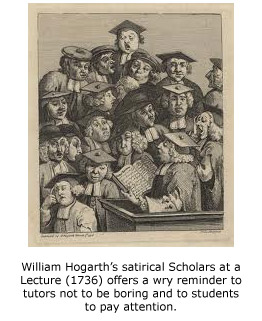
William Hogarth’s satirical Scholars at a Lecture (1736) offers a wry reminder to tutors not to be boring and to students to pay attention1 ‘Third Class Degree Dying Out’, Times Higher Education, 5 Sept. 2003: www.timeshighereducation.co.uk/178955/article: consulted 4 Nov. 2013.

2 That’s one reason why performance-related-pay (PRP) for teachers, based upon examination results for their taught courses, remains a very blunt tool for rewarding teaching achievements. Furthermore, all calculations for PRP (to work even approximately justly) need to take account of the base-line from which the students began, to measure the educational ‘value-added’. Without that proviso, teachers (if incentivised purely by monetary reward) should logically clamour to teach only the best, brightest, and most committed students, who will deliver the ‘best’ results.

3 John Milton, Lycidas: A Lament for a Friend, Drowned in his Passage from Chester on the Irish Seas (1637), lines 70-72: ‘Fame is the spur that the clear spirit doth raise/ (That last Infirmity of Noble mind)/ To scorn delights and live laborious days.’

4 On the marketisation of higher education, see film entitled Universities Plc? Enterprise in Higher Education, made by film students at the University of Warwick (2013): www2.warwick.ac.uk/fac

For further discussion, see Twitter

To read other discussion-points, please click here

To download Monthly Blog 35 please click here

Tags: community, customers, degree, degrees, payments, social cohesion, students, teachers, tuition, university
Share this entry
  • Share on Facebook
  • Share on X
  • Share on WhatsApp
  • Share on Pinterest
  • Share on LinkedIn
  • Share by Mail
https://www.penelopejcorfield.com/wp-content/uploads/2020/12/P.J.C.png 0 0 Penelope J. Corfield https://www.penelopejcorfield.com/wp-content/uploads/2020/12/P.J.C.png Penelope J. Corfield2013-11-01 12:00:222021-01-12 18:53:17MONTHLY BLOG 35, DONS AND STUDENT-CUSTOMERS? OR THE COMMUNITY OF LEARNERS?
You might also like
MONTHLY BLOG 19, IN PRAISE OF PUBLIC INFORMATION, AND DISPRAISE OF SUGARED PUBLIC RELATIONS
MONTHLY BLOG 122, PROPOSED ROOTS PROJECT FOR TEENAGERS
MONTHLY BLOG 182, TO LAUGH OR CRY? RESPONDING TO ACADEMIC CRITICISMS
MONTHLY BLOG 17, EVENTS LIVED THROUGH – PART TWO: 1971
MONTHLY BLOG 37, HOW DO PEOPLE RESPOND TO ELIMINATING THE LANGUAGE OF ‘RACE’?
MONTHLY BLOG 83, SEX AND THE ACADEMICS
MONTHLY BLOG 39, STUDYING THE LONG AND THE SHORT OF HISTORY
MONTHLY BLOG 66, WHAT’S SO GREAT ABOUT HISTORICAL EVIDENCE?
Search Search

Monthly Blogs

  • MONTHLY BLOG 184, THE MOON – FAMILIAR FRIEND OR LONELY STRANGER? 2 April 2026
  • MONTHLY BLOG 183, HICKORY DICKORY DOCK! IN MEMORY OF MY LATE BROTHER JULIAN, OUR HAPPY CHILDHOOD TOGETHER, AND HIS LIFELONG SENSE OF DROLL HUMOUR 1 March 2026
  • MONTHLY BLOG 182, TO LAUGH OR CRY? RESPONDING TO ACADEMIC CRITICISMS 2 February 2026
  • MONTHLY BLOG 181, A YEAR OF POEMS 3 January 2026
  • MONTHLY BLOG 180, TIME & INSPIRATION 1 December 2025
  • MONTHLY BLOG 179, IDENTIFYING DIFFERENT ERAS OF TIME: POTENTIAL & PITFALLS … 1 November 2025
  • MONTHLY BLOG 178, THINKING THROUGH TIME AT ARTHUR’S STONE IN HEREFORDSHIRE 1 October 2025
  • MONTHLY BLOG 177, SONGS ABOUT TIME 3 September 2025

Categories

  • 2026 – Year of Poetry
  • Autobiography
  • Civics
  • Current Affairs
  • Family Memories
  • History
  • Monthly Blog
  • Notices
  • Personal
  • Reviews
  • Skills
  • Time

Archives

Tags

academics agenda ancestry battersea britain christianity continuity degree diagenesis dialectical discussion education eighteenth century ethnicity Georgian government historian historians history humanities humans knowledge labour labour party language London metamorphosis paradigm shift Penelope J Corfield poet policy politicians politics professor research students teachers time traditions transformation universities university vocational voters writing

Penelope J. Corfield

Penelope J. Corfield is a historian, lecturer and education consultant. She recently served as the President of the International Society for Eighteenth-Century Studies (ISECS).

Recent Posts

  • MONTHLY BLOG 184, THE MOON – FAMILIAR FRIEND OR LONELY STRANGER? 2 April 2026
  • MONTHLY BLOG 183, HICKORY DICKORY DOCK! IN MEMORY OF MY LATE BROTHER JULIAN, OUR HAPPY CHILDHOOD TOGETHER, AND HIS LIFELONG SENSE OF DROLL HUMOUR 1 March 2026

CONTACT

Penelope J. Corfield Historian
contact me here

SEARCH THIS SITE

Search Search

SHARE THIS

QUICK LINKS

© Copyright - Penelope J Corfield 2026. All rights reserved. | Dancing Dates Film by Edwina Hannam | Site by Starling Design
  • Link to X
  • Link to Rss this site
  • Link to Mail
Link to: MONTHLY BLOG 34, COPING WITH WRITER’S BLOCK Link to: MONTHLY BLOG 34, COPING WITH WRITER’S BLOCK MONTHLY BLOG 34, COPING WITH WRITER’S BLOCK Link to: MONTHLY BLOG 36, TALKING OF LANGUAGE, IT’S TIME TO UPDATE THE LANGUAGE OF RACE Link to: MONTHLY BLOG 36, TALKING OF LANGUAGE, IT’S TIME TO UPDATE THE LANGUAGE OF RACE MONTHLY BLOG 36, TALKING OF LANGUAGE, IT’S TIME TO UPDATE THE LANGUAGE OF...
Scroll to top Scroll to top Scroll to top

This site uses cookies. By continuing to browse the site, you are agreeing to our use of cookies.

OKLearn more

Cookie and Privacy Settings


How we use cookies

We may request cookies to be set on your device. We use cookies to let us know when you visit our websites, how you interact with us, to enrich your user experience, and to customize your relationship with our website.

Click on the different category headings to find out more. You can also change some of your preferences. Note that blocking some types of cookies may impact your experience on our websites and the services we are able to offer.

Essential Website Cookies

These cookies are strictly necessary to provide you with services available through our website and to use some of its features.

Because these cookies are strictly necessary to deliver the website, refusing them will have impact how our site functions. You always can block or delete cookies by changing your browser settings and force blocking all cookies on this website. But this will always prompt you to accept/refuse cookies when revisiting our site.

We fully respect if you want to refuse cookies but to avoid asking you again and again kindly allow us to store a cookie for that. You are free to opt out any time or opt in for other cookies to get a better experience. If you refuse cookies we will remove all set cookies in our domain.

We provide you with a list of stored cookies on your computer in our domain so you can check what we stored. Due to security reasons we are not able to show or modify cookies from other domains. You can check these in your browser security settings.

Google Analytics Cookies

These cookies collect information that is used either in aggregate form to help us understand how our website is being used or how effective our marketing campaigns are, or to help us customize our website and application for you in order to enhance your experience.

If you do not want that we track your visit to our site you can disable tracking in your browser here:

Other external services

We also use different external services like Google Webfonts, Google Maps, and external Video providers. Since these providers may collect personal data like your IP address we allow you to block them here. Please be aware that this might heavily reduce the functionality and appearance of our site. Changes will take effect once you reload the page.

Google Webfont Settings:

Google Map Settings:

Google reCaptcha Settings:

Vimeo and Youtube video embeds:

Other cookies

The following cookies are also needed - You can choose if you want to allow them:

Accept settingsHide notification only