Penelope J Corfield
  • HOME
    • Index to Blogs
    • Monthly Blogs
    • CONTACT
    • Key to Dancing Dates Film
  • CURRENT
    • President International Association C18 Studies
    • Lectures on offer
    • London University’s Long C18 History Seminar
    • Living in Battersea
    • Career at a Glance
    • PJC Publications
  • BRITISH HISTORY
    • Long C18 Overviews
    • Society & Culture
    • Town Life
    • Electoral History
    • Radical Poets
    • The Professions
    • Religion & Irreligion
  • GLOBAL
    • Urban History Through Time
    • C18 European History Overviews
    • Gender History
    • ‘Racial’ Classifications as Pseudo-Science
    • Responding to Climate Change
    • Advance of the International Sphere
  • TIME & HISTORY
    • Time & The Shape of History (2007)
    • Rethinking Historical Periodisation
    • Dimensions of The Long Term
    • Returning to Big History
  • HISTORY-MAKING
    • Why History Matters
    • History of History
    • Fellow Historians
    • Arts of Academic Assessment
    • Pleasures of Intellectual Life
  • REVIEWS
    • History Book Reviews
      • Social History
      • Approaches to History
      • Big History
    • Theatre Reviews
    • Civic/Political Commentaries
    • Personal Portraits
  • Menu Menu

MONTHLY BLOG 29, SHOULD EACH SECRETARY OF STATE FOR EDUCATION REWRITE THE UK SCHOOLS HISTORY SYLLABUS?

1 April 2013/in Civics, Monthly Blog/by Penelope J. Corfield

If citing, please kindly acknowledge copyright © Penelope J. Corfield (2013)

The answer is unequivocally No. (Obvious really but worth saying still?)

History as a subject is far, far too important to become a political football. It teaches about conflict as well as compromise; but that’s not the same as being turned into a source of conflict in its own right. Direct intervention by individual politicians in framing the History syllabus is actively dangerous.
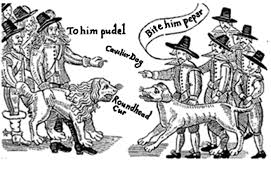
2013-4 Cavaliers and Roundheads

Rival supporters of King and Parliament in the 1640s civil wars, berating their opponents as ‘Roundhead curs’ and ‘Cavalier dogs’: the civil wars should certainly appear in the Schools History syllabus but they don’t provide a model for how the syllabus should be devised.

There are several different issues at stake. For a start, many people believe that the Schools curriculum, or prescriptive framework, currently allots too little time to the study of History. There should be more classes per week. And the subject should be compulsory to the age of sixteen.1  Those changes would in themselves greatly enhance children’s historical knowledge, reducing their recourse to a mixture of prevalent myths and cheerful ignorance.

A second issue relates to the balance of topics within the current History syllabus, which specifies the course contents. I personally do favour some constructive changes. There is a good case for greater attention to long-term narrative frameworks,2  alongside high-quality in-depth studies.

But the point here is: who should actually write the detailed syllabus? Not individual historians and, above all, not individual politicians. However well-intentioned such power-brokers may or may not be, writing the Schools History syllabus should be ultra-vires: beyond their legal and political competence.

The need for wide consultation would seem obvious; and such a process was indeed launched. However, things have just moved into new territory. It is reported that Education Secretary has unilaterally aborted the public discussions. Instead, the final version of the Schools History syllabus, revealed on 7 February 2013, bears little relation to previous drafts and discussions.3 It has appeared out of the (political) blue.

Either the current Education Secretary acted alone, or perhaps had some unnamed advisers, working behind the scenes. Where is the accountability in this mode of procedure? Even some initial supporters of syllabus revision have expressed their dismay and alarm.

Imagine what Conservative MPs would have said in 2002 if David Blunkett (to take the best known of Blair’s over-many Education Ministers) had not only inserted the teaching of Civics into the Schools curriculum as a separate subject;4 but had written the Civics syllabus as well. Or if Blunkett had chosen to rewrite the History syllabus at the same time?

Or imagine what Edmund Burke, the apostle of moderate Toryism, would have said. This eighteenth-century politician-cum-political theorist, who was reportedly identified in 2008 as ‘the greatest conservative ever’ by the current Education Secretary,5 was happy to accept the positive role of the state. Yet he consistently warned of the dangers of high-handed executive power. The authority of central government should not be untrammelled. It should not be used to smash through policies in an arbitrary manner. Instead Burke specifically praised the art of compromise or – a better word – of mutuality:

All government, indeed every human benefit and enjoyment, every virtue, and every prudent act, is founded on compromise and barter.6

An arbitrary determination of the Schools History syllabus further seems to imply that the subject not only can but ought to be moulded by political fiat. Such an approach puts knowledge itself onto a slippery slope. ‘Fixing’ subjects by political will (plus the backing of the state) leads to intellectual atrophy.

To take a notoriously extreme example, Soviet biology was frozen for at least two generations by Stalin’s doctrinaire endorsement of Lysenko’s environmental genetics.7 A dramatic rise in agrarian productivity was promised, without the need for fertilisers (or more scientific research). Stalin was delighted. Down with the egg-heads and their slow research. Lysenko’s critics were dismissed or imprisoned. But Lysenkoism did not work. And, after unduly long delays, his pseudo-science was finally discredited.
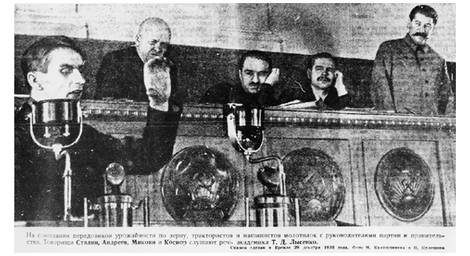
2013-4 Lysenko_with_Stalin - Copy

A rare photo of Stalin (back R) gazing approvingly at Trofim Lysenko (1898-1976)
speaking from the rostrum in the Kremlin, 1935

In this case, the Education Secretary is seeking to improve schoolchildren’s minds rather than to improve crop yields. But declaring the ‘right’ answer from the centre is no way to achieve enlightenment. Without the support of the ‘little platoons’ (to borrow another key phrase from Burke), the proposed changes may well prove counter-productive in the class-room. Many teachers, who have to teach the syllabus, are already alienated. And, given that History as a subject lends itself to debate and disagreement, pupils will often learn different lessons from those intended.

Intellectual interests in an Education Secretary are admirable. The anti-intellectualism of numerous past ministers (including too many Labour ones) has been horribly depressing. But intellectual confidence, tipped into arrogance, can be taken too far. Another quotation to that effect is often web-attributed to Edmund Burke, though it seems to come from Albert Einstein. He warned that powerful people should wisely appreciate the limits of their power:

Whoever undertakes to set himself up as a judge of Truth and Knowledge is shipwrecked by the laughter of the gods.8

1 That viewpoint was supported in my monthly BLOG no.23 ‘Why do Politicians Undervalue History in Schools’ (Oct. 2012): see www.penelopejcorfield.co.uk.

2 I proposed a long-span course on ‘The Peopling of Britain’ in History Today, 62/11 (Nov. 2012), pp. 52-3.

3 See D. Cannadine, ‘Making History: Opportunities Missed in Reforming the National Curriculum’, Times Literary Supplement, 15 March 2013, pp. 14-15; plus further responses and a link to the original proposals in www.historyworks.tv

4 For the relationships of History and Civics, see my monthly BLOG no.24 ‘History as the Staple of a Civic Education’, www.penelopejcorfield.co.uk.

5 Michael Gove speech to 2008 Conservative Party Annual Conference, as reported in en.wikipedia.org/wiki/Michael_Gove, consulted 3 April 2013.

6 Quotation from Edmund Burke (1729-97), Second Speech on Conciliation with America (1775). For further context, see D. O’Keeffe, Edmund Burke (2010); I. Kramnick, The Rage of Edmund Burke: Portrait of an Ambivalent Conservative (New York, 1977); and F. O’Gorman (ed.), British Conservatism: Conservative Thought from Burke to Thatcher (1986).

7 Z. Medvedev, The Rise and Fall of T.D. Lysenko (New York, 1969).

8 Albert Einstein (1879-1955), in Essays Presented to Leo Baeck on the Occasion of his Eightieth Birthday (1954), p. 26. The quotation is sometimes (but wrongly) web-attributed to Edmund Burke’s critique of Jacobin arrogance in his Preface to Brissot’s Address to his Constituents (1794).

For further discussion, see Twitter

To read other discussion-points, please click here

To download Monthly Blog 29 please click here
Tags: britain, conflict, david blunkett, edmond burke, education, history, lectures, papers, politics, presentations, professor, universities
Share this entry
  • Share on Facebook
  • Share on X
  • Share on WhatsApp
  • Share on Pinterest
  • Share on LinkedIn
  • Share by Mail
https://www.penelopejcorfield.com/wp-content/uploads/2020/12/P.J.C.png 0 0 Penelope J. Corfield https://www.penelopejcorfield.com/wp-content/uploads/2020/12/P.J.C.png Penelope J. Corfield2013-04-01 12:00:212021-01-12 18:54:23MONTHLY BLOG 29, SHOULD EACH SECRETARY OF STATE FOR EDUCATION REWRITE THE UK SCHOOLS HISTORY SYLLABUS?
You might also like
MONTHLY BLOG 163, DO PARTISAN IDENTITIES ADD A PLEASANT FLAVOUR TO DAILY LIVING – OR DO THEY REALLY CONSTITUTE A TRAP THAT UNDERMINES TRUE HUMAN SOLIDARITY?
MONTHLY BLOG 136, A YEAR OF GEORGIAN CELEBRATIONS – 4: ENJOYING THE ANNUAL DUCK FEAST
MONTHLY BLOG 126, Does classifying people in terms of their ‘Identity’ have parallels with racist thought? Answer: No; Yes; and ultimately, No.
MONTHLY BLOG 150, Tribute to the Gracious International City of Geneva – Historic Home of Three Hegemonc Radical Thinkers – and, Additionally, Thronged with Sparrows
MONTHLY BLOG 102, ARE YOU AN OPTIMIST? HOW WELL DO YOU KNOW YOUR OWN TEMPERAMENT?
MONTHLY BLOG 142, A YEAR OF GEORGIAN CELEBRATIONS – 10: Annual Commemorations UK ANTI-SLAVERY DAY ON 18 OCTOBER & THE LIFE OF OLAUDAH EQUIANO (c.1745-97)
MONTHLY BLOG 135, A YEAR OF GEORGIAN CELEBRATIONS – 3: THE SCOTTISH MUSIC OF NIEL GOW
MONTHLY BLOG 125, WHAT DOES IT MEAN TO BE A WHOLE PERSON? WHY WE SHOULD ALL BE ARTY-SMARTY.
Search Search

Monthly Blogs

  • MONTHLY BLOG 184, THE MOON – FAMILIAR FRIEND OR LONELY STRANGER? 2 April 2026
  • MONTHLY BLOG 183, HICKORY DICKORY DOCK! IN MEMORY OF MY LATE BROTHER JULIAN, OUR HAPPY CHILDHOOD TOGETHER, AND HIS LIFELONG SENSE OF DROLL HUMOUR 1 March 2026
  • MONTHLY BLOG 182, TO LAUGH OR CRY? RESPONDING TO ACADEMIC CRITICISMS 2 February 2026
  • MONTHLY BLOG 181, A YEAR OF POEMS 3 January 2026
  • MONTHLY BLOG 180, TIME & INSPIRATION 1 December 2025
  • MONTHLY BLOG 179, IDENTIFYING DIFFERENT ERAS OF TIME: POTENTIAL & PITFALLS … 1 November 2025
  • MONTHLY BLOG 178, THINKING THROUGH TIME AT ARTHUR’S STONE IN HEREFORDSHIRE 1 October 2025
  • MONTHLY BLOG 177, SONGS ABOUT TIME 3 September 2025

Categories

  • 2026 – Year of Poetry
  • Autobiography
  • Civics
  • Current Affairs
  • Family Memories
  • History
  • Monthly Blog
  • Notices
  • Personal
  • Reviews
  • Skills
  • Time

Archives

Tags

academics agenda ancestry battersea britain christianity continuity degree diagenesis dialectical discussion education eighteenth century ethnicity Georgian government historian historians history humanities humans knowledge labour labour party language London metamorphosis paradigm shift Penelope J Corfield poet policy politicians politics professor research students teachers time traditions transformation universities university vocational voters writing

Penelope J. Corfield

Penelope J. Corfield is a historian, lecturer and education consultant. She recently served as the President of the International Society for Eighteenth-Century Studies (ISECS).

Recent Posts

  • MONTHLY BLOG 184, THE MOON – FAMILIAR FRIEND OR LONELY STRANGER? 2 April 2026
  • MONTHLY BLOG 183, HICKORY DICKORY DOCK! IN MEMORY OF MY LATE BROTHER JULIAN, OUR HAPPY CHILDHOOD TOGETHER, AND HIS LIFELONG SENSE OF DROLL HUMOUR 1 March 2026

CONTACT

Penelope J. Corfield Historian
contact me here

SEARCH THIS SITE

Search Search

SHARE THIS

QUICK LINKS

© Copyright - Penelope J Corfield 2026. All rights reserved. | Dancing Dates Film by Edwina Hannam | Site by Starling Design
  • Link to X
  • Link to Rss this site
  • Link to Mail
Link to: MONTHLY BLOG 28, ANSWERING QUESTIONS POST SEMINAR PAPERS/ LECTURES Link to: MONTHLY BLOG 28, ANSWERING QUESTIONS POST SEMINAR PAPERS/ LECTURES MONTHLY BLOG 28, ANSWERING QUESTIONS POST SEMINAR PAPERS/ LECTURES Link to: PJC WEBSITE REVIEW/4 – THE LIFE OF STUFF (1993) BY SIMON DONALD Link to: PJC WEBSITE REVIEW/4 – THE LIFE OF STUFF (1993) BY SIMON DONALD PJC WEBSITE REVIEW/4 – THE LIFE OF STUFF (1993) BY SIMON DONALD
Scroll to top Scroll to top Scroll to top

This site uses cookies. By continuing to browse the site, you are agreeing to our use of cookies.

OKLearn more

Cookie and Privacy Settings


How we use cookies

We may request cookies to be set on your device. We use cookies to let us know when you visit our websites, how you interact with us, to enrich your user experience, and to customize your relationship with our website.

Click on the different category headings to find out more. You can also change some of your preferences. Note that blocking some types of cookies may impact your experience on our websites and the services we are able to offer.

Essential Website Cookies

These cookies are strictly necessary to provide you with services available through our website and to use some of its features.

Because these cookies are strictly necessary to deliver the website, refusing them will have impact how our site functions. You always can block or delete cookies by changing your browser settings and force blocking all cookies on this website. But this will always prompt you to accept/refuse cookies when revisiting our site.

We fully respect if you want to refuse cookies but to avoid asking you again and again kindly allow us to store a cookie for that. You are free to opt out any time or opt in for other cookies to get a better experience. If you refuse cookies we will remove all set cookies in our domain.

We provide you with a list of stored cookies on your computer in our domain so you can check what we stored. Due to security reasons we are not able to show or modify cookies from other domains. You can check these in your browser security settings.

Google Analytics Cookies

These cookies collect information that is used either in aggregate form to help us understand how our website is being used or how effective our marketing campaigns are, or to help us customize our website and application for you in order to enhance your experience.

If you do not want that we track your visit to our site you can disable tracking in your browser here:

Other external services

We also use different external services like Google Webfonts, Google Maps, and external Video providers. Since these providers may collect personal data like your IP address we allow you to block them here. Please be aware that this might heavily reduce the functionality and appearance of our site. Changes will take effect once you reload the page.

Google Webfont Settings:

Google Map Settings:

Google reCaptcha Settings:

Vimeo and Youtube video embeds:

Other cookies

The following cookies are also needed - You can choose if you want to allow them:

Accept settingsHide notification only