MONTHLY BLOG 24, HISTORY AS THE STAPLE OF A CIVIC EDUCATION
If citing, please kindly acknowledge copyright © Penelope J. Corfield (2012)
Politicians have a duty to attend to civics as well as to economics. Indeed, we all do. So talking about whether the study of History is ‘useful’ for the economy is a very partial way of approaching an essential component of human’s collective living. We all need to be rooted in space and time. Politicians should therefore be advocating the study of History as the essential contribution to individual and social connectedness. In a word, civics in the full meaning of the term. Not just learning how to fill in a ballot paper – but learning how communities develop over time, how they cope with conflict and with conflict-resolution, and, incidentally, how they struggle to create truly fair and democratic societies.
Praise of the study of History as a means of learning essential skills is all very well. Lots of useful things are indeed achieved by this means. People learn to evaluate complex sources, to make and debate critical judgments based upon careful assessments of often contradictory evidence, and to understand continuity and change over the long term. So far, so good.
Yet it is seriously inadequate to recommend a subject only in terms of the skills it teaches and not in terms of its core content. It’s like (say) recommending learning to sing in order to strengthen the vocal chords and to improve lung capacity. Or (as the ad agency Saatchi & Saatchi notoriously did in 1988) recommending a visit to the Victoria & Albert Museum in order to enjoy a nice egg salad in its ‘ace caff’ – with some very valuable art objects attached.
 By the way, so notorious has that advertisement become that it is strangely difficult to find the originals image on the web. It seems to have been self-censored by both the Museum and the ad agency – probably in shame.
When recommending History, there is a crucial Knowledge agenda at stake as well as a supporting Skills agenda. Of course, the two are inextricably linked. Historical skills without historical Knowledge are poorly learned and quickly forgotten. But learning History has a greater and essential value purely in its own right. It is not ‘just’ a route to Skills but a subject of all-encompassing and thrilling importance.
All of human life is there; and all humans need access to this shared reservoir of knowledge about our shared past. People always glean some outline information by one means or another. They pick up myths and assumptions and bits and pieces from their families and communities.
But people learn more and better when they learn systematically: about the history of the country that they live in; and about the comparative history of other countries, both nearby and far away; and about how a myriad of different developments around the world fit into a long-term human history, which includes continuities as well as change.
Needless to say, these perceptions are hardly new. ‘Histories make men wise’, as Francis Bacon long ago observed. Thinkers and doers from classical Greece to Winston Churchill have agreed and recommended its study.
 Why then has the subject matter of History been comparatively undervalued in recent years? It can’t just be the power of the Skills agenda and the influence of ministers fussing about every subject’s contribution to the economy.
Nor can it be that History teachers are ‘boring’ and that they teach students nothing but the dates of kings, queens and battles. Ofsted report after Ofsted report has stated otherwise. The subject is considered to be generally well and imaginatively conveyed. Moreover, the sizeable number of students choosing to take the subject, even once it has ceased to be compulsory, shows that there is a continuing human urge to understand the human past.
Nonetheless, the public reputation of History as a subject of study is currently poor. It is often dismissed as the ‘dead past’. Why should students need to know about things that have long gone? The pace of technological change in particular seems to point people ‘onwards’, not backwards. What can the experience of the older generation, who notoriously have trouble coping with shiny new gadgets, teach the adept and adaptable young?
Well, there are many answers to such rhetoric.
In the first place, things that are ‘dead’ are not necessarily lacking in interest. It is valuable to stretch the mind to learn about vanished cultures, as some indeed have. Impressively, archaeologists, historians, palaeontologists, biologists and language experts have together discovered much about the long evolution of our own species – often from the skimpiest bits of evidence. It’s a highly relevant story about adaptation and survival, often in hostile climes.
Meanwhile, there is a second answer too. It’s completely fallacious to assume that everything in the past is ‘dead’. Much – very much – survives and develops through time, to create a living history, which embraces everyone alive today. The human genome, for example, is an evolving inheritance from the past. So are the dynamic histories, languages and cultures that we have so variously created.
We need more long-term accounts of how such things continue, evolve and change over the very long term. The recent stress by historians upon close focus studies, looking at one period or great event in depth, has been fruitful. Yet it should not exclude long-term narratives. They help to frame the details and to fit the immediate complexities into bigger pictures. (My own suggestion for a secondary-schools course on ‘The Peopling of Britain’, in which everyone living in Britain has a stake, is published in the November issue of History Today).1 In sum, we all need to learn systematically – and to continue learning – about our own and other people’s histories. It’s a lifetime project, for individuals and for citizens.
• My December Blog will consider further how historians can advance the public case for studying History.
1 P.J. Corfield, ‘Our Island Stories – The Peopling of Britain’, History Today, vol. 62, issue 11 (Nov. 2012), pp. 52-3.
For further discussion, see Twitter
To read other discussion-points, please click here
To download Monthly Blog 24 please click here

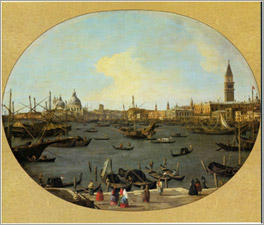 Okay, so not everywhere can look like Venice. Cities have to adapt and change. Venice itself is not immune from innovations. Yet, in the relentless processes of urban development, much more effort is needed to save each place’s distinctive identity – and to introduce or reintroduce such qualities, if they have been lost. If every omni-urban scene looks like every other omni-urban scene, humans have collectively lost something vital.
 But my partner saw this image on screen, grinned, and said ‘Great’. I suspect that he was trying to annoy me, although this building is not in fact my personal nomination for the world’s architectural black-spot. Anyhow, a much more important consideration would be to understand the impact of these buildings upon the immediate locality and the wider city environment – and what visitors and locals think in reality.
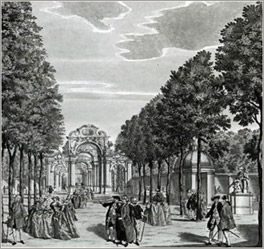 • A musical focus. The Vauxhall Gardens in their prime attracted open-air audiences for summer evening concerts of song and music at both popular and classical levels. Now London has many specialist venues and the bifurcation between high-brow and low-brow can’t easily be undone. But why should the area not host a musical venue of some sort? Maybe a low-cost hall for hire? Plus a link from the Proms in the Park to Vauxhall where London’s open-air summer concerts began?
 This illustration flatters the proposed Market Towers. The sky is deep blue, shading to lighter sky and lights at ground level. The Towers seem to cast no shadows. The surviving Grade I listed building at their feet (centre R) is merged into the background, foretelling its coming obscurity. The traffic at a major traffic interchange is strangely reduced to give the picture harmony. The struggling commuters battling through the wind funnel at the feet of high-rise buildings by the exposed riverside don’t exist. Bah! Humbug! And … more anon.

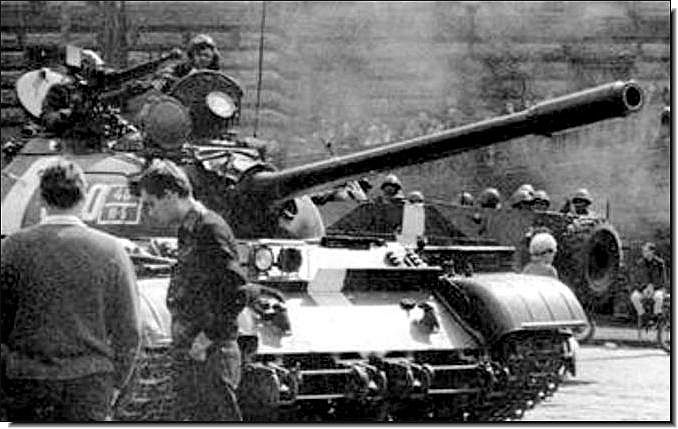 In the aftermath of Czechoslovakia, the response in Britain was not so drastic. I personally wasn’t so blind about the faults of the Soviet system. And I was not a member of the British CP, so couldn’t resign in protest. Nonetheless, the general effect was dispiriting. The political and cultural left,1 which at that time were still in synchronisation, were angered but also depressed.
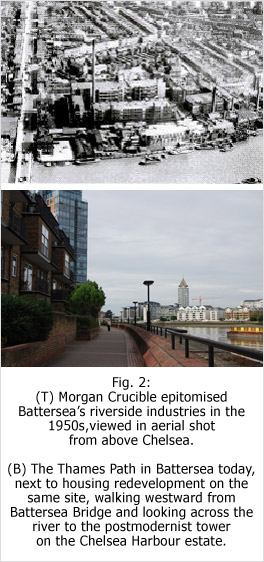
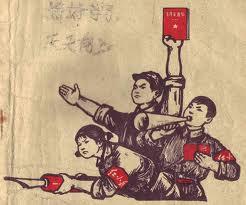 So 1968 was an educative moment for me. Vague utopianism had to be rejected as much as totalitarianism. Indeed, utopianism had to be treated with even more suspicion, since it seemed the more seductive. The answer – between brute force and empty rhetoric – had to be more humdrum and more realistic. In company with my partner Tony Belton, I became more active within the Labour Party. In 1971, we were both elected as councillors in the London Borough of Wandsworth. The outcome of that experience also proved to be stimulating but far from simple – see my next month’s discussion-piece.
 As the sorry tale of FIFA currently implies, oligarchies without external audit and accountability sooner or later get corrupted. So there was a serious principle as well as praxis behind the late Labour Government’s extension of the audit culture to so many aspects of public administration.
 Alternatively, the quest for measured information can insensibly become itself a substitute for effective management. The false impression is gained that managers can organise everything if only they have a large enough database. That way, vast sums of money are wasted only to find that giant systems don’t work.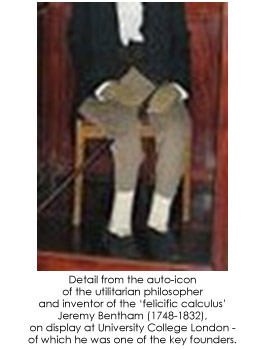
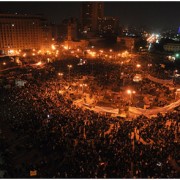
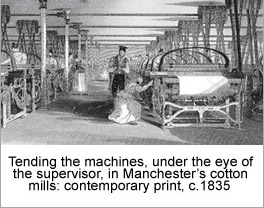 Secondly: political revolutions also need to be located within a spectrum of different sorts and degrees of change. It is very rarely, if ever, that everything is transformed all at once. The rhetoric of dramatic metamorphosis is both fearful and hopeful: ‘All changed, changed utterly;/ A terrible beauty is born’, as Yeats saluted the Irish Easter Rising in 1916. Yet, when the dust dies down, continuity turns out to have dragged at the heels of revolution after all. What is known as admirable heritage to its fans is deplorable inertia to its critics. Thus Karl Marx once denounced with righteous passion: ‘the tradition of all the dead generations [that] weighs like a nightmare on the brains of the living’.
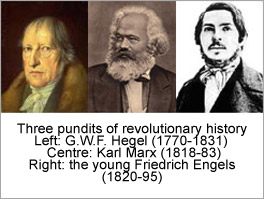 Yet no. Not only does fundamental change frequently develop via evolutionary rather than revolutionary means; but revolutions do not always introduce macro-change. They can fail, abort, halt, recede, fudge, muddle, diverge, transmute and/or provoke counter-revolutions. The complex failures and mutations of the communist revolutions, which were directly inspired in the twentieth century by the historical philosophy of Marx and Engels, make that point historically, as well as theoretically.